
Full notes
Full Zero-K update
Read the full published notes in a cleaner layout. The original post stays linked below.
What changed
- UI and audio
- Maps
- Workshop
- Gameplay
- Performance
Zero-K changes
A conflict has been brewing over the course of this series. Half the cold takes, those on general design principles, often imply that Zero-K avoids special abilities, while the other half shatter this impression by being about specific special abilities. In this post we will try to resolve this apparent disagreement by exploring how special abilities work and what makes an ability suitable for Zero-K.
The set of design principles arrayed against special abilities is truly daunting. To start with, abilities that require frenetic or precise clicks are rejected by the idea that players should not have to fight the UI. Many other potential abilities are ruled out for being too numbery, making units too stupid, or for imposing arbitrary target restrictions. Atomic unit design pushes us towards having few abilities, special or otherwise. But despite all these restrictions, Zero-K has many more special abilities than other games with Total Annihilation ancestry.
Some design principles encourage special abilities. Quant's Rule reflects a desire for units to be unique and interesting, and special abilities are certainly a way to achieve that. More importantly, special abilities are fun, and not just to use. Zero-K steadily accumulates special abilities as a result of its open source laissez-faire development style, with many contributors working on whatever they find most interesting. This process predates Complete Annihilation, as early engine developers added features such as bubble shields and the deformable terrain that makes terraform possible.
The pace of special ability development ramped up with the advent of Complete Annihilation and Lua scripting. Many of our design principles were also being hammered out around this time, but the purpose of them was more to channel this outpouring of creativity, rather than attempt to stem the tide. This period gave us area cloakers, morphing, jumpjets, terraform, and a host of manually fired weapon-like abilities. It is hard to overstate how satisfying it is to mess around with new abilities, I have even written abilities that my designer side knew had little chance of making it into the game.
In fact, the design principles that seem to restrict special ability design actually let it flourish. We were free to experiment within the guidelines without worrying too much about whether the result would be fundamentally at odds with the rest of the game. Our experiments could still fail, but less catastrophically; the game would not break. Without any guidance we may have been too scared, or disorganised, to try anything new.
So Zero-K allows, and even encourages, special abilities as long as they fit into the design. In practise this means abilities have to pass two tests: they need to make sense within the game world and they should not be too hard to use. Whether an ability makes sense is the easier of the two to judge, since we have reasonably clear rules about things like armour classes, and the "theoretical ideal ability" test from Aim and Fire can be used for more than weaponry. How hard an ability is to use, i.e. how fiddly it is, can be harder to judge, since it involves tradeoffs against how much the ability adds to the game. The two guiding principles for fiddliness are that players should not fight the UI, and that abilities should avoid making units implicitly stupid. A lot of fiddliness comes down to how much attention is required to use it.
The least fiddly type of ability is the passive ability. Damage types such as slow and disarm can be considered passive abilities, as could uncontrollable abilities such as shields. There is little risk of fiddliness or stupidity with such abilities, however the risk is not zero. For example, Racketeer needed quite a bit of AI work to make it smart enough to stagger its homing disarm missiles to maximise uptime. Technically the issue with Racketeer boiled down to firing being an active ability, but all units use their active abilities to control how their passive abilities are expressed, so accepting this technicality for this definition would render the concept of passive abilities useless.
The next-best thing to a passive ability is a toggled ability that is designed to rarely need disabling. In practice this works a lot like a passive ability, but it is theoretically quite different due to the UI/Game World split, pictured below. Units are free to choose when and how to use active abilities, which opens up the possibility of units failing to do so correctly, either while idle or in response to player commands. The advantage of an automated rather than passive ability is that it can be disabled in edge cases, and that being able to disable an ability often makes more sense within the logic of the world. For example, Solar Collectors have a state toggle to keep them open under fire, because closing feels like a choice rather than something that is forced.
The third type of ability, beyond passive abilities and automated active abilities, is manual abilities, which require direct player intervention to use. This category causes the most trouble, with the fiddliness of a manual ability largely depending on two things: the type of command used to control the ability, and how often the ability is used.
There are broadly three types of command, categorised by the type of target they usually require: no target, ground target, or unit target. The simplest type of commands are those with no target. Examples include Swift boost, Krow cluster bomb, and the self-destruct button on crawling bombs. Just click the button (or press the hotkey) and the ability fires. This does not mean it is easy to know when to use an ability, just that issuing the command is not the hard part. The special abilities in Warlords Battlecry are all untargeted, which may have been an influence for Swift boost.
State toggles can be considered as a sub-category of untargeted commands, but the mental overhead of tracking the state makes them a bit harder to use. Most toggled abilities, such as cloaking and floating, can be left on their default state, but there are a few that require toggling to use their full mechanics. The Pull/Push toggle on gravity guns is a good example, as is the manual hunker down ability of heavy turrets.
Ground targeted commands are the next-easiest type of command, the reason being that the ground is large and static while units are relatively small and often mobile. Ground targeted commands could be broken down further into line moves and area commands, but the added complexity of dragging a line or a circle trades off against increased expressiveness. Every targeted manual ability in Zero-K can be shot at the ground, and most are designed with this use in mind.
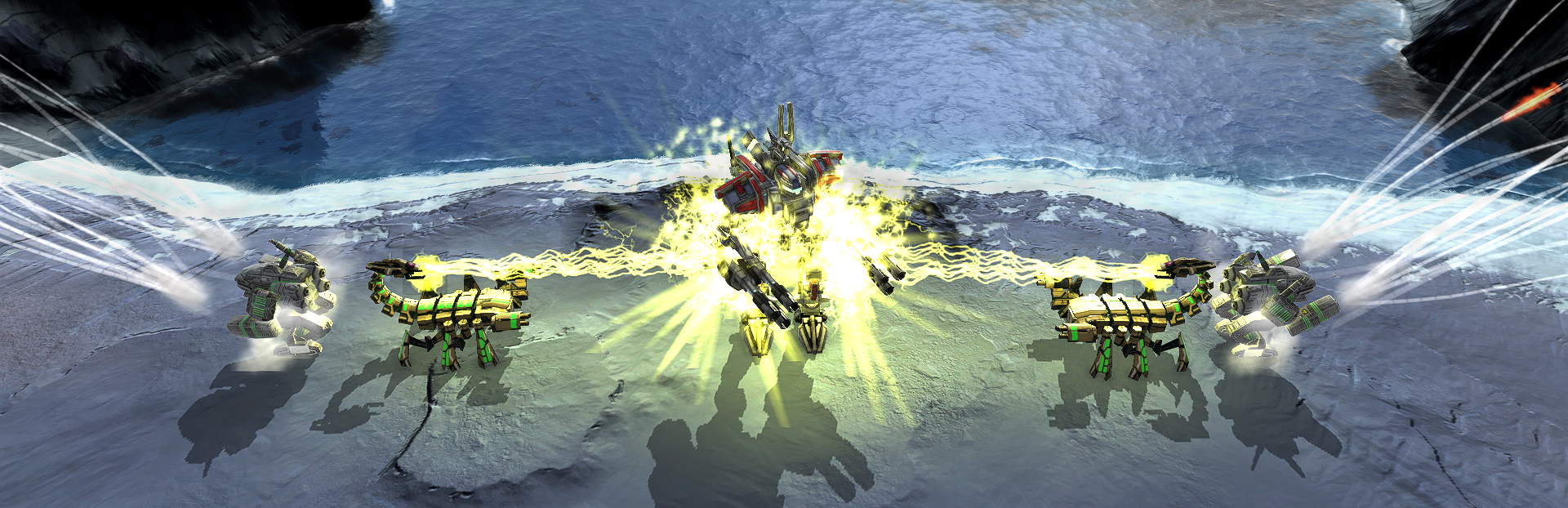
Unit targeted commands are the hardest type to use. Structures are easier to click than units, and allies are easier to click than enemies, but they are all harder to click than the ground, so very few of our manual abilities are meant to be shot directly at units. Only a few of the most expensive units (Reef, Scorpion, Detriment, and some advanced commander weapons) have this type of command. The result is that players will rarely need to click enemy units, however, the word "need" is doing a lot here.
Strictly speaking, players do not have to click the enemy units to have their own units use their abilities, however, this leaves the choice of target up to the unit AI. In practice players often tell their units to pick off a particular enemy unit by right-clicking it to issue a Force Fire command. The target priority even persists until overridden by another attack-type command, which is neat. But Force Fire has another use, one that, in conjunction with Hold Fire, circumvents the aforementioned guidelines for manual ability design. This is because, in Zero-K, if a unit has a single weapon, then it will (almost) always be treated as an ordinary weapon, regardless of how "special" it is.
Quite a few of the ordinary weapons in Zero-K would be implemented as special abilities if they were to appear in other games. Some artillery units have reload times in the teens, with Lance even taking 23 seconds to reload. Firewalker fires bursts of fire that linger on the ground, while Placeholder launches miniature black holes to trap units in place. Players frequently set these units to Hold Fire and use them manually, just like a special ability. Even our nuke and missile silos use ordinary weapons, although these structures are set to Hold Fire by default. The only weaponless unit with a targeted special ability is the Lobster, as it caused too many accidents back when it responded to Force Fire.
Using Hold Fire to turn ordinary weapons into special abilities might seem like a bit of a hack, but doing so has many benefits. To start with, using an ability by right clicking is more fluid than the two-step process of selecting the ability then left clicking. Hold Fire also lets players opt-in to complexity, and unit AI toggles such as overkill prevention and anti-bait let players configure how eager units are when told to use these abilities on their own initiative. The usual pattern is for players to micromanage a handful of units early on, then set groups of them to Fire At Will later.
Returning to special abilities, weapons that are regularly used with Hold Fire work in much the same way as automated active abilities. They are expected to work in the hands of unit AI, which makes them much less troublesome than manual abilities. These weapons would actually make terrible manual abilities, because they regularly want to be fired as often as possible, which is one of the clearest indicators that a manual ability requires too much player attention.
A good manual ability for Zero-K is one that players regularly have available, but do not use. Consider the alternative, if an ability takes 30 seconds to reload, and your aim is to use it as much as possible, then you now have a chore that requires your attention every 30 seconds. There is no decision in whether to use it, even though there may be some decisions to make in how it is used, it is just something that needs doing. This is why there are no ground-based sprint abilities: it is too easy for a sprint to be spammed to cross the map faster. Swift only gets away with it because it does not need boost to cross the map very fast.
This brings us to a simple rule for manual abilities: they must have long reload times, or at least have some sort of opportunity cost, to prevent them from becoming chores. Jumpjets avoid this problem by being barely faster than walking, on flat maps, so that the distance gained is rarely worth the risk of being caught without a jump. Particularly expensive units can get away with breaking this rule, such as the Paladin's spammable EMP missiles, but rules like these can be broken by big expensive units that are expected to be the centre of attention.
The design principles of Zero-K significantly constrain the special ability design space, but we still manage to have fun within it. Passive and automated abilities are relatively safe, with atomic unit design being the main hurdle, whereas too many manual abilities risk becoming chores. We currently have few enough manual abilities to put almost all of them on the same hotkey. The best way to add more would be to add more units, or even factories, to give players different abilities to manage, rather than more to manage at once.
Source
Changelog.gg summarizes and formats this update. How we read updates.