Howdy friends, As you know, we've been working with the console versions of Wreckfest ever since the launch of the game's PC version.
Full notes
Full Wreckfest update
Read the full published notes in a cleaner layout. The original post stays linked below.
What changed
0 fixes2 additions1 change0 removals
Performance
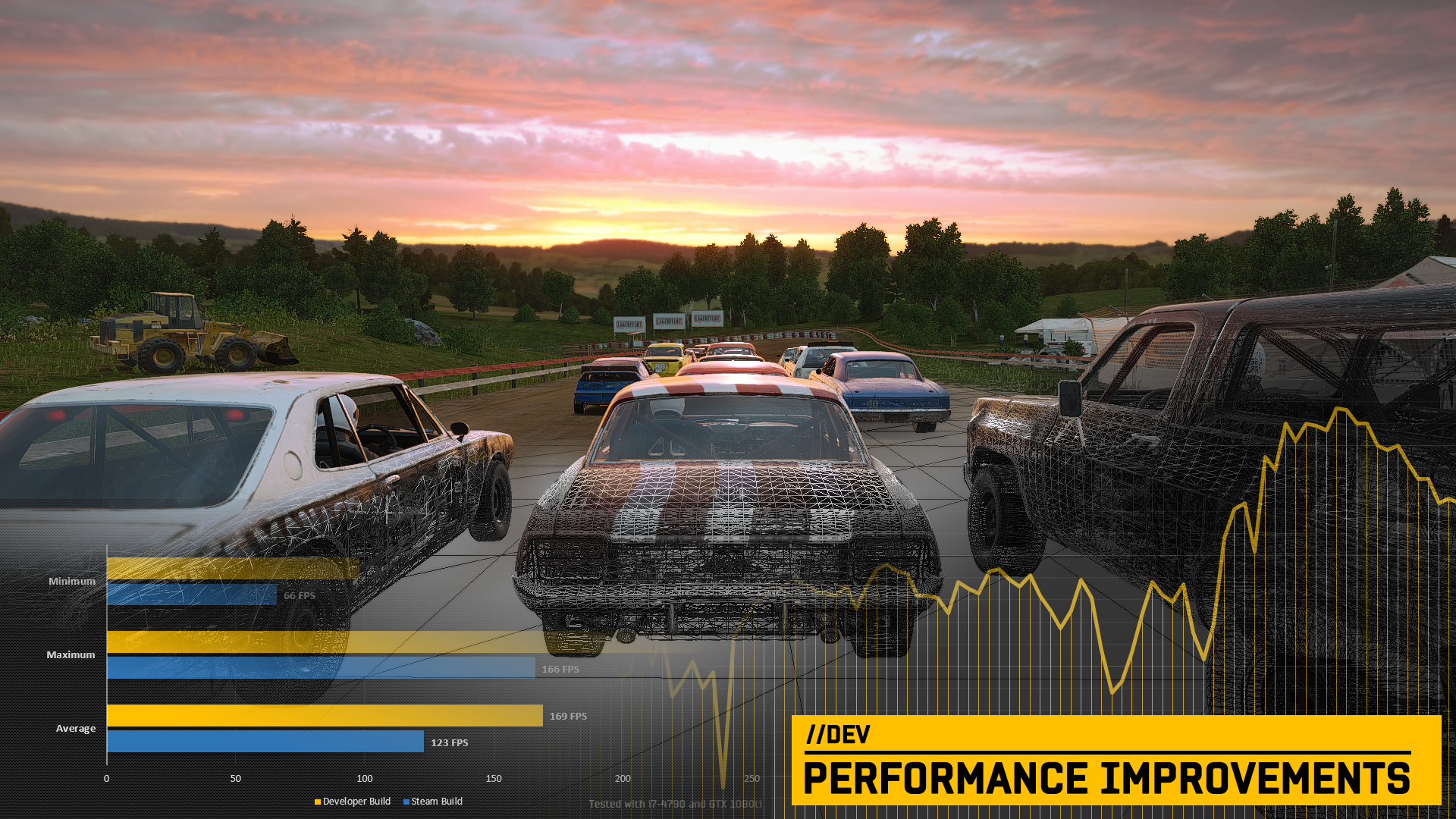
addedHowdy friends, As you know, we've been working with the console versions of Wreckfest ever since the launch of the game's PC version. One major task that we've been keeping ourselves busy with is improving the performance on both console and on PC. Needless to say that whatever your platform, maintaining a smashing framerate is almost as critical in a fast-paced racing game as it is in a first-person shooter, and sure enough, improvements in this regard is something that we know many of you have been looking forward. We're happy to let you know that much work has been completed already. For instance, the optimization of the rendering engine has yielded immediate gains in the raw rendering performance, instancing is now used for billboard trees as well as spectators, saving valuable memory, and vehicles now have multiple levels of detail that are used based on the distance to the camera – and the new vehicle detail setting that you can change according to how much grunt your gaming rig has. While optimization is an on-going process, and yes, we know that there are still further gains to be had, we thought this would be a good opportunity to take a look what kind of performance improvements you can expect in future. To do that, we decided that the best way to show you the goods is to go old-school and simply compare the Minimum, Maximum and Average framerate between the latest Steam release and our current internal developer build. The comparison was performed by doing three laps with exactly the same event settings: Midwest Motocenter, manually selected Mixed Class AI Set, 24 cars and Noon time of day, and while doing our best to ape the gameplay in both runs. The graphics quality options were set to Medium with V-Sync naturally disabled. This is of course not a scientific analysis at all (just look at how hardcore the lads over at Digital Foundry are doing it), but nevertheless, we'll let the numbers speak for themselves:
addedOpen the larger graphic by clicking here . As you can see, there's a considerable performance improvement with the average framerate seeing a whopping 37% increase after switching to the new build. The minimum framerate naturally occurs at the race start with most of the other cars still in the viewport, and while it's still a taxing situation, the new numbers look much healthier with almost a 50% improvement over the Steam build. The best part of all this is that all this improvement is gained without needing to dial back the game's visuals. While we were at it, we also compared the system and video memory usage between the Steam build and latest developer build, with results as follows:
changedLarger graphic here . The difference is not as striking as was the case with framerate, but even so we can see roughly a 10% reduction in the memory consumption, no doubt thanks to instancing support and track specific optimizations that we've been doing. This track is probably one of the tracks benefiting the least from the latter, seeing as it has never been very resource hungry compared to certain other tracks. Incidentally, this track was chosen for this performance comparison exactly because it's one of the tracks that has not seen much work done on it since the last Steam release due to not really needing much optimization. This comparison was performed in single-player, with proper multiplayer benchmarking with a full grid being obviously
Wreckfest changes
addedHowdy friends, As you know, we've been working with the console versions of Wreckfest ever since the launch of the game's PC version. One major task that we've been keeping ourselves busy with is improving the performance on both console and on PC. Needless to say that whatever your platform, maintaining a smashing framerate is almost as critical in a fast-paced racing game as it is in a first-person shooter, and sure enough, improvements in this regard is something that we know many of you have been looking forward. We're happy to let you know that much work has been completed already. For instance, the optimization of the rendering engine has yielded immediate gains in the raw rendering performance, instancing is now used for billboard trees as well as spectators, saving valuable memory, and vehicles now have multiple levels of detail that are used based on the distance to the camera – and the new vehicle detail setting that you can change according to how much grunt your gaming rig has. While optimization is an on-going process, and yes, we know that there are still further gains to be had, we thought this would be a good opportunity to take a look what kind of performance improvements you can expect in future. To do that, we decided that the best way to show you the goods is to go old-school and simply compare the Minimum, Maximum and Average framerate between the latest Steam release and our current internal developer build. The comparison was performed by doing three laps with exactly the same event settings: Midwest Motocenter, manually selected Mixed Class AI Set, 24 cars and Noon time of day, and while doing our best to ape the gameplay in both runs. The graphics quality options were set to Medium with V-Sync naturally disabled. This is of course not a scientific analysis at all (just look at how hardcore the lads over at Digital Foundry are doing it), but nevertheless, we'll let the numbers speak for themselves:
addedOpen the larger graphic by clicking here . As you can see, there's a considerable performance improvement with the average framerate seeing a whopping 37% increase after switching to the new build. The minimum framerate naturally occurs at the race start with most of the other cars still in the viewport, and while it's still a taxing situation, the new numbers look much healthier with almost a 50% improvement over the Steam build. The best part of all this is that all this improvement is gained without needing to dial back the game's visuals. While we were at it, we also compared the system and video memory usage between the Steam build and latest developer build, with results as follows:
changedLarger graphic here . The difference is not as striking as was the case with framerate, but even so we can see roughly a 10% reduction in the memory consumption, no doubt thanks to instancing support and track specific optimizations that we've been doing. This track is probably one of the tracks benefiting the least from the latter, seeing as it has never been very resource hungry compared to certain other tracks. Incidentally, this track was chosen for this performance comparison exactly because it's one of the tracks that has not seen much work done on it since the last Steam release due to not really needing much optimization. This comparison was performed in single-player, with proper multiplayer benchmarking with a full grid being obviously
Howdy friends, As you know, we've been working with the console versions of Wreckfest ever since the launch of the game's PC version. One major task that we've been keeping ourselves busy with is improving the performance on both console and on PC. Needless to say that whatever your platform, maintaining a smashing framerate is almost as critical in a fast-paced racing game as it is in a first-person shooter, and sure enough, improvements in this regard is something that we know many of you have been looking forward. We're happy to let you know that much work has been completed already. For instance, the optimization of the rendering engine has yielded immediate gains in the raw rendering performance, instancing is now used for billboard trees as well as spectators, saving valuable memory, and vehicles now have multiple levels of detail that are used based on the distance to the camera – and the new vehicle detail setting that you can change according to how much grunt your gaming rig has. While optimization is an on-going process, and yes, we know that there are still further gains to be had, we thought this would be a good opportunity to take a look what kind of performance improvements you can expect in future. To do that, we decided that the best way to show you the goods is to go old-school and simply compare the Minimum, Maximum and Average framerate between the latest Steam release and our current internal developer build. The comparison was performed by doing three laps with exactly the same event settings: Midwest Motocenter, manually selected Mixed Class AI Set, 24 cars and Noon time of day, and while doing our best to ape the gameplay in both runs. The graphics quality options were set to Medium with V-Sync naturally disabled. This is of course not a scientific analysis at all (just look at how hardcore the lads over at Digital Foundry are doing it), but nevertheless, we'll let the numbers speak for themselves:
Open the larger graphic by clicking here. As you can see, there's a considerable performance improvement with the average framerate seeing a whopping 37% increase after switching to the new build. The minimum framerate naturally occurs at the race start with most of the other cars still in the viewport, and while it's still a taxing situation, the new numbers look much healthier with almost a 50% improvement over the Steam build. The best part of all this is that all this improvement is gained without needing to dial back the game's visuals. While we were at it, we also compared the system and video memory usage between the Steam build and latest developer build, with results as follows:
Larger graphic here. The difference is not as striking as was the case with framerate, but even so we can see roughly a 10% reduction in the memory consumption, no doubt thanks to instancing support and track specific optimizations that we've been doing. This track is probably one of the tracks benefiting the least from the latter, seeing as it has never been very resource hungry compared to certain other tracks. Incidentally, this track was chosen for this performance comparison exactly because it's one of the tracks that has not seen much work done on it since the last Steam release due to not really needing much optimization. This comparison was performed in single-player, with proper multiplayer benchmarking with a full grid being obviously