
In this update15
Full notes
Full Veritas Tales: Witch of the Dark Castle update
Read the full published notes in a cleaner layout. The original post stays linked below.
What changed
- UI and audio
- Gameplay
- Store
- Balance
- Maps
- Events
Veritas Tales: Witch of the Dark Castle changes
Soni Village, Uda District, Nara Prefecture, Japan.
In a small village of about 1,200 people, with only a single traffic light, one game craftsman spent six years building a certain indie game.
Yoshio Nishimura.
Fresh out of school, he joined Capcom, and after working on titles such as Street Fighter III, Capcom vs. SNK, and Dungeons & Dragons: Shadow over Mystara, he ultimately served as chief of background art on Monster Hunter.
At 31, he left Capcom and joined George Kamitani as the "eighth member" of Vanillaware. From Odin Sphere through 13 Sentinels: Aegis Rim, he led the background team for more than twenty years.
(George Kamitani — president of Vanillaware. After directing Princess Crown (1997) during his time at Atlus, he founded its predecessor company, Puraguru, in 2002, then reorganized it into Vanillaware in 2005. He has overseen a body of work — including Odin Sphere, Muramasa: The Demon Blade, Dragon's Crown, and 13 Sentinels: Aegis Rim — known for its meticulous hand-drawn 2D visuals and strong authorial voice.)
In other words, behind the charismatic creator George Kamitani, Nishimura was the man who effectively shouldered a significant part of Vanillaware's visual side.
And that very man left Vanillaware.
The reason wasn't a negative one — during the COVID-19 pandemic he made up his mind and moved to a mountain village in Nara, and came to love it so much that he could no longer bring himself to commute to the office.
Kamitani, too, sent him off not as a "firing" but as a"graduation"— sotsugyō, a Japanese word often used for a positive, mutually agreed parting rather than a resignation or dismissal.
If anything, this is something Kamitani has been deliberately engineering as part of Vanillaware's long-term strategy: a movement in which creators like Nishimura eventually strike out on their own, noren-wake style — the old Japanese custom by which a master craftsman lets a proven apprentice open their own shop under a related brand. Nishimura, the story goes, is the first of them.
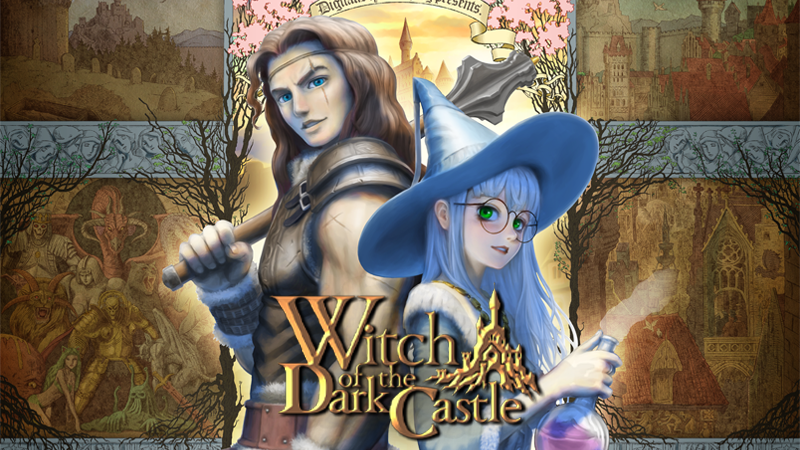
The first work from Digitalis Publishing, the label Nishimura founded after going independent, is the game at hand: Veritas Tales: Witch of the Dark Castle.
It's an extremely niche, deeply idiosyncratic passion project: a reconstruction of the "gamebooks" that flourished in the era before the NES in a modern digital environment.
But at the same time, it is the first test case of a "new initiative" that Kamitani envisions for Vanillaware — a long-term strategy of sending directors out into the world without the company's name on their shoulders, much like a ramen shop granting an apprentice their own branch.
Why does a man who worked on titles like Monster Hunter and 13 Sentinels: Aegis Rim keep making games out in a farming village? We set out to listen to the voice of a craftsman standing at the margins of the games industry.
Interview, text, and editing: TAITAI
Original text: Denfami-Nico-Gamer
Veritas Tales Witch of the Dark Castle
Steam post imageYoshio Nishimura. Towering majestically behind him is Byōbu-iwa (“Folding Screen Rock”), a scenic landmark of Soni Village.
The Year the Bubble Burst, and There Were Only Two Job Postings
First, let me start with the basics: who is Yoshio Nishimura, and how did you end up in the games industry in the first place?
Nishimura: My story begins with the collapse of the economic bubble (Japan's asset-price bubble, which burst in the early 1990s). I was studying illustration at the Osaka Designers' Institute (a vocational design school), and the year I graduated, the school received only two job listings from companies in total. The year before, there had been more than a hundred.
That's a brutal start.
Nishimura: I was staring down the very real possibility of not landing a job anywhere. That's when a friend told me, "Capcom is hiring." I'm from Uwajima, in Ehime Prefecture, and I'd come all the way to Osaka because I wanted to draw — so if I couldn't find work, I had nothing to fall back on. I applied like a drowning man clutching at straws, and somehow I got in.
Did you actually like games?
Nishimura: I'd loved games for as long as I could remember.
But I never imagined I'd become someone who makes them. It was more that I figured, as long as I could get a job where I got to draw, that would be enough.
And the person interviewing you on Capcom's side was Yoshiki Okamoto, I hear.
Steam post imageYoshiki Okamoto. (Image via レジェンドクリエイター・岡本吉起氏インタビュー。17億円の借金から大復活を遂げたゲーム業界の風雲児の過去、現在、そして未来を聞く)
(Yoshiki Okamoto — a former senior managing director at Capcom. He produced countless hits, beginning with Street Fighter II, and drove the company's golden age through the 1990s. After leaving Capcom in 2003 he founded Game Republic, and in recent years he has also become active as a YouTuber.)
Nishimura: That's right. Okamoto was there for the second round of interviews — and it was wildly entertaining.
Three of us were interviewed at once, and he kept throwing challenges at us. He set up this back-and-forth where you had no choice but to make the case for how interesting you were, how useful you could be.
What was it like, specifically?
Nishimura: Whenever someone gave an answer, he'd create this atmosphere of, "The next answer's going to top that, right?" I ended up telling embarrassing stories about myself that I'd never normally share. At one point he practically shouted, "You — you're hired!!!" right there on the spot, with enough momentum that the people around him had to rein him in.
But it really was fun. It got me fired up, too. It was the kind of interview that made you think, "I have to sell myself even harder." And it left me certain: "I absolutely have to work for this company."
So even though you hadn't originally set out to join a game company, Okamoto's interview made you want to join Capcom?
Nishimura: Yes. At first my attitude was just, "As long as I can draw." But after meeting Okamoto, it was Capcom all the way. I came to feel, "This is where I want to work."
Once you joined Capcom, what was your first job?
Nishimura: Cyberbots. I handled the objects in the robot-themed backgrounds, the cockpit UI, the hit-point display, the demo sequences, and so on.
Back then, though, I wasn't especially good at drawing. So even when I made pixel art, I was the kind of guy whose boss would say, "Nishimura, your art, well…" (he laughs ruefully).
Wait, really?
Nishimura: The one thing I was good at was anything that moved. Breaking objects, animated elements — I was always making that kind of motion within the backgrounds.
So I got to handle animation and UI in general, and on titles like Street Fighter III I even made things like the bonus stage where you smash up a car.
So even though your position was background artist, you were doing all sorts of things.
Nishimura: That's right. There was a strong sense of everyone building the game together. Even as an artist, there was a culture of freely speaking up about the game's content. So as long as you raised your hand, you'd get to try all kinds of things.
The titles I worked on include Dungeons & Dragons: Shadow over Mystara, SNK vs. Capcom and Capcom vs. SNK, Tech Romancer, Power Stone, and Street Fighter III. And the last title I was involved with — well, Monster Hunter is probably the one I'm best known for.
The Capcom Years: A Kind of Youth, and What I Gained There
(Image via モンスターハンター | CAPCOM )
On Monster Hunter, what was your role?
Nishimura: I was the main chief of background art. I was also given a fair amount of say over the game's systems.
Oh? What kinds of proposals did you make, specifically?
Nishimura: The easiest example would be the map design.
Originally, we'd been trying to build large, open-world-style stages, but that was extremely difficult on the PlayStation 2 of the time.
On top of that, Capcom was thinking in terms of a multi-platform framework — being able to develop for several consoles at once. Nintendo's hardware, Sega's Dreamcast, and so on. If you try to build for the lowest common denominator across all that hardware, your texture budget and memory both end up quite constrained.
So I judged that large stages were out of the question. Instead, we'd break things into small stages and link them together.
That's a pretty fundamental part of the game.
Nishimura: Looking back now, that's certainly true. The wyvern went to the watering hole; now it's moved to the northern plains — you track it while checking the map. That's the kind of game we set out to make.
Did artists at Capcom back then really have that much authority to decide game content?
Nishimura: Though I doubt it was like that across the entire company.
Part of it was that the team's planner was a junior of mine, and a big part was that I'd been on that team since early on.
I don't know how it is now, but back then Capcom had an atmosphere where everyone chimed in on game design. And Okamoto, who was at the top of development, had this philosophy: "Anyone can come up with an idea — what counts is sheer numbers."
How to put it — if you imagine a hierarchy within the development team, the sense was: programmers at the top, the artists below them, and the planners at the very bottom.
(In Japanese studios of that era, "planners" were roughly what the West would call game designers.)
Planners at the very bottom — that's fascinating. Usually it seems to be the other way around.
Nishimura: Say there's some operation that's hard to program. Doing it might introduce bugs, and it might cost a great deal. A programmer is well placed to judge that.
It's the same for the artists. Saying "make 500 pieces of equipment" is easy, but actually creating them is grueling. So the artist can push back with an alternative: maybe we can pull it off through recoloring or swapping out the underlying materials.
Ah, I see — so if the planners sit too far upstream, you end up with these awkward situations where people have no choice but to do it?
Nishimura: Exactly. In other words, what matters is a vibe where the people who take the most time and bear the most cost can speak up forcefully.
They didn't have complete authority, of course, but there was an atmosphere where the people on the ground could make the call and change how something was built.
That's a real strength of the front lines. The plan isn't absolute; the people who actually build it can say "that's impossible" or "we could do it this way." And as a result — in a good sense — the plans become disposable, something it's fine to throw away?
Nishimura: That's right. For better or worse, there was a strong drive of "whatever it takes to make a fun game." There were arguments, too. But I think everyone was highly motivated.
"I'd Like to Believe That If You Have Fun Making It, the Players Will Have Fun Too"
If you had to name one thing you learned at Capcom, what would it be?
Nishimura: What stuck with me was something of Okamoto's that I heard secondhand from my boss.
"When you have fun making something, you'd like to believe the players will have fun too — wouldn't you?"
It's that "like to believe" — the wishing in it — that I love so much.
As for the atmosphere at the company, there was plenty that was hard. There were nights spent sleeping at the office, and plenty of work sent back for redos. Making games takes time, there's pride on the line, and you have to push past your own limits.
But my seniors did their best to keep things enjoyable for us. We'd all get together and buzz about it: how do we make this fun, how do we make it cool?
That sounds like a wonderful environment.
Nishimura: So my memories of the Capcom years carry a certain springtime-of-youth quality. Making games joyfully — creating that atmosphere might have been the single biggest thing I learned.
On the other hand, you did end up leaving Capcom. Why was that?
Nishimura: This gets a little dark, but there was a period when people kept leaving.
Okamoto left, the internal structure changed, and a lot of people quit. There was a stretch where the whole atmosphere shifted.
As a company grows, situations like that are probably unavoidable…
Nishimura: Maybe so. This was just my own gut sense, but the mood shifted away from the fun of making games toward being chased by schedules, chased by quality.
When I joined a new project, I let the stress build up, took the team's problems on as if they were all my own responsibility, and ended up wrecking my health. My boss told me, "Don't worry about it," but I'd hit my limit.
I see.
Nishimura: And besides, Monster Hunter was just too big. It was grueling, but it was truly good work.
My boss even said it was "the most fun he'd had since joining the company" — that's how good it was. I think I got to do the best work, with the best team. It's just that it was too big.
Too big — in what sense?
Nishimura: If I'd stayed at Capcom, I might have ended up surviving only as "the guy who makes Monster Hunter."
I was afraid I might end up saying,"This is all there will ever be."My health was shot, too, so I decided to step away once and try something different.
On to Vanillaware: A Burning Desire to "Get Better at Drawing"
After you left Capcom, did you go straight to Vanillaware?
Nishimura: No. My health was in bad shape, so I rested for a while. At first I was hoping to get into something like a CG commercial-production company. I'd come to realize that video work and animation were my strengths. But I took their hiring tests and failed completely.
On top of that, at that point I also had a strong desire of my own.
A desire — meaning?
Nishimura: I wanted to get better at drawing.
During my Capcom years, I'd been drifting further and further toward CG — pixel art, polygons, that whole direction. So I had this nagging sense that my drawing ability itself had stayed weak.
On the Monster Hunter team there was a character artist named Kanbe, who was an absurdly good draftsman. It was a kind of frustration — I found myself wanting to be able to draw much better.
So you wanted to hone your craft as a creator, in a purer way.
Nishimura: Right around then, a friend told me Vanillaware was hiring. This is it, I thought.
At the interview, the ones who showed up were George Kamitani and Shigatake, is that right?
(Shigatake — an illustrator at Vanillaware. One of the studio's founding members, with the company since its Puraguru days, he has worked on nearly all of its titles.)
Nishimura: That's right. When I told them I'd been making Monster Hunter at Capcom, they were delighted. Though there was also a bit of a "why would you ever come somewhere like this?" air to it (he laughs ruefully).
I'd seen the artwork Vanillaware used in their job ad and thought, this is good — seriously amazing work. And on top of that, they were offering to let me draw. I had no confidence in my own art, so it was very much an "if you'll take me, yes please" situation. I think Kamitani was glad to have me, too.
By the time you joined Vanillaware, were they already working on Odin Sphere?
Nishimura: That's right. Odin Sphere had about three stages of backgrounds finished — a forest, a wasteland, and a snowy mountain. Back then Shigatake was making the backgrounds, but there were few character artists.
After I came on, I took the lead on backgrounds, and Shigatake shifted over to characters and monsters.
As an aside — Odin Sphere is really full of clever touches that come precisely from being made by such a small team, isn't it?
Nishimura: The team was extremely small, yes. Resources were limited, too. It was mostly story-driven, structured so that motivation carried you through the stretches in between.
What do you feel you gained at Vanillaware?
Nishimura: Truly — it's the company that granted the very thing I'd wished for: getting better at drawing.
On a large-scale production, the slice you're responsible for keeps getting narrower and narrower. My last job at Capcom was around the time of Devil May Cry 3, and I'd drifted into a supervisory role — handing out tasks to people and managing them. Once that happens, you can't draw backgrounds anymore.
What I wanted most was to make the art itself.
I just had this drive to create, to express something. But inside a big company, you keep drifting away from that.
Vanillaware had so few people that there was no room to call yourself a "supervisor." It was simply: make it, draw it. So I really did get to draw, constantly. And that made me happy.
The Man Called George Kamitani: If told "It's Not Fun," He Takes the Hit — and Fixes It
There's no talking about a company like Vanillaware without talking about George Kamitani. From where you stood, what kind of person was he?
Nishimura
Kamitani is, when it comes down to it, someone who carries Capcom's bloodline.
He holds a clear answer in his hands
"If it isn't fun, it's meaningless." He worked with this tremendous will never to ship something until it was truly fun.
It was true of the art, and of the games too: he puts out the very best he's capable of within his current potential. He won't compromise — he tries to work at the highest possible standard.
So every time, he ends up tightening the noose around our own necks (laughs).
But each project pushed further than the last, and the next title further still — that's how things kept moving forward. And our drawing improved along with it.
"We won't ship it unless it's fun" — plenty of people say that out loud. But in Kamitani's case, left unchecked, he'll really keep going until the company would collapse. There's a genuine seriousness to it — a kind of madness, even.
Nishimura: That's right. Above all, he's a remarkably receptive, unguarded person. Normally, when someone tells you "this part isn't fun," you might make excuses, or fire back with theory.
But in Kamitani's case, he properly takes the hit — and then afterward, he properly fixes it.
That's fascinating to hear.
Nishimura: It might be better if he didn't let it get to him, but I think that's just how much he's staking his life on it.
He takes the hit, and then he properly changes things. He'll change the direction, too. Wherever something can be changed, he changes it. That receptiveness — I thought it was remarkable.
The public image of Kamitani tends to be of someone who has this grand vision — the worldbuilding is like this, the art is like that — and slams it all down fully formed. But when you actually talk to him, a lot of stories come out about how he isn't keeping tight control of the floor by himself. Like the staff just go off and build things on their own. That's very interesting to me.
Nishimura: It's true that Kamitani has an incredible vision.
But the parts in between — those, we on our side often fill in. We'd all think about "what do we do here," and there were places we'd just go ahead and do without consulting Kamitani.
Going ahead without consulting him — is that really all right?
Nishimura: He properly takes it in.
For instance, on Dragon's Crown, Kamitani told me, "Make lots of dungeons." But with nothing but stone walls, the art just wouldn't come alive, no matter what.
So I'd build the outside scenery, saying, "Well, this is the forest before you enter the dungeon."
I've actually heard that story from Kamitani himself.
Nishimura: Before long, Kamitani said to me,"Nishimura, you have no intention of making dungeons, do you?"(laughs). "Ah, busted," I thought — and kept making them anyway.
But in the end, Kamitani added a setting where there's an entrance to the labyrinth — not just exploring inside the dungeon — and absorbed what I'd made into the game.
Kamitani leaves room on our side to think, room for trial and error. Most people would want the answer right away, I think, but he waits. And whatever you express, he takes it in, digests it, and works it into the story. That part of him is remarkable.
In a Small Studio, Everyone Scoring 80 Isn't Enough
What's fascinating, listening to how Kamitani makes things, is how different it is from the philosophy of large-scale development. In big productions, rather than drawing out 100% of an individual's talent, the wheel inevitably gets turned toward a system where everyone can reliably put out 70 or 80 points.
But Vanillaware — Kamitani — being a small team, seems to place enormous importance on each individual being able to put out 100 points, or even 120.
Nishimura: There's something to that, yes. At Vanillaware, a great deal was being shouldered by Kamitani alone. So as a company, we wanted somehow to build a direction of supporting him.
If Kamitani himself were to say, "Support me," that would be bad. So those around him needed to generate an atmosphere of "let's support the president."
I've heard a few episodes like that from around the time of 13 Sentinels: Aegis Rim, too.
Nishimura: That's right. 13 Sentinels has so much text and so many terms that, for instance, I kept saying, "We really need to make an archive, or we'll be in trouble."
But at first, I couldn't get permission. Kamitani's thinking was that he'd build the excitement within the scenario and make it stick in the player's memory properly, so auxiliary things like that weren't needed.
Convenient, but from the standpoint of the game experience, perhaps a bit heretical.
Nishimura: But later on, when a different staff member brought it up, it became "All right, let's make it, then." In the end, I was the one who made almost all of that archive.
I believe I was able to be genuinely useful. Though as for how Kamitani truly felt about it deep down — that's something I still don't entirely know.
I think this is a pretty important point. For someone with a strong authorial voice, an auxiliary feature can look like something that chips away at the work's experience. On the other hand, you also need to make things clear for the player.
Nishimura: That's right. If you don't build those things, everything ends up depending on Kamitani. And unless you make it succeed, things like that won't come about in the future. So while I did feel apologetic about it, I also believed there were things that simply had to be done.
That's probably one of the difficulties of a small team, too. For someone to put out an outstanding 120 points, those around them have to support that — distortions and all. Not a tidy organization of 80-point performers, but a floor built so that sharp people can run while staying sharp.
Nishimura: Yes. Kamitani is someone who tries to make things that don't yet exist in the world. That's precisely why those around him are given room to think. It's demanding, but I think that's also what leads to the fun.
A Background Artist Builds the World's "Rules"
Key visual from Muramasa: The Demon Blade.(Image via PS Vita『朧村正』公式サイト )
At Vanillaware, "background" isn't simply a team that draws the pictures in the back, is it?
Nishimura: At Vanillaware, we more or less call all graphics other than the characters "background."
That includes the UI, the movies, the effects, and the small details too. When the character artists were busy, I'd sometimes make the big bosses as backgrounds.
Making a boss as a background? What does that look like, specifically?
Nishimura: I made the Red Dragon in Dragon's Crown, and I also made Darkova in Odin Sphere, Ippondatara in Muramasa: The Demon Blade, and so on.
The huge bosses that fill the screen were sometimes made by the background team.
I see. But once you include all that, the word "background" doesn't begin to contain it. You're building the coherence of the screen, the game's readability, its impact — the very rules of the space.
Nishimura: Perhaps so. What was good about joining Vanillaware was that I really did get to make all sorts of things.
Not just backgrounds, but UI, effects, bosses, movies. Precisely because it's a small company, you have to do everything. That suited me.
And you held the lead of the background team all the way through Dragon's Crown.
Nishimura: I was allowed to be the lead through Dragon's Crown, and after that I made a point of handing the lead over to my juniors. Whether or not you hold the lead changes your motivation enormously.
It's better to experience it at least once, and it leads to growth. So I increasingly left it to others and moved into a supporting role myself.
And it's around there that you start moving toward "making your own game."
Nishimura: That's right. Though the desire to become a director had been with me for a long time. I made an adventure book back in elementary school, and even in my Capcom days I'd go and pitch proposals to my boss. The urge to make games was always there.
Akuryōtō no Hihō: The Taste of a Short, Successful Sprint
Before we get to Witch of the Dark Castle, there was Akuryōtō no Hihō, made as a bonus for Dragon's Crown Pro. How did that come about?
(Akuryōtō no Hihō — literally "The Treasure of the Demon Island," a gamebook created as a bonus for Dragon's Crown Pro.)
Nishimura: Atlus came to us wanting to attach a bonus. I was suddenly called into that meeting and asked, "Nishimura, what'll you do?"
Dragon's Crown is fantasy, and I'd made an adventure book back in elementary school. If we were going to make some kind of bonus without being able to spare much manpower, I thought a gamebook — something one person could make — would be a good fit. It pairs well with both tabletop RPGs (TRPGs) and Dragon's Crown. It has that good old retro flavor, too.
When I floated it to Kamitani on the spot, Atlus said, "Sounds good," too, and it came together as "Let's go in that direction, then."
And then, afterward, Kamitani said to me,"Nishimura — you're actually going to do it?!"(laughs).
Wait… (laughs).
Nishimura: Maybe he'd assumed I would turn it down with a "There's no way I can make a bonus like that." But I'd already taken it as settled, and frankly, I'd gone and found it interesting.
By that point, my head had already started moving on its own. Even after I'd left my seat, my mind kept racing ahead in that direction. So — let's just do it.
How long was the development period?
Nishimura: It might have been less than four months. Onishi, a Vanillaware programmer, was incredible and put it together in a flash. My ideas kept flowing, too, and it was mostly finished in three or four months. Not counting debugging.
That's an incredible sense of speed.
Nishimura: And that felt really good. "If I can make this much in such a short time, maybe this suits me," I thought. That success carried through to where I am now.
Except this time, Witch of the Dark Castle ended up taking six years (laughs).
Nishimura: That's right (laughs). I started out thinking I could make it in a short time, then got too particular about it, and it took six years.
In a sense, it's a"Vanillaware thing"— but I really do feel I've inherited that bloodline, and deeply so.
"Graduating" from Vanillaware: To Make Something Small, Without the Brand on His Back
Tell us about how you came to leave Vanillaware, too.
Nishimura: The trigger was the COVID-19 pandemic. As a company, a movement formed to permit remote work. I was, in part, the one who built that system.
It pained me to see staff who'd caught COVID and couldn't come in burning through their paid leave, so I tried to set up a remote-work framework.
I see — so COVID was the trigger.
Nishimura: But once we'd started, I found myself wanting to use that system. Working without being tied to a place had been a dream of mine to begin with.
On top of that, as COVID grew worse, I had a certain unease — that living in a big city, if the lifelines were ever cut, I might not be able to save myself or anyone else.
I wasn't married yet at the time, but my wife — as she is now — and I talked about "going somewhere," and we ended up coming to Soni Village.
So you were working remotely from there, but your life and the company's policy stopped lining up.
Nishimura: Yes. As COVID settled down, the company's stance became "we'd like you to come in to some degree." But I was in Soni Village, far from Osaka. I couldn't get there. It no longer fit the company's policy, so I came to leave.
That said, it wasn't that I wanted to quit Vanillaware, nor that Kamitani wanted to let me go. My life had simply changed, and our lifestyles purely stopped matching up.
The path from there to Witch of the Dark Castle is quite unusual, isn't it? Even though you'd left Vanillaware, I hear you have Kamitani's — Vanillaware's — support as well.
Nishimura: To begin with, I'd been making it as a hobby even before I left. At home, little by little, I was building the scenario and the graphic resources. I think I worked on it for about three years.
Kamitani had long been mulling over a problem:"If you carry the name Vanillaware, you have to make something correspondingly big."
So, he thought, if you made a small-scale title under a different name — not Vanillaware — perhaps that's how a director could come into their own. He'd been sharing that kind of thinking with me, too.
So Kamitani, for his part, carried a sense of the problem: how should new games be made?
Nishimura
Yes.
And at that point, I showed him
"Well, this is the kind of thing I'm making at home. Please let me make this." And he said, "Sure." For me, the true story is that I came to be allowed to make it as a kind of graduation.
This word "graduation" is quite important. Rather than making the creator carry the Vanillaware brand, the maker steps out, starts small, and builds at their own size. It's close to a ramen shop granting an apprentice their own branch.
Nishimura: That's right. I think Kamitani has the idea that he'd like to see it spread — older people inside the company stepping away to some degree and making the things they themselves want to make. I'm riding along with that.
Why a Gamebook? The Origins of Witch of the Dark Castle
So, once more: tell us what kind of work Witch of the Dark Castle is, and why you wanted to make it.
Nishimura: For me, gamebooks were what introduced me to the genre of fantasy in childhood.
Back then, I wasn't very good at reading. I don't think it was anything as serious as dyslexia, but reading books was hard for me.
Wait — you loved gamebooks, but you weren't good at reading books?
Nishimura: That's right (he laughs ruefully).
But through gamebooks, I gradually became able to read. I learned words, I copied the illustrations and got better at drawing. There was a lot I gained from gamebooks as knowledge, too. So I have this feeling of wanting to thank gamebooks — to repay the debt.
Repay the debt.
Nishimura: Compared to back then, gamebooks have cooled off quite a bit. There are still people making them, so I don't think it's gone so far as to have "died out," but it's not as common as it once was. So I want to get it going again.
For instance, every time some IP comes out, a gamebook comes out too. A Demon Slayer gamebook, a Jujutsu Kaisen gamebook — I want to create a situation where that's taken for granted.
But just doing that with books wouldn't make much use of my skills or knowledge. So I thought I'd make use of the form of a game.
I see.
Nishimura: Even someone who isn't good at reading might be able to play if there's music, if there are effects, if the pictures move. And for people who play games, it might become a gateway into the habit of reading. With that kind of approach, I want to broaden gamebooks a little more.
In terms of gamebooks that influenced you, which ones are we talking about?
Nishimura: The biggest is J. H. Brennan's The Castle of Darkness — the GrailQuest series.
(J. H. Brennan — an Irish gamebook author. His best-known work, the GrailQuest series, was a humor-filled take on the Arthurian legends that won worldwide popularity in the 1980s. The Castle of Darkness (1984) is its first volume; in Japan it was published as Ankokujō no Majutsushi, "The Sorcerer of the Dark Castle.")
Its Japanese title — Ankokujō no Majutsushi, "The Sorcerer of the Dark Castle" — even ties directly into Witch of the Dark Castle. After that came Sorcery! and Fighting Fantasy. From gamebooks, my interest spread toward tabletop RPGs as well.
(Sorcery! and Fighting Fantasy — a British gamebook series launched by Steve Jackson and Ian Livingstone. Fighting Fantasy drove the worldwide gamebook boom, and Sorcery! was born from it as a spin-off. Many translated editions were published in Japan, and the series came to symbolize the gamebook culture of the 1980s.)
(Image via Amazon.co.jp: 暗黒城の魔術師 (サラブレッド・ブックス 387) : J.H.ブレナン, 真崎 義博: 本 )
What do you think is the fundamental appeal of gamebooks? These days, there's a sense that the same kind of essence carries over into games like Elden Ring, too.
Nishimura: It comes down, I think, to"understanding a situation and making a choice."For human beings, these two things are tremendously important.
As long as we're alive, we face problems every day.
I'm hungry; where should I go; what should I do. People look at a situation and judge. Even walking is, in fact, a choice. You walk because you want to go to the bathroom. You reach out because you want something on the shelf. It looks almost like moving on instinct, but you're actually choosing.
A gamebook pares that down to something extremely simple. Understand the situation, make the choice. You concentrate on that alone. That, I think, is where its primitive appeal lies.
Why You Die So Quickly in Gamebooks
This was true of the old gamebooks, and it's true of Witch of the Dark Castle too — you die pretty quickly, don't you? Why is that necessary?
Nishimura: It's not that I'm trying to say you can never see what's coming, but I think it expresses how a choice changes the future. Dying is an extreme outcome, in game terms.
In the real world, choices don't come with a clear right or wrong answer. But in a game, you can put it in the form of "choose this and you're right," "choose this and you're wrong."And through that, the weight of a choice becomes visible.
So the difficulty is also a kind of spice — a way to make people feel the fun of choosing.
Nishimura: A gamebook is always asking the reader: what will you do?
So you can step right into that world and start playing right away. That, I think, is the greatest charm of a gamebook.
Being asked "what will you do" — that itself is the heart of a gamebook.
Nishimura: Exactly. It's the joy of being able to choose. Not zero options, and not just one.
There are choices, you pick one, and there's success and failure. I think it's tremendously thrilling and fun.
"Turn to 14": What Stays Unchanged, Even Digitized
In making a gamebook in a modern, digital form, what were the parts you changed, and the parts you mustn't change?
Nishimura: Something like"Turn to 14"— that, I felt, mustn't be changed. It's the part where people who know gamebooks go, "Yes, yes — this is it."
The same goes for dying quickly. There are gamebooks where you don't die quickly, but there really were a lot of gamebooks where you do. So I've put that in as well.
("Turn to 14" — a famous line from the GrailQuest series. When your adventure ends in failure, you're sent to page 14, where you die.)
"Turn to 14" is like what we'd now call an internet meme, isn't it?
Nishimura: The middle of an adventure is hard. But when it ends, it feels good. I treasure that sensation, too. If you can see it through to the end, I think it becomes a fun, satisfying experience.
As for what I changed: because it's digital, you can save. Music plays. There's voice. There are effects. Wherever it could be made lavish, I made it lavish.
The fact that things like your HP notes are managed automatically is a big deal, too. With a paper gamebook, you have to keep rewriting the sheet by hand.
Nishimura: That's a strength of digital. But I wanted to keep the sense of playing a gamebook. I'm grateful to gamebook culture, so I have this wish that people who play this will go on to pick up paper gamebooks again, too.
That's why I didn't want it to be just a text adventure. I wanted an experience as if you were playing a gamebook. I want to convey: this is, at its root, a digitized version of the thing called a gamebook.
Is the difference from a visual novel found in that sense of "reading a book"?
Nishimura: Yes. As a pure system, I think it is a variant of the text adventure and the RPG. But I swung the presentation all the way over to "a book."
A typical adventure game often has you view the world from your own viewpoint. Witch of the Dark Castle is first-person too, but what you're looking at is a book on a desk. The player is, throughout, reading a book.
So even with a lot of text, it's natural — because it's a book. And even if the pictures don't move much, it's natural — because it's a book.
In this game, I place enormous importance on that… though getting people to think "Ah, I see!" really doesn't come across unless they actually play it.
300-Plus Illustrations, a 20-Hour Epic — and Still "Just a Hobby"
I hear there are more than 300 illustrations this time.
Nishimura: Including the small ones, there are over 300 pieces of art that actually appear in the finished game, and all of them are ones I drew alone, little by little. I'd draw them only once I'd decided, while making the game, "this is needed," so there's almost nothing that went unused.
For the first three years, I'm told, there wasn't even an engineer — you just kept stockpiling the scenario and the art you needed.
Nishimura: Looking back, I was working away alone, silently, to a degree where I can't even tell what I meant to do with it all. At first I had no plan or prospect for shaping it into a game; I was simply drawing and saving it up.
With no exit decided, how were you able to keep going?
Nishimura: All I can say is that it was fun. I think it was a hobby.
Also, one of the things that got me started on this work was a topic I came across on X (formerly Twitter).
A witch in the forest takes in an orphan, and the child grows up into a muscular, handsome man. The boy adores the witch like a mother, but since they aren't related by blood, there are also feelings like those of a lover. There was a manga or novel along those lines being talked about.
When I saw it, I couldn't quite grasp that feeling. These two looked like nothing but parent and child to me. So, then, what would it take for it to become romantic love? I started writing Witch of the Dark Castle meaning to turn that into a story.
At first, it was an inquiry to understand the structure of an emotion.
Nishimura: That's right. I think it began from curiosity. Of course, I'm sure I also had the wish to finish it someday and have someone play it. But basically, I was writing because I loved it.
Gamebooks have a thickness to them, don't they? Open the pages, and all sorts of characters appear. Figuring out how I could create that richness myself was fun. It might be a bit obsessive of me, but I got completely swept up in it.
The Meaning Folded into the Name "Digitalis Publishing"
(Image via 概要 – ジギタリス出版 )
Tell us about the label's name this time, Digitalis Publishing, as well. To begin with, what is "digitalis"?
Nishimura: The first time I learned the word "digitalis" was through a PC game by Hummingbird Soft called Laplace no Ma. Digitalis shows up there as a medicine that raises your stamina. It's also a cardiac stimulant.
In reality it's a plant — the foxglove. In Japanese it also goes by names like "witch's hat" and "fox's glove." The word "digitalis" itself is also related to the word for "finger." And it has a close etymological kinship with the word "digital."
(Digitalis is the botanical name of the foxglove; it derives from the Latin digitus, "finger" — the same root as "digital.")
The things I make tend to involve witches, or foxes. I want to keep making things like that going forward. And they're digital, too.
And I truly loved Laplace no Ma. I'm a little obsessed, honestly (laughs). So I settled on the name Digitalis Publishing.
(Laplace no Ma — a horror RPG for PC released by Hummingbird Soft in 1987. With a Gothic worldview drawing on the Cthulhu Mythos and a steep difficulty, it's known as a cult classic with a fervent following.)
Beyond Witch of the Dark Castle, do you plan to keep making digital gamebooks?
Nishimura: Yes. In time, I'd love for digital gamebooks like this to gain recognition, and for similar authors to gather around them.
When that happens, I'd like to open up the libraries and tools we've built and start a movement of "let's make these together."
That sounds like a rather interesting undertaking.
Nishimura: There are people who insist on paper, I'm sure, and people who'd rather play casually on a smartphone. There'll be people who want to make short things that finish in an hour or two.
It would be good if people in all sorts of positions could make them. I think it'd be interesting if these could go out onto distribution platforms like Steam and the Nintendo eShop as indie works of a slightly different shape from the usual indie game.
Tending Fields and Making Games in Soni Village
The Soni Highlands.(Image via 環境 – ジギタリス出版 )
Changing the subject a little — tell us about your life now. Where do you live, and how do you make games?
Nishimura: I now live in a place called Soni Village, in Uda District, Nara. It's a truly small village with only a single traffic light. On paper the population is about 1,200, but I think the number of people actually in the village is a bit smaller. The proportion of elderly residents is high, too.
That said, it's also a tourist destination. There are places to enjoy beautiful nature, like the Soni Highlands and Byōbu-iwa. There's an association called "The Most Beautiful Villages in Japan," and we're one of its members. Autumn here is truly lovely.
Why Soni Village?
Nishimura: COVID was the trigger.
I'd originally lived in Osaka, but back then I had this odd sense of crisis — "if I'm in a big city, won't I be helpless if something ever goes wrong?"
My wife and I talked it over and decided to relocate. And the place she pointed to and said "here" was Soni Village.
That was a bold move.
Nishimura: I looked for a rental through the vacant-house bank and was lucky enough to meet a wonderful owner. The land was good, too. This is the place, I thought.
In Soni Village there are mountains like Byōbu-iwa and Yoroidake ("Armor Peak"), and they're exactly like the scenery of Monster Hunter, which I'd worked on. The backgrounds of Monster Hunter take their motif from a place in Scotland called Glencoe. There are mountains of bare, exposed rock — really striking. Soni Village has scenery close to that.
The majestic Byōbu-iwa, with Nishimura.
You also do your own farming now, don't you?
Nishimura: Yes. It's not quite enough to call self-sufficiency, but I grow vegetables and eat them. It's "natural farming" — no pesticides, no fertilizer, planting the seedlings right into the waist-high weeds. They grow surprisingly well.
Back when I was a company employee, I'd get up early to do farm work, then start my game work around ten. And I'd do field work on Saturdays and Sundays, too.
Since becoming self-employed, it's reversed: I do my game work hard on weekends and busy stretches, and farm on weekdays. When the moment comes — the seedlings have grown, the seeds have to go in — I give that priority. I do what I like, when I like.
Is it quite different from commuting to an office to make games?
Nishimura: Completely different. The stress is different. I genuinely like people, so not getting to see my colleagues is lonely. But there are people in the village too, and being here gives me room to think about all sorts of things.
My health is good, as well. I have almost no aches or pains. Time seems to move more slowly. The sun goes down, the insects sing, a deer passes right by, and there are tanuki (raccoon dogs) too. Mountain songbirds come to the deck of the house. When you cherish things like that, your heart grows rich.
It really is "sunny-day farming, rainy-day game-making" — a twist on the old phrase "sunny-day farming, rainy-day reading."
(The old phrase is seikō udoku — "tilling the fields on fair days, reading on rainy days," an idiom for a serene life lived close to nature. Here it's reworked into "sunny-day farming, rainy-day game-making.")
Nishimura: Back when I was in the city, it was just back and forth between office and home, and before I knew it I'd think, "Oh — the cherry blossoms are already over."
But now I can feel the four seasons. I'm properly looking at something, and feeling something. I think that's been good.
For Lifelong Gamebook Fans, and the Young Who've Never Known Them
Finally, a message for your readers and players, please. Could we have one for longtime gamebook fans, and one for young people who don't know gamebooks, separately?
Nishimura: For those who loved the gamebooks of old, I think you'll enjoy the surprise of "oh, so that's where they used this," along with the nostalgia and the new twists.
There are plenty of in-jokes that people who played back then will get. I made this precisely for you — and for me — so I'm confident it won't disappoint you. I'd love for you to play it.
For those who don't know gamebooks, it might look a little nerdy, a bit niche. But I think it's an experience that seems common yet really isn't.
Where exactly is it an experience that "really isn't" common?
Nishimura: It's the part where it's a game that especially makes you use your imagination.
A situation is described, and you make a choice. In that moment, a person predicts the future: "what's going to happen next?"
Then you find out whether you were right or wrong. This is something we do in daily life too, but doing it deliberately as a game lets you feel just how much you live by using your imagination.
Imagination — that's certainly one way to look at it.
Nishimura: Why did gamebooks catch on long ago? It's simply because they were fun.
These days, because of cultural circumstances and the state of the publishing industry, they may not have spread the way they did back then. Part of it, I think, was that the sheer number of titles grew too large.
But in essence, they're fun. People who feel that way must still be out there — just waiting to be reached. So I really want people to pick it up, just once, and give it a try.
Also, I hear you're positive about video streaming of this game — why is that? With a story-centered game, there's a concern that being watched on stream dilutes the point of playing it yourself.
Nishimura: As I said earlier, a gamebook has the experience of "what would you do?" at its center, right?
Watched on a stream, that becomes"what would that streamer do?"A cautious person proceeds cautiously; a deeply curious one opens the dangerous door. The efficiency-minded pick the safe road. The choices mirror that person's character.
I think the experience differs between when you play it yourself and when someone else plays it.
So streaming isn't merely a spoiler — it becomes a place to watch "someone else's choices."
Nishimura: Yes. This game is packed with all kinds of events and choices. So, honestly, I don't think many people will see every route the game has to offer.
For example, in a stream of an action game you can see the player's skill and reactions, and in a competitive game the speed of their decisions and the mind games are fun to watch. So in a stream of this game — a gamebook — what is there to see, and what makes it fun?
Nishimura: Probably the fun is in seeing that person's leanings. Do they avoid danger, or step into it? Do they trust a stranger, or doubt them? Do they choose by profit and loss, or by feeling?
So watching someone else's stream is fun, I think — and if you can, watching another person's playthrough after playing it yourself would be even more enjoyable.
I went right here. That person went left. I helped them. That person abandoned them… and so on.
In that, I think, lies the old-and-new appeal of the gamebook as a form. (End.)
Gamebooks Are Fun Because You Get Lost
After finishing the interview, one thing stayed with me, strongly.
Witch of the Dark Castle is by no means a work that merely says, "We've made gamebooks convenient and easy to follow, as a modern game."
Quite the opposite. It's a work that deliberately leaves the unfairness and the inconvenience in.
The unfairness of dying instantly. The labor of reading the text and having to picture the situation in your own head. That "pause" where you must stop, just once, before pressing a choice.
In a modern experience or UI design, those things get shaved away — smoother, more comfortable, so you never get lost.
But the appeal of a gamebook lies in that very act of getting lost, Nishimura says.
Because you get lost, it becomes a choice. Because you choose, failure carries meaning. Because you fail, there's meaning in trying once more.
Listening to Nishimura, you come to feel that the gamebook, as a form, isn't simply a retro pastime — it's a device for recovering the "weight of choice" that games originally possessed.
And the life of the man who makes them, too, you could say, has been an accumulation of choices.
Go to Capcom. Quit. Go to Vanillaware. Keep drawing. Pass the lead to a junior. Move to Soni Village. Till the fields. Make an indie game.
Not one of those choices quite follows a rational career path. But on rationality alone, a work like Witch of the Dark Castle probably wouldn't be born.
A gamebook begins the moment you open the page. And the one who chooses is always the reader.
Whether Witch of the Dark Castle is fun, too, will in the end be for players to choose. But at the very least, the story of how this work came to be is quite a fun one.
Because this is a work that lies at the end of a rather unusual branch — one fork in the larger choice of "making games for a living."
Source
Changelog.gg summarizes and formats this update. How we read updates.