
Full notes
Full Time to the Frontline update
Read the full published notes in a cleaner layout. The original post stays linked below.
What changed
- Performance
- UI and audio
- Gameplay
- Store
Time to the Frontline changes
Before discussing how this short was made, here’s some context.
Time to the Frontline is meant to be a very narrative-driven game. To me, Alexis isn’t just “the player character', she’s someone I want you to connect with emotionally. After losing her children, Ethan and Lily, in a Chronarch attack, she feels that it should have been her who was dematerialized instead of them. "Alexis’ Nightmare" is one way guilt manifests: a dream where the war in time crashes directly into her memories.
You can watch the full video on Youtube
This cutscene started as a script. I wrote the main story in a Google Doc to clarify what actually happens. Then I broke it into shots, each with a title and a brief description of what the camera sees and what the characters do. That became my “script” for the cinematic sequence.
Next, I moved into planning. In ClickUp, I listed all the assets I already had and those I needed to buy from Fab, leaving sound and music for later so I could match them to the final mood.
I sketched the entire scene in Excalidraw: rough lines and colors for the landscape, character placements, camera angles—pretty much an ugly storyboard that I needed to understand.
[carousel][/carousel]
Once the plan felt solid, I rebuilt those drawings in Unreal. I placed the environment, blocked out the cameras, and started working on the MetaHumans. Alexis was already created, but Ethan and Lily weren’t. MetaHuman only supports adults, so making kids was tricky: I ended up creating adults with younger traits and then scaled them down in the scene. Because children are just scaled humans, right?
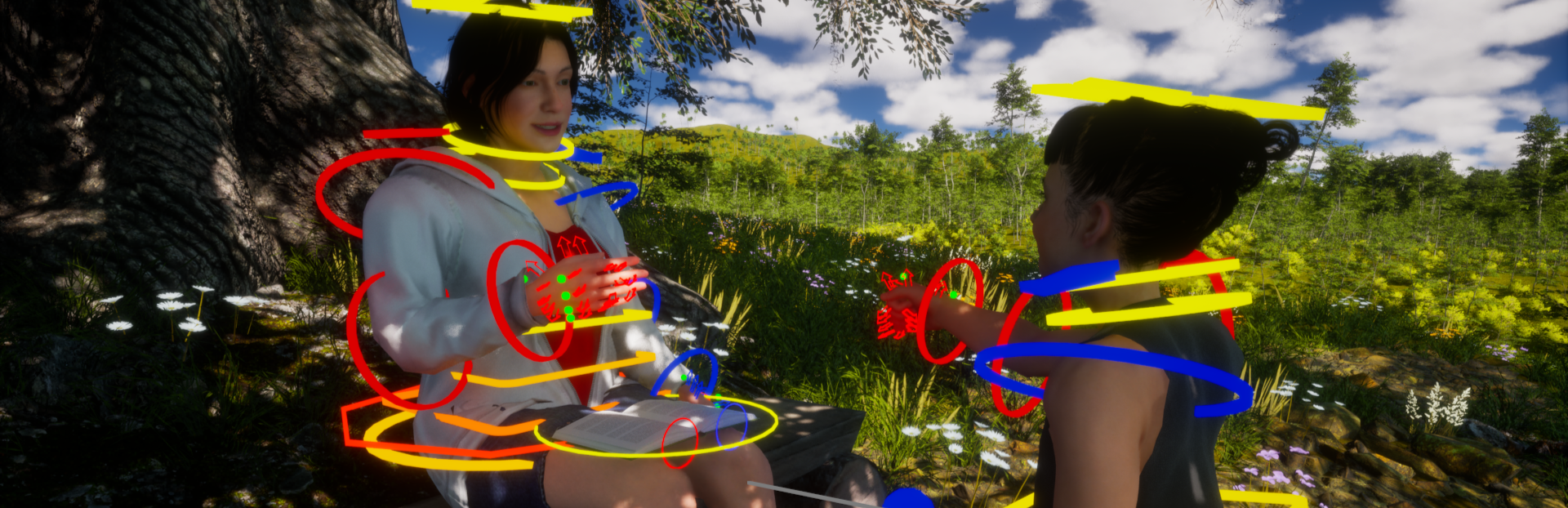
At that point, every shot existed only as T‑pose MetaHumans in underwear. To avoid cluttering the document, I added quick screenshots of each shot back into the original “shots” file so I always had a visual reference next to the description.
[carousel autoadvance="true"][/carousel]
Then came animation (the slowest part). I had almost no experience with Unreal’s animation rig (or animations in general), so my first attempts were terrible. I considered using AI mocap but, with a limited budget and a desire to learn to animate myself, I decided to do it manually. It took about two and a half months, but now I can create my own animations whenever a pack doesn’t quite fit my needs.
Only after the animations were in a decent place did I buy outfits for the characters. Alexis’ dress was clipping everywhere, so I had to learn how to adjust and reshape it to behave correctly. Once the characters looked dressed and alive, I added fun details: Niagara particles and fluids, blood decals, and alternate “possessed” versions of the characters with different textures.
[carousel autoadvance="true"][/carousel]
While all that was happening, facial animation was still missing—characters moving around without expressions was hilarious. Luckily, Unreal has a feature that lets you record your face and generate facial animations from it, so I used that to give everyone expressions that matched the nightmare.
With the visuals in place, I moved on to sound, selecting SFX, placing them in the scene, and choosing music that escalates the nightmare. After that, it was a long loop of polishing, camera tweaks, focus adjustments, and fixing issues that didn’t work.
[carousel autoadvance="true"][/carousel]
Learning the Movie Render Queue in Unreal was a journey on its own: setting it up correctly, choosing the right settings, and finally achieving a clean export. Since I was still learning new
Source
Changelog.gg summarizes and formats this update. How we read updates.