
In this update4
Full notes
Full Theatre of War: Rearmed update
Read the full published notes in a cleaner layout. The original post stays linked below.
Repeated intro
Hello everyone!
What changed
- UI and audio
- Maps
- Gameplay
- Fixes
Theatre of War: Rearmed changes
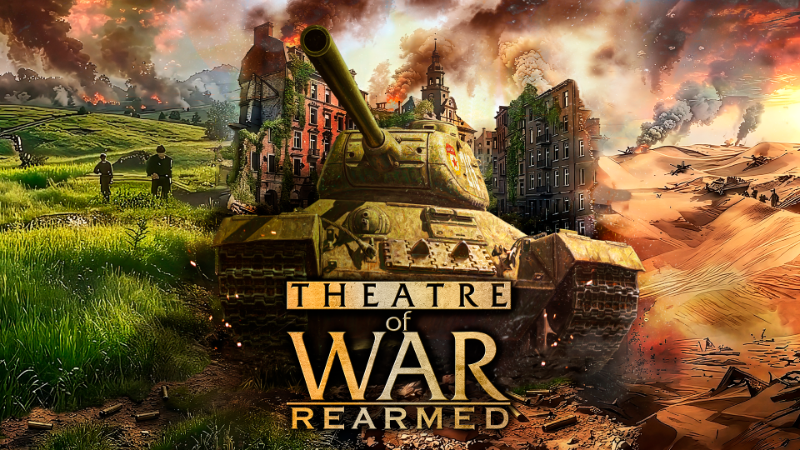
This is the first entry of our dev blog. A series where we talk about what exactly is new in the Rearmed version of the game. We will discuss everything, from graphics and UI to every little detail of the gameplay.
If you want to try it yourself, there’s an open playtest running now. It’s only available for a couple of weeks, so make sure to sign up on the game’s main page!
Theatre of War Rearmed We have a lot (and we mean it) of ground to cover, so let’s not prolong this introduction any longer than necessary.
Today’s theme is visuals!! This is only the first part out of two, as the number of tweaks and fixes done in Rearmed is so broad that, if we tried to fit it all into a single Steam post, it would qualify as a short novel.
So, without further ado~
Maps
As you (probably) know, Rearmed is based on the latest version of the Theatre of War engine that was used for the third game. This means that maps from the older games were simply not quite good enough to be reused.
So, the developer recreated every original map from the ground up to make them compatible with the new version. Yes, every single one of them. That’s 70 maps in total, or 170 if you count all the variations.
What does that mean in practice? It means creating meshes for every type of Level of Detail, while also building entirely new terrain topology.
But that’s not all. Every map has now been tuned with different types of soil, Noise Textures, and Normal Maps. So, it’s not just a visual upgrade, these maps now also support gameplay mechanics that were introduced later in the series. Just look at the difference!
And let’s not forget about good old gardening. New grass and flora have been added to make the locations feel more alive. Combined with corrected structures and objects, as well as tweaks to roads, craters, and textures, the environments now truly feel like realistic battlefields.
As a final touch, the seasons now show much greater visual diversity and have been significantly improved overall.
There is also a lot of under-the-hood work done on the maps, ensuring they feel modern and no longer out of place compared to the ones from Theatre of War 2 and 3.
Objects
Starting from the second game, your units gained the ability to enter buildings - a great feature that was sorely missed in the first one. Previously, buildings were just boxes you couldn’t interact with in any way. Well, not anymore!
Every building can now house your troops, features properly transparent windows, and has realistic wall thickness. To achieve this, the developer reworked both the collision models and textures.
Next, trenches. Old Theatre of War 1 trenches were also redesigned. Back then, they were about two meters wide, which defeated their purpose, as infantry would die in droves, as artillery shells could hit such wide targets far too easily.
So, they were completely overhauled. They are now one meter wide, come in both winter and summer variants, and include heavy weapon nests for you to take advantage of.
Units, Part 1
We’re almost running out of time, but we still want to talk about unit models, vehicle models in particular.
The game now includes around 300 types of armored units: tanks, artillery, armored cars, planes, and even one brave helicopter
Every model has been meticulously reworked in several ways. First, collision systems have been greatly improved. They now take into account optics, viewing slits, tracks, rollers, and wheels, allowing for much more accurate penetration simulation.
Stationary and anti-aircraft guns also received their share of improvements. Previously, some of them simply lacked animations for deployment or mobility, forcing them to remain permanently stationary. Which was far from ideal. That has been fixed! Now you can take your favorite artillery wherever you like.
And finally, the presentation! The developer invested significant time carefully adding historically accurate camouflage, tactical and identification markings, and many other small details.
Conclusion
That’s a lot. And it’s still not everything! There’s so much more to cover, even when focusing purely on the visual side of things. The infantry rework, for example. But we’ll leave that for next time.
All in all, this is a massive overhaul with the main goal of unifying the experience across all Theatre of War games, both visually and in terms of gameplay. We can’t wait for you to dive into Rearmed and experience it for yourselves.
Let us know what you think about these changes in the comments!
Source
Changelog.gg summarizes and formats this update. How we read updates.