
Full notes
Full The Riftbreaker update
Read the full published notes in a cleaner layout. The original post stays linked below.
What changed
- Gameplay
- Events
- Store
- Balance
- Maps
The Riftbreaker changes
Hello Riftbreakers!
As game developers, we have the incredible pleasure of building games that we would want to play and sharing them with millions of people around the world to enjoy. As awesome as that is, we are often quite anxious about every new release. After all, the release day is always the ultimate test for the game - not only when it comes to the technical side, but also from the game design standpoint. Luckily, playtesting exists, and players are usually more than happy to play the game early and share feedback. This allows us to fix the vast majority of serious errors, but also reveals that real players play the game very differently from developers. Today, we would like to share some things we observed when watching you play the game - what we saw in live playtests, streams, YouTube videos, and co-op sessions. Some of these things really were eye-opening!
Going back to the 2019 demo was an experience for sure. We didn't even remember that old Sentinel Towers did not need any power back then.
The Riftbreaker was first revealed on the 8th of March, 2019. The first opportunity to play the game itself came just three weeks later, at PAX East in Boston. We prepared a special “event demo” for the show. It was a very early version of the Prologue we have in the game today, but it had one significant difference: you started with a pre-built basic outpost. It wasn’t anything fancy - just a couple of factories, some walls, and a couple of Sentinel Towers. Our intention was to let you jump into the action straight away, skipping the building phase. We assumed that the trade show floor was not really optimal for staying longer and building up a base on your own. However, while observing our visitors play the game for the first time, we realized they put a lot of effort into the building phase, actively upgrading the structure we had made. Sometimes, players would go even further and sell all buildings to build the base on their own. We were surprised, to say the least, but we were determined to learn from this experience.
We made the effort to make all the buildings look nice, and players dismantled them anyway :(
The event demo remained largely unchanged for the rest of the 2019 shows we attended (shoutout to anyone we met there, also RIP in peace, E3). Back at home, we were already preparing to come back better and stronger. We all know how those plans ended, as 2020 had thrown us all a curveball. Still, the game industry tried to fill this gap with online showcases, including the very first Steam Next Fest. We presented our new and improved Prologue during that event. The biggest difference was that the player had no buildings at the start. The ‘new’ first objective in the demo was to dig up some carbonium and build a Headquarters. It gave us a natural opportunity to teach players these mechanics while also allowing them to build everything on their own. More importantly, it was the players themselves who showed us a good way to do so. Two birds, one stone!
This is the 2019 final Prologue wave, considered unbeatable and completely overwhelming. We had no idea what our own game had in store for us!
Observing our players' behavior is also a useful tool for tailoring the difficulty. Before we launched our alpha test, we invited some gamers to our office to try out the early version of The Riftbreaker. They all had one thing in common - they were not fans of top-down, real-time-strategy games. The task we gave them was simple: just play the game as if we weren’t there. They could comment on what they wanted and ask questions, but we would not say a word. After the test concluded, we gathered their feedback and tuned the game accordingly. The idea behind inviting players who were not expert at the genre was to make the game accessible and easy to pick up for anyone, without any prior knowledge of this type of games. This allowed us to tweak the difficulty to a level suitable for as many players as we could. We also made a conscious decision to allow difficulty customization and all sorts of cheats and mods. This allows you to adapt the game to your expectations and needs, increasing accessibility.
In 2021 we would have had no chance at beating today's Cryo Fields Brutal survival. Luckily, you taught us how to play!
We took a different approach when it comes to the Brutal difficulty mode. At a couple of points during the game’s development, we “overtuned” the difficulty ramp and the general power of the enemy creature attacks in Survival mode. Our intention was to purposefully give the players too much to handle, and then dial it back just a little to keep it challenging. We got close to the final wave on several occasions, but ultimately always failed. We got so confident that no one would be able to beat the game on Brutal that we even issued a challenge to our community: beat the game, record a video, and receive a prize. We didn’t expect anyone to complete it, but many people did - with ease. We had to know how it’s done, and we had video evidence, so we started analyzing the footage.
Back then there was no co-op and no buddies who could help you with organizing the base, exploring, and fighting. Still - you showed us it was all possible!
As it turns out, we played our game completely wrong. We got completely schooled on how to play Survival. Instead of building and fortifying a relatively small base as we did, the “pro” players cleared the entire map and claimed all of the resource deposits. The early game was more difficult for them due to a less structured defensive setup, but in the late game, they crushed their enemies with an overwhelming economic advantage. By the time the final waves arrived, these players could afford to build an absolutely incredible amount of defenses. We thought our Survival mode encouraged a more careful approach to gameplay. Instead, we learned that aggressive industrialization was one of the keys to victory. What is even more important, it was not the only difference between our and our players’ styles. They were much faster, chose a build order that suited their needs, and pushed to get the maximum out of every resource. In short, they showed us how to play the game on Brutal. Naturally, we continued tweaking the difficulty levels well after the event, but it gave us a fresh perspective on the game's skill ceiling.
Sometimes, all you want to do after a hard day at work is chill and build a megabase - and that's completely cool! We made sure you always had the tools to do so at your disposal.
After the game's release, we continued monitoring how you played and where we could introduce features to improve the overall quality of life in The Riftbreaker. These observations, combined with tons of feedback we received from you over the years, resulted in a multitude of changes and additions that made the game simply more fun. However, we also discovered something much more interesting. A large portion of our player base preferred to customize the game’s difficulty rather than choose one of our presets. They either made the game significantly harder by increasing the number of enemies and their damage, or built their own creative mode by shortening building and research times and making resource deposits infinite. We expected that to some degree. In fact, the sandbox and custom difficulty modes were present in the game from the very first day. We also kept adding more and more decorations to use over the years to give those players more tools to play with.
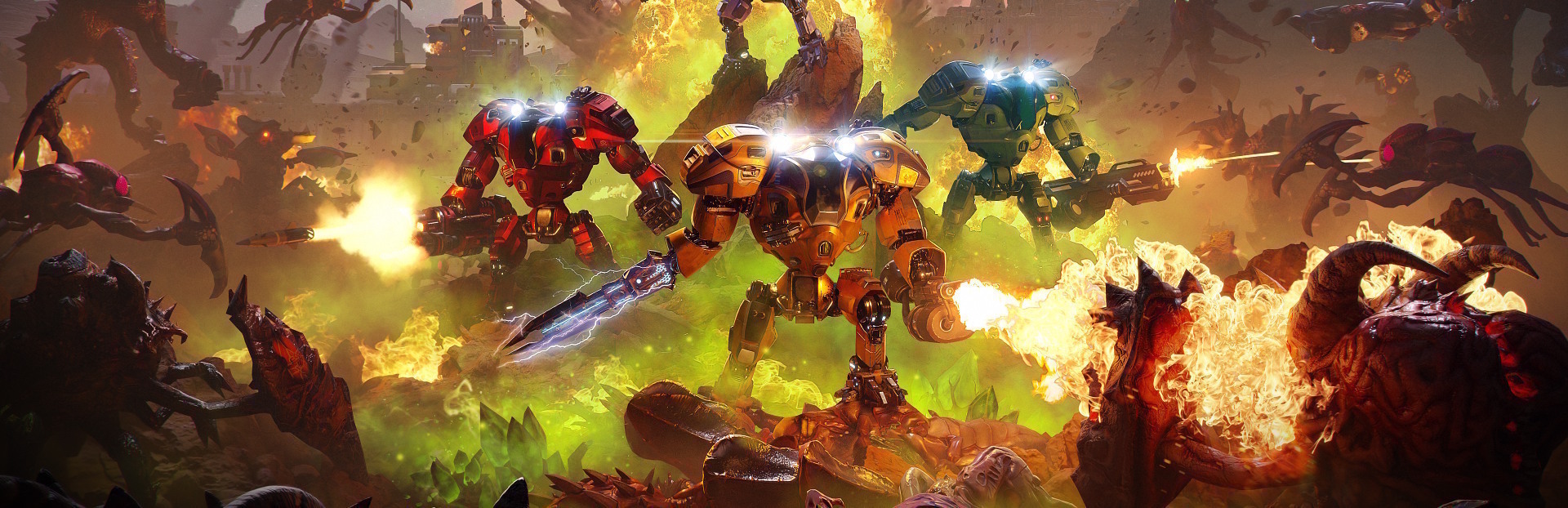
Please excuse the unacceptable behavior of the red mecha. We will take disciplinary action.
However, the real shock came after the release of the online co-op mode. While reviewing streams and other videos, we realized that mission objectives were not a priority for many co-op player groups. Again, this is somewhat to be expected among returning players, but many new players also preferred this playstyle. Completing missions was a means to an end for them; the players were more interested in unlocking new biomes and decorative elements than in progressing the story. We realized that for a large portion of our playerbase, the main source of enjoyment was hanging out with their friends, smashing through a horde of creatures every now and again, and building cool fortresses. It was about the journey, not the destination. Somehow, The Riftbreaker became a much more popular social experience than we expected. It was a heartwarming feeling for us. After thousands of hours we spent with the game over the past couple of years, it is sometimes difficult to take a step back and look at The Riftbreaker from the perspective of a fresh player. You know the saying - after this much time, you stop seeing the forest, and start cataloging the trees. Moments like these pull us out of that headspace and remind us why we started making games in the first place. Thank you for that!
I guess we should call co-op Riftmender, because it encourages so many nice interactions (❁´◡`❁)
We guess most of you experience something similar in your day-to-day jobs and activities. Car mechanics always look for things that can break down, musicians can’t listen to their own songs, and workers at a potato chips factory won’t touch another potato chip in their lives. What we wanted to say in this post is: we see you, and we know why you play. Our goal is primarily to give you a break from the mundane and offer a fun experience. We will keep making games with that goal in mind. The fun factor comes first, even if sometimes we’re too deep in analyzing bug reports and optimizing code to acknowledge it. Join our Discord at https://www.discord.gg/exorstudios and our newsletter at https://www.exorstudios.com/blog/#newsletter for more insights like these.
See you next time! EXOR Studios
Source
Changelog.gg summarizes and formats this update. How we read updates.