
In this update4
Full notes
Full Tabletopia update
Read the full published notes in a cleaner layout. The original post stays linked below.
What changed
- Gameplay
- Balance
- Performance
Tabletopia changes
Cradle of Glass and Neon
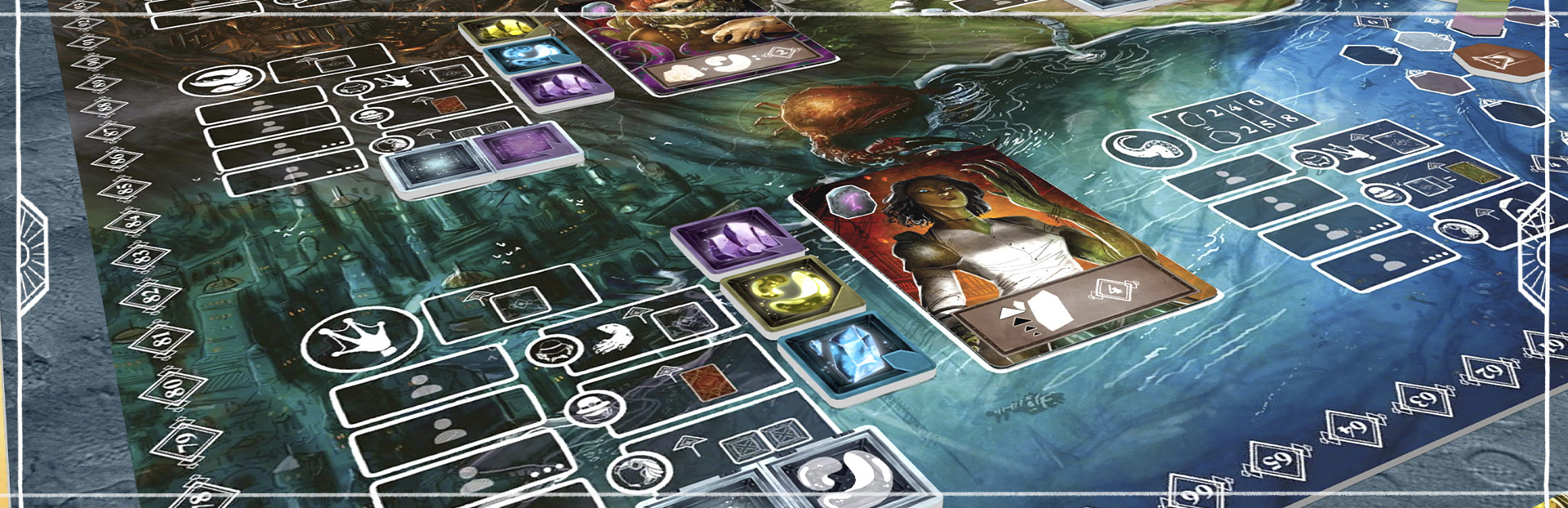
The world of board games continues to explore science fiction, shifting from traditional space exploration toward more intriguing and dangerous themes of bioengineering. Publisher Dranda Games, already known for projects such as Isle of Trains: All Aboard and Pioneer Rails, has introduced a new ambitious project, Mutagen.
The game transports players to an alternate 1920s, where scientific progress accelerated thanks to a mysterious energy source known as the Great Shard. Its influence transformed society: instead of mechanical upgrades, people began experimenting with biological mutations, turning their own abilities into tools of economic and strategic superiority.
Players take on the role of faction leaders striving to prove that their approach to mutation is the most effective. The goal is to score the most victory points across four rounds by gradually upgrading workers, developing production chains, and adapting strategy to changing conditions. The game supports 1-4 players and lasts roughly 60-90 minutes, placing it firmly in the medium-weight euro category with a strong focus on planning and combo-building.
The Gleam of a Cold Scalpel
At its core, Mutagen uses classic worker placement, but with a crucial twist: each worker can mutate and gain new abilities. Players start with the same set of four workers, yet over time they evolve into distinct specialists.
Each placement triggers not only the chosen location’s action but also an additional effect tied to that specific worker. After mutations are acquired, these effects are enhanced or expanded, turning a standard turn into a chain of linked actions. A single placement can simultaneously generate resources, trigger conversions, and unlock new opportunities.
This creates a dynamic where not only placement choice matters, but also action order. Players construct their own combinations, optimizing the interaction between mutations. Unlike traditional euro games, where efficiency often depends on resource control, here the key lies in developing a unique set of abilities.
The board offers various areas for gathering materials, upgrading workers, completing objectives, and gaining long-term bonuses. Limited spaces increase competition, and the ability to strengthen workers makes blocking particularly impactful. Losing access to a key zone may disrupt an entire chain of actions rather than a single effect.
An Alphabet of Amino Acids
Mutagen’s strategic depth revolves around choosing development paths. Early in the game, players focus on collecting resources and acquiring initial upgrades, but specialization becomes necessary by the mid-game.
One path involves building powerful combo turns, where one worker generates resources, another processes them, and a third converts them into points. Another approach focuses on completing objectives and accumulating bonuses for specific upgrade combinations. A third option is a flexible strategy that reacts to opponents and shifts direction quickly.
Each worker evolves independently, creating asymmetry within a single faction. One may become a resource generator, another an upgrade specialist, and a third a scoring engine. The result is a miniature internal economy where efficiency depends on sequencing actions correctly.
The scoring system supports strategic variety. Points can be earned through worker development, completing objectives, resource accumulation, and long-term effects. This encourages adaptation rather than rigid planning.
Final Research Log
The biopunk setting extends beyond visual style. Mutations are directly tied to gameplay and reflect the gradual strengthening of workers. Each upgrade feels like a qualitative leap that reshapes the structure of a turn.
The game progresses in escalating phases. The first round is preparatory, players build foundations. The second and third rounds are critical for engine development. In the finale, the most powerful combinations emerge, enabling long chains of actions. This pacing keeps the game dynamic and avoids repetition.
The Mutagen also includes a solo mode, allowing players to experiment with strategies and explore combinations. This broadens the audience and appeals to those who prefer solo sessions.
Who is ready to create the most powerful biopunk faction:
those who enjoy evolving workers and gradually strengthening abilities
players who like building efficient engines and action chains
fans of optimization and long-term planning
enthusiasts of unusual settings, especially biopunk themes
fans of medium-weight euro strategies
those who value a solo mode for testing and refining strategies
At the intersection of science and ambition, a faction emerges that can rewrite the rules of evolution. Become the one who leads it to victory. Test your skills in this alternate universe online via Tabletopia.
Source
Changelog.gg summarizes and formats this update. How we read updates.