
In this update10
Full notes
Full Sublustrum update
Read the full published notes in a cleaner layout. The original post stays linked below.
What changed
- UI and audio
- Gameplay
Sublustrum changes
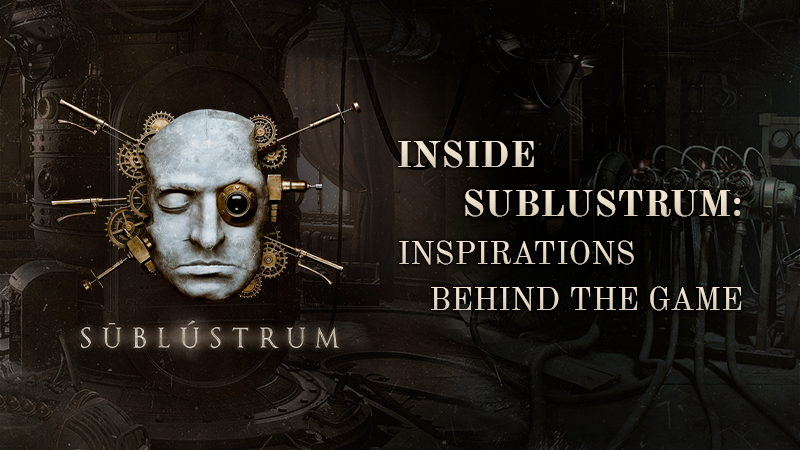
Sublustrum is a video game built entirely around atmosphere. Its world draws from decadence, steampunk, and surrealism while its story touches the irrational and the unconscious’ dreams and memories. It becomes a tale exploring the possibilities of consciousness and the limits of human perception.
Sublustrum draws from many of the interests of its creators, authors of the game, such as arthouse cinema, music, surrealism, psychology, the theory of infrasound, and many, many others – forming a rare, intriguing palette.
To understand how Sublustrum was created, it’s worth looking at the inspirations behind it.
Music as the First Source of Inspiration
Originally, Sublustrum was conceived as an interactive addition to a music album, so its earliest and strongest influence was the sound of Anthesteria: dark ambient blended with neoclassical elements.
In the game, music is not the background — it is the soul of the entire experience. Each location has its own sonic identity: a detuned piano in the professor’s apartment, Arabian rhythms in the desert, psychedelic guitar textures or hypnotic throat singing. Often, the sound determines the visuals, dictating or even imposing the emotional shape of a scene.
The voiceover is not professional, but authentic. In the original game, players hear the real voice of a professor from the Institute of Paleozoology, recorded in his office, surrounded by bones and skulls of fossil animals. Nothing is overly polished; in Sublustrum, authenticity takes center stage.
Locations Built from Mood and Detail
Mechanisms, interiors, and props are all created with meticulous care. Yet the creators were guided less by specific objects and more by mood: the feelings evoked by abandoned houses and factories, forgotten basements, vintage instruments and machinery or unusual architectural elements.
Even the locations are designed with plausibility in mind; in the Shimmering World, however, reality dissolves into pure surrealism: floating staircases, buildings from the turn of the 19th and 20th centuries stranded in the desert, and steampunk machinery reminiscent of Dalí’s dream imagery.
The environments themselves carry the narrative. They channel the memories and subconscious of the protagonist’s absent brother.
Attention to detail in every scene proves that the Sublustrum world does not tolerate haste or today’s clip thinking. It invites players to slow down, look closely, dive into details, observe, and reflect. Meaning is woven into the environment, waiting to be deciphered.
Visual Cinematic Influences
The visual language of Sublustrum is influenced by cinema as well. Here, you can find lots of references and allusions to iconic works like:
1) The black-and-white nightmare space of David Lynch’s Eraserhead.
2) The post-apocalyptic world of Konstantin Lopushansky in Dead Man’s Letters.
3) Symbolism, atmosphere and philosophy from Tarkovsky’s Stalker
4) Fritz Lang’s Metropolis – city aesthetics.
5) The noir futuristic dystopian mood of Alex Proyas’s Dark City.
6) Steampunk aesthetics, fantasy worlds, and exploration of memory in Jeunet & Caro’s The City of Lost Children.
Final Thoughts
Sublustrum isn’t a game that explains itself, but rather invites exploration. Every shadow, sound, and detail carries meaning, waiting to be deciphered, interpreted and understood through the viewer’s own lens.
When you finally leave Sublustrum, you carry a piece of its world with you: a faint echo of a melody, the shadow of a staircase leading nowhere and the feeling that there are truths just waiting to be discovered.
Source
Changelog.gg summarizes and formats this update. How we read updates.