
In this update12
Full notes
Full Skyos update
Read the full published notes in a cleaner layout. The original post stays linked below.
What changed
- Gameplay
- Maps
- Workshop
- Balance
- Server
- Store
Skyos changes
The Next Chapter of SKYOS
When SKYOS first launched, its focus was centered on space exploration, orbital systems and the experience of operating beyond Earth.
Since then, the project has grown into something much larger.
SKYOS is now being developed toward an immersive first-person lunar colonization experience. The planned progression will begin with a single spacecraft, continue with the establishment of a foothold on the Moon and gradually expand into resource extraction, infrastructure and the foundations of a permanent colony.
Important development note: The lunar content shown in this announcement is currently in active development and is not yet available in the public version of SKYOS. This article presents the project’s new direction, the systems currently being built and the gameplay foundation planned for future updates.
Start with a rocket. Build a colony.
From orbit to the lunar surface
The journey to the Moon will begin from Earth.
The player will launch the spacecraft, perform the trans-lunar injection maneuver and continue the journey toward the lunar environment.
As the spacecraft approaches the landing area, a transition will load the lunar surface before the final descent sequence begins.
This sequence will show the spacecraft slowing down, performing its rotation maneuver, deploying its landing systems and completing its final approach toward the surface.
The goal is to make the arrival on the Moon feel like a meaningful stage of the journey rather than a simple instant transition between environments.
A complete landing sequence
The landing sequence is designed around several distinct visual phases.
The spacecraft slows its approach, performs its rotation maneuver, deploys its landing legs and uses different groups of thrusters before touching down on the lunar surface.
Engine effects, dust and surface interaction accompany the final descent to reinforce the weight and intensity of the landing.
For now, this part is presented as a cinematic sequence. More advanced player controls may be explored later, but they are not yet part of the current system.
From spacecraft to first lunar home
Landing is only the beginning.
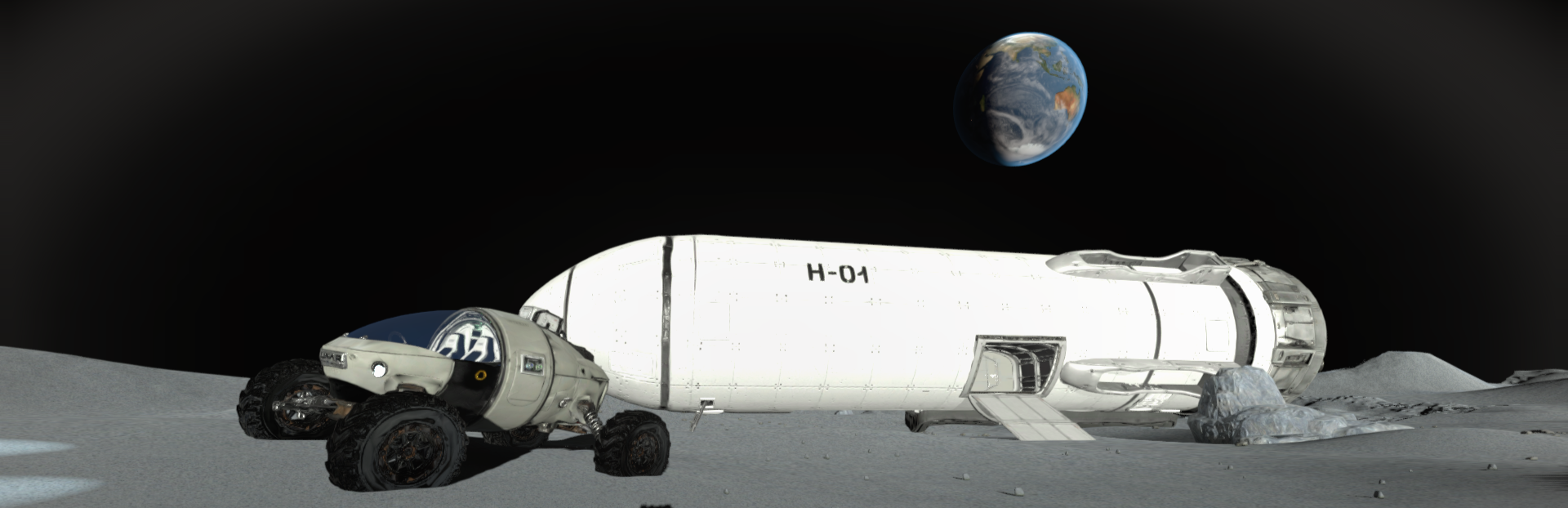
After reaching the lunar surface, the spacecraft can be transformed into the player’s first operational habitat. The vehicle rotates into a horizontal position and becomes the RocketHome.
The RocketHome will serve as the colony’s first shelter, workshop, storage area and survival center. From there, players will prepare equipment, manage essential resources and begin expanding across the lunar surface.
Building the first habitat
The interior of the RocketHome is being developed as a functional and customizable living space.
Players will be able to install and organize equipment such as:
Storage containers
Battery systems
Oxygen reserves
Water storage
Workstations
Sleeping equipment
Hydroponic growing systems
A modular placement system is currently being developed so that equipment can be positioned directly inside the habitat rather than being limited to a completely predefined layout.
Survival and the first resources
Life on the Moon depends on infrastructure.
Oxygen, water, food, energy and temperature management will form the foundation of the early survival experience. These systems will not exist only as passive status bars. They will be directly connected to the equipment, vehicles and structures operated by the player.
Water will be one of the first major resources.
The player will explore the surface, locate potential ice deposits and deploy extraction equipment over suitable areas. Extracted water can then be collected, transported and distributed between the RocketHome, greenhouses and future colony structures.
Hydroponic and later aquaponic systems will allow the colony to begin producing food locally instead of relying entirely on supplies transported from Earth.
The modular rover system
Exploration and logistics require a vehicle capable of adapting to different missions.
The lunar rover is being expanded into a modular platform. Instead of relying on several separate vehicles, players will eventually be able to change the rear module depending on the objective of each mission.
Current configurations include:
Long-range rover — additional equipment storage, oxygen reserves and extended battery autonomy
Oxygen transport rover — a high-capacity oxygen tank for survival logistics
Water transport rover — a large tank for collecting and transporting water
Ice scanner rover — specialized equipment for locating potential ice deposits
Resource transport rover — a cargo bed designed to move construction materials and extracted resources
Each module has been modeled as a separate functional component and is being prepared for integration into the gameplay systems.
More than survival
Water extraction, oxygen management and food production are essential, but they represent only the beginning of the larger progression.
The long-term objective of SKYOS is lunar colonization.
Players will gradually expand beyond the first RocketHome and develop a larger network of infrastructure:
Cargo landing sites
Maintenance hangars
Greenhouses
Solar installations
Water and oxygen storage
Warehouses
Mining sites
Processing facilities
Habitation modules
Research and industrial buildings
Future cargo missions from Earth will deliver equipment, construction materials and specialized machinery. Local resource extraction will progressively reduce the colony’s dependence on Earth.
The goal is to transform an isolated landing site into a functioning lunar settlement.
Designed with future cooperation in mind
SKYOS is currently being developed as a single-player experience, but the underlying systems are being structured with future cooperative gameplay in mind.
Exploring the Moon alone can be immersive.
Building a colony with friends could make the experience even more meaningful.
No cooperative release date is being announced at this stage, but avoiding unnecessary technical limitations now is an important part of the project’s long-term direction.
What comes next?
The next major development step is the rover maintenance hangar.
This structure will allow the player to bring the rover inside, access its equipment and exchange modules according to the next mission.
The hangar will connect several systems that have already been created:
Modular rover configurations
Equipment storage
Module selection
Mechanical attachment systems
Resource logistics
Vehicle maintenance
After the hangar is operational, development will continue toward completing the ice detection, water extraction, transport and greenhouse gameplay loop.
Work in progress
Everything shown in this announcement comes from the current development version of SKYOS.
The lunar environment, spacecraft landing sequence, RocketHome, modular rover systems, resource equipment and colony mechanics shown here are not yet included in the public build currently available on Steam.
Some of these systems are functional internally, while others remain prototypes, visual targets or components being integrated. Models, interfaces, lighting, effects and gameplay mechanics may continue to change as development progresses.
This announcement presents the new direction of SKYOS and the foundation being built for future updates. It should not be interpreted as a list of features already available in the current public version.
Thank you
SKYOS is being developed independently, one system at a time.
Every purchase, wishlist, comment and piece of feedback helps support the project and makes it possible to continue expanding this world.
Thank you to everyone who has already joined the journey.
Start with a rocket. Build a colony.
— ALKALINE
Source
Changelog.gg summarizes and formats this update. How we read updates.