
Full notes
Full Sefton Asylum update
Read the full published notes in a cleaner layout. The original post stays linked below.
What changed
- Gameplay
- Events
Sefton Asylum changes
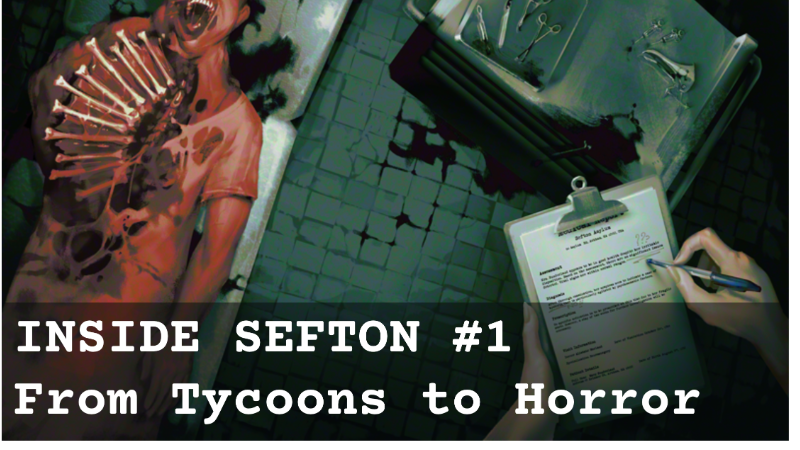
This is the first in a short series about a shift that changed a lot for us as a studio.
For three years, we had been making tycoon games. Then, with Sefton Asylum, we found ourselves moving toward something darker, stranger, far more narrative: a first-person horror game. That change didn't happen overnight and it didn't come from a single idea either. It came from a longer process of rethinking what kind of studio we were, what kind of games we wanted to make and what parts of our past work we wanted to carry with us.
I'm Vichou, the game producer on Sefton Asylum. Over the past months, I started documenting that transition from the inside. I interviewed several people on the team and turned those conversations into a few short articles.
This first one is about the beginning: where Sefton Asylum came from, what kind of horror made sense for a team like ours and how our background in tycoon games shaped the project more deeply than we first expected.
Tycoon games teach us that tension gets interesting when it comes from structure. From competing priorities and real consequences, rather than from raw panic or direct danger. A good tycoon loop is rarely about one dramatic event. It's about the slow pressure created by systems that keep colliding until the player has to choose what matters most.
For Sefton, we took that instinct and turned it inward. Instead of running a system, the player is trapped inside one. You can still see it in the game's core pitch: each night is built around a constant trade-off between caring for patients and using that same time to investigate the asylum and gather evidence.
Ludo, who directed our previous tycoon games, came up with Sefton's initial high concept. He's not the kind of horror player who follows every release in the genre. So instead of starting from horror games themselves, he started from things that already felt unsettling to him in real life. Part of that came from time spent around medical institutions through his grandmother, who lives in a specialized care wing for elderly people with dementia. What stayed with him wasn't sensational horror. It was something quieter: the atmosphere of those places, the unease of systems meant to care for people and the way pressure and exhaustion can slowly strip that care of its humanity.
It also connected with influences Ludo had for years, especially writers like Lovecraft, Chambers and Barker. What interested him here wasn't cosmic horror in the broad sense. It was Herbert West–Reanimator, with its fixation on forbidden medicine, reanimation and obsession pushed past the body's limits. This isn't horror about distant gods. It stays close to the body, to care and to the moment when the urge to heal, fix or improve starts justifying cruelty in the present.
Egon, our lead game designer, helped clarify what kind of horror Sefton was actually trying to build. For him, horror has to do more than scare. It has to say something. That's why he keeps coming back to intention. He wants the player to feel responsible for their patients, clever when they manage their limited time well and able to adapt under pressure rather than just endure it. In his view, pressure only gets interesting when it stays clear and fair enough for the player to respond to it. That's a very different starting point from horror built only on helplessness.
It also gives the game its subtext. Beneath the monsters and the mystery, Sefton looks at a form of unchecked progress: the moment when a system becomes so convinced that it's improving humanity that it starts accepting immediate harm, crossing ethical boundaries and losing sight of actual human beings in the name of a greater promise. That familiar belief that every problem can be solved if we just push further, move faster and stop worrying too much about the human cost in the present. The horror isn't only the monster entering the room. It's the procedure that made the monster possible.
Val, our level designer, translates that into space. He isn't trying to build a sequence of scary rooms. He's building an asylum that feels “as fascinating as it is unsettling”, with a strong sense of spatial coherence, pacing and environmental storytelling. For him, the hospital has to read as a real workplace first, with routine, logic and traces of daily life, before slowly revealing something much darker underneath. What makes the place feel wrong isn't just the atmosphere. It's the sense that it still works, but no longer in the way a hospital should.
To me, that's the clearest bridge between our tycoon background and this project. The genre changed, the camera changed, the tone changed, but the core instinct is still there. We're still building around pressure, structure and consequences. This time, all of it is serving something darker and more personal.
Vichou Game Producer
Source
Changelog.gg summarizes and formats this update. How we read updates.