
In this update9
Full notes
Full SAE update
Read the full published notes in a cleaner layout. The original post stays linked below.
What changed
- Gameplay
- Maps
SAE changes
How do we bring SAE to life for you? Here is how we bring the Stingray in the Game!
Welcome to a different sort of update!
In this update we will introduce you to our latest creation, the Stingray, and give you a glimpse into the development of such animals. Stay tuned!
Manta or Stingray?
About three weeks ago, we were wondering how we could animate the oceans more in our game SAE. That's when I came across one of our favorite animals: The stingray and the manta ray.
After some careful consideration, we decided to use the stingray because it has a wider range and more exciting behaviors than the manta ray.
So let's get to it - enjoy the following insights!
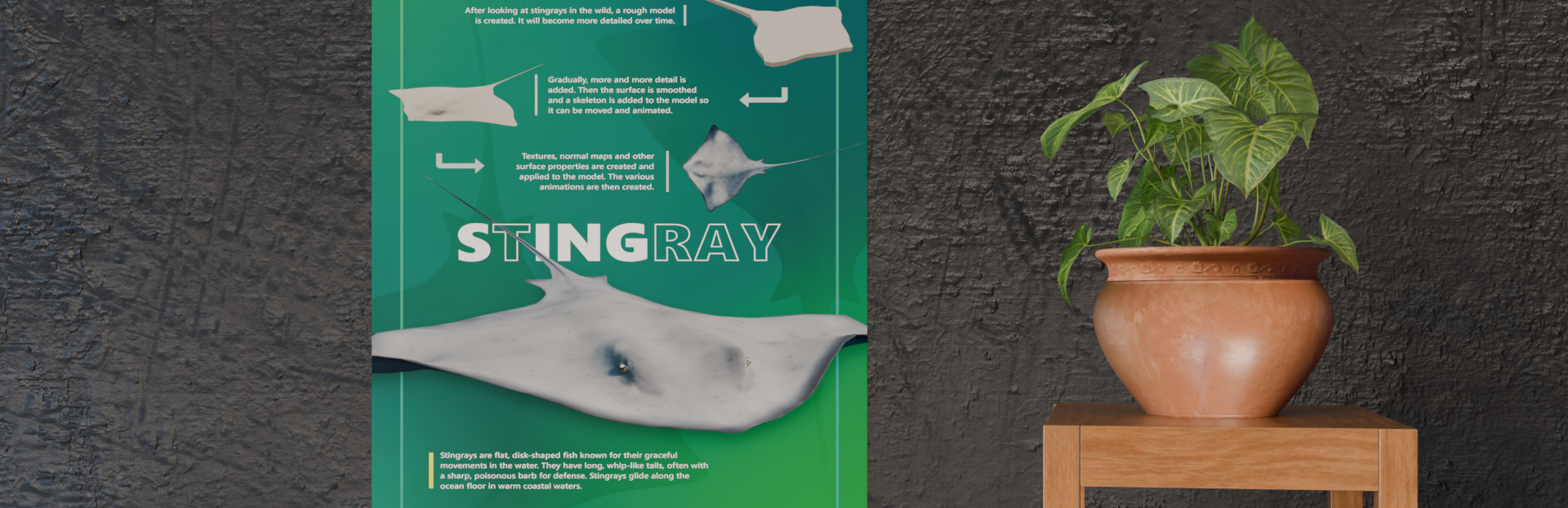
Get it before it's too late: Limited Edition Stingray Poster!
We have spared no effort to create a new poster, limited to 20 copies. Get your hands on one of the few posters showing the development of the Stingray at SAE. The poster is in A3 format (29.7 x 42.0 cm). Printed on high-quality, 250g/m2, glossy photo paper with vivid colors and crisp details. Our posters are sure to make a statement wherever they're displayed.
You too can decorate your room with a stingray!
Step 1: What does a stingray look like in real life?
When the rough model is finished, smooth the surface - in Blender with Modifiers - and sculpt the finer details, such as the eye sockets.
First, we look for as many sources as possible to create an accurate model of the stingray. This involves looking at and reading a lot of pictures, videos and articles.
Source: https://animalia.bio/common-stingray
Step 2: The rough shape
The next step is to create a (very) rough model in 3D software. The following scheme is used when creating 3D models: From rough to fine. You start as rough as possible and add more and more detail over time.
Step 3: Smooth and sculpt the surface
When the rough model is finished, smooth the surface - in Blender with Modifiers - and sculpt the finer details, such as the eye sockets.
Step 4: Adding the skeleton
In order to add animations, a skeleton must be added to the model. These bones must then be assigned to the appropriate body parts.
Step 5: The textures
What else do you need? Right, the textures! Again, first rough, then more and more detailed. Then you need a normal map and a roughness map, which can create artificial roughness and shine.
Now we're done with the model. But that doesn't mean the stingray is happy swimming around in the water!
Step 6: Creating animations
This step is particularly time-consuming (and nerve-wracking!). Each bone has to be animated individually. Everything has to fit together. And in the end, it has to look realistic.
You can find two videos of the animations here.
Step 7: Behavior, movement and reactions
We have come so far, but there is still so much missing. The animal's behavior still needs to be implemented in the game. This takes about 50% of the total time and is also the most boring part.
First, you have to research the behavior of stingrays. Are they solitary or
Source
Changelog.gg summarizes and formats this update. How we read updates.