
In this update11
Full notes
Full Resonance: A Plague Tale Legacy update
Read the full published notes in a cleaner layout. The original post stays linked below.
What changed
- UI and audio
- Gameplay
- Events
- Balance
Resonance: A Plague Tale Legacy changes
⚠️ CONTAINS POTENTIAL SPOILERS
As we go more in-depth with the development process and inspirations for Resonance: A Plague Tale Legacy, you may find some minor spoilers in this Devblog.
Have a good read!
Hi all!
Great to have you aboard as Resonance: A Plague Tale Legacy release is just around the corner!
At Asobo, each team’s wrapping up production. It’s been intense, it’s been a crazy stretch, but a good kind of crazy. We’re now crafting everything for launch, the game visuals, screens that actually show what you’ll be diving into, progression tips... All hands on deck for the final debugging, last-minute translations into the supported languages, and recording voices outside of English.
The team can't wait to see you with a controller in hand. It’s almost time!
Now, Sophia spots her destination on the horizon, a legendary island, hidden somewhere in the Mediterranean Sea.
And so, legends take shape…
A quick mythology introduction.
In Greek mythology, it all begins with a broken promise. The ungrateful king of Crete, Minos, faces Poseidon, and unleashes his wrath. The sea god curses his queen, Pasiphaë, to give birth to the Minotaur, half-man, half-bull.
To hide this shameful child, Minos calls upon Daedalus, a master architect, to build a labyrinth so intricate that no one could ever escape. And then he claims a cruel toll from Athens: every year, fourteen youths will be sent to feed the beast that has grown savage and relentless.
But hope comes in the form of Theseus, son of the Athenian king, who volunteers for the deadly ordeal. Guided by Ariadne, Minos’s clever daughter, he ventures deep into the maze, faces the Minotaur, and strikes it down. With the thread Ariadne gave him as a lifeline, he retraces his steps and emerges into freedom. Yet vanity blinds him, and he abandons Ariadne, who curses him in return, condemning him to a life of solitude and misfortune.
Is that where the story ends? Not even close.
Resonance begins the moment the thread vanishes, and nothing guarantees the way back…
At Edge of the Maze
by Emma-Louise, writer in our narrative crew.
Today’s heroes, yesterday legends… Can you tell us more about how the characters come together in one story, and how two different eras shape the plot around the myth?
The Plague Tale series talks of themes like loss of innocence, illness and devotion. As a standalone spin-off, Resonance: A Plague Tale Legacy walks in line with those themes, as well as adds to them: at its core, it is a game about family, loyalty and betrayal. While we want it to offer a self-contained experience for the newcomers, you best be certain that we hid plenty of surprises for the fans of the series.
Resonance is a story about dualities. The tale of the Minotaur was the perfect setting piece to add to our own mythos. Our modern eye saw it as a way to explore our characters’ vulnerabilities and the loss of control that they are forced into… Those themes are especially present in the character Theseus, whose path Sophia follows on her journey on the island.
About parallel and converging paths…
The motifs of savagery and of taming what will not be tamed are front and center to the journey of both our protagonists. Sophia, born in a life of struggle and violence, searches for something better for herself; while Theseus, as a well-off member of the Minoan civilization, turns to violence to further his goal. They both have the same — forgive the pun — bull-headed resolve and desire to control their own destiny.
Mediterranean vibes and historic inspirations, from Venice golden hour to a mythic island
by Olivier, art director and Thomas, writer in our narrative team.
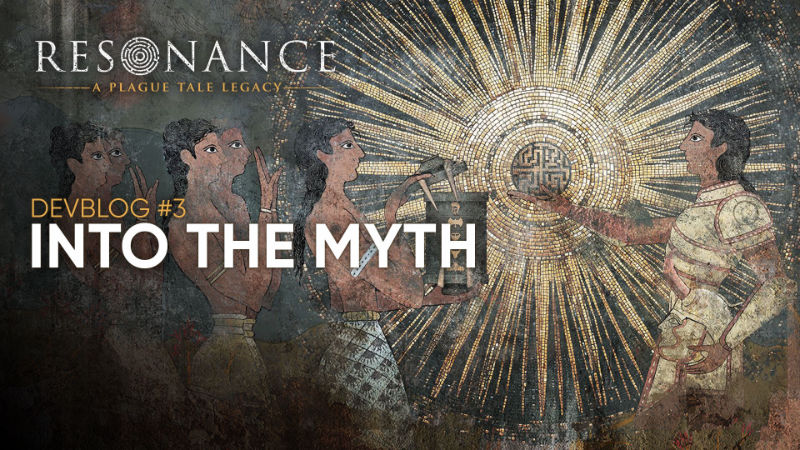
The story of Resonance: A Plague Tale Legacy takes place in the early 14th century and partly during the Minoan civilization, around 2,000 years before Christ — a challenge in itself in terms of historical authenticity.
Telling the story of the Minotaur's island while relying on faded frescoes and illegible clay tablets was no easy task. That's why we ended up letting players live that story rather than having it told to them (but we won't go into too much detail here, you'll have to find out for yourselves 😊).
Yet these constraints also offered interesting ways to convey narrative to players, starting with the artifacts Sophia can find on the island.
Drawing inspiration from real Minoan objects, we tried to think of them as pieces of the greater puzzle Sophia is trying to unravel:
What is an orrery doing on this island? Was someone trying to predict the movement of the stars? And those seal stones depicting people playing with a bull before putting it to death: was this a sport? A symbolic trial? A sacrifice?
As we wrote the actual dialogues, a key distinction also arose between sense of historicity and factual historicity. The first is essential to the player's willing suspension of disbelief, that remarkable ability of our brain to think “Ok, I’m playing a character in the 14th century. I can buy that.” Factual historicity refers to the documented accuracy of what we present: Had this technology been invented yet? Did these words actually exist? Unfortunately, the two don't always go hand in hand.
The hardest part is sometimes not knowing what people talked about, but how they talked about it. With the help of a medieval history Associate Professor who worked with us on A Plague Tale: Requiem (Hello Roxane! 😉), we tried to find the right balance. The last thing we want is for an immersed player to suddenly burst out laughing when a character cries "By cock's bones!" in a moment of danger, or "Fie on this world!" through tears (both historically attested, for the record).
We write stories to move players, to make them feel for characters they can relate to in a world they believe is real. When this fine line was too hard to draw, we chose the player's sense of historicity, their immersion and emotion. That's what we hope will give them the best possible experience of Sophia's story.
What are the key settings in the story, and which real-world places influenced them?
The adventure kicks off in a raiders’ camp in the lagoons near Venice, rough, poor, but still full of life. We drew from the Red City Arena in Requiem, adding worn fabrics and cloth to make it feel warmer and more lived-in.
With almost no 14th-century references for that kind of place, we looked at working-class areas in Africa and Asia, especially wooden structures common at the time.
Then comes the beauty of Venice, still largely preserved from that era. That part was more straightforward, but bringing the carnival to life, with huge crowds, and making the city feel real rather than idealized was a real challenge.
These settings are still pretty rare in video games. Even ancient Greece hasn’t been explored that much, and the Minoan period, as far as we know, has never really been touched.
Let’s zoom in on the island: what were you trying to achieve with it?
A big part of the game happens on the island, and our main concern was keeping it from feeling repetitive.
The Cyclades (Greek Archipelago) are beautiful. White limestone cliffs, turquoise water, pine trees… So we pulled references from across Greece: volcanic landscapes like Santorini, Stromboli to introduce darker rock and a more unsettling mood in some levels. More colorful rock formations like Thiorichio, and places like Preveli Beach to vary the vegetation.
For Minoan architecture, Knossos and Akrotiri were key inspirations. The bigger challenge was adapting that style to fit arenas and large-scale structures that didn’t exist at the time. We kept core Minoan elements, like columns and friezes, then blended in later Greek and Roman influences to make it feel familiar and coherent.
What did you start from, and how did you make it your own?
We wanted the world to feel as real as possible, so we drew from both games and films. Assassin’s Creed Odyssey was a great reference for ancient Greece, while Gladiator and Troy gave us a more immersive, human take on that era.
But the goal was never to copy, it was to reinterpret those influences through the Minoan lens, which is much less explored. That’s what helped us build something hybrid: grounded in history, but still unique.
What makes the Minoan universe so special?
The Minoan world is largely unexplored in games, which gave us a rare kind of freedom, so we had to invent almost everything from scratch.
What makes the world stand out is that tension between history and imagination. You’ve got the restrained, colorful look of Minoan architecture on one side, and these massive, almost excessive arenas on the other, plus the contrast between familiar Mediterranean scenery and more ominous volcanic settings.
That blend of the familiar and the unknown is really what defines the experience.
The song of the open sea
By Aurélien, audio director and Olivier Derivière, composer.
With music, ambience and soundscape, Olivier and Aurélien took on the challenge of turning the labyrinth into a place that feels alive and… watching you…
The atmosphere of the game is viscerally driven by sound design, how did you build it?
For Resonance, we wanted to create a real sonic journey into the Minoan world.
We kept the grounded and authentic audio approach from A Plague Tale series: every sound had to feel physical, believable, and connected to real materials: stone, wood, metal, water, wind, footsteps, fabrics, impacts, and mechanisms. But at the same time, Resonance goes deeper into myth. So we worked on that balance between reality and the myth.
We didn’t want a generic “ancient Greece” sound. We wanted something more specific: ancient, massive, mysterious, and tied to the Minoan civilization.
A big focus was the sound of the puzzles and the architecture. The mechanisms had to feel massive but precise, like an ancient form of advanced technology. When something moves, unlocks, or opens, it should feel like the whole architecture is reacting. Reverbs and spaces were also key. Each place had to answer differently: corridors, caves, temples, arenas. The reverb helps tell the player the scale, age, and mystery of the place.
The Sound Effects (SFXs) give the world its body and reality. And that naturally opens the door to music, which brings the emotion, the memory, and the myth.
Sound and music tell the story in their own way.
The SFXs anchor the player in the world: the sea, the wind, the stone, the mechanisms, the crowds, and the spaces. They make the island feel real, but also suggest that something ancient and dangerous is hidden beneath the surface.
The music brings another layer: emotion, mystery, memory, and mythology.
We wanted both to blend together. A reverb can feel musical, a mechanism can become almost rhythmic, a crowd can create tension, and silence can be as important as sound. Together, sound and music create the atmosphere of Resonance: grounded, ancient, massive, and mysterious, a memorable journey into the remains of an advanced Minoan civilization.
Thanks for reading Into The Myth
The sea song is still echoing, right? For now, we leave you guys on the island’s shores. Give it a few weeks: no more child’s play, you’ll see what’s waiting for you there…
We’ll meet at the gate of the labyrinth, Resonance: A Plague Tale Legacy available 08.27.2026.
Bye! 🗡️
Source
Changelog.gg summarizes and formats this update. How we read updates.