
In this update6
Full notes
Full Profiler Files - New Orleans update
Read the full published notes in a cleaner layout. The original post stays linked below.
What changed
- Gameplay
- Events
Profiler Files - New Orleans changes
Welcome to this new Profiler's Log!
As you can see, from now on, these logs won't be videos anymore—just text. It’s not out of laziness (well, maybe a little...), but because video just isn't necessary for the upcoming chapters of this dev diary.
Even more importantly: we don't want to risk accidentally spoiling the adventure for you. But don't worry—our posts will still have plenty of images, and we’ll drop some gameplay clips every now and then... after double and triple-checking that they won't ruin the surprise. Honestly, it’s a real dilemma and a bit frustrating not to show you more, but it’s for your own good, I promise.
I’m David, the game designer, and today, I'd like to take you to the very heart of what makes Profiler Files tick, and explore with you the design philosophies that have guided every decision, every mechanic, every line of dialogue in the game.
An Unapologetic Gaming Oddity
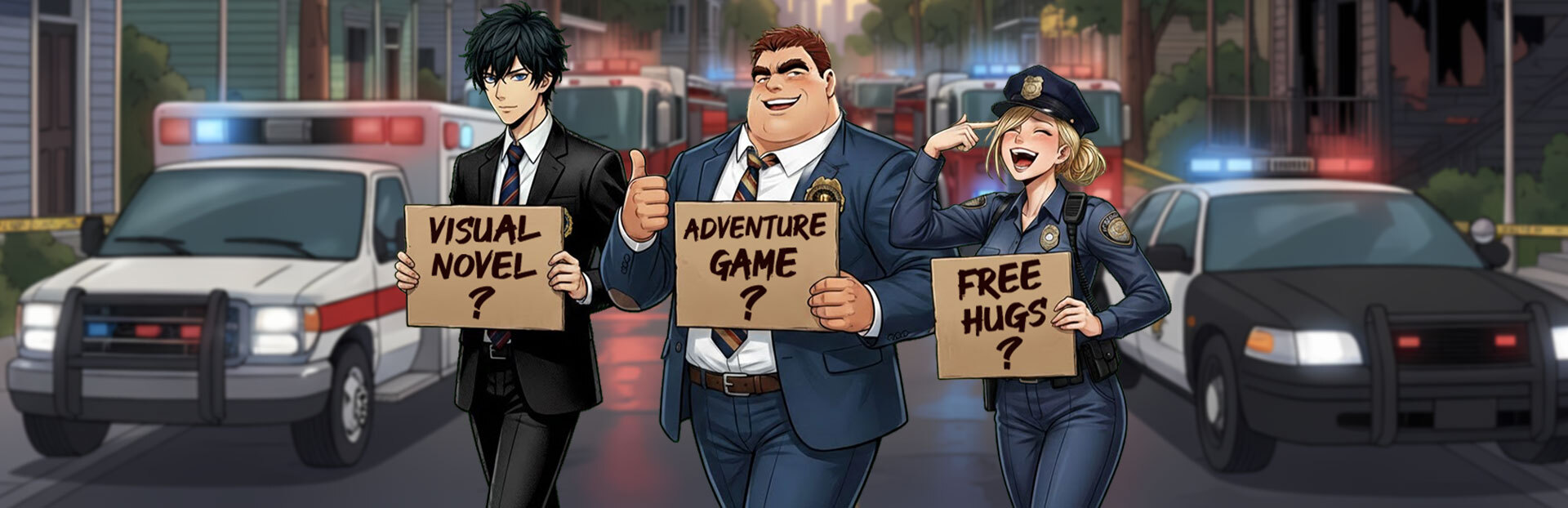
I don't think I'm taking too much of a risk in saying that Profiler Files is a difficult game to categorize – a bit like Capcom's Ace Attorney series. At first glance, you might mistake it for a classic visual novel. But dig a little deeper, and you'll quickly realize it diverges considerably. The narrative branches are far more numerous, the dialogue choices infinitely more consequential, and their impact sometimes enormous on the course of the story.
But what truly sets Profiler Files apart are its investigation and psychological profiling mechanics. These systems aren't mere narrative ornaments: they're the beating heart of the gameplay. Your brain will be put to the test, your ability to read emotions and subtext constantly challenged. And trust me, your deductions – or your mistakes – will sometimes radically influence the trajectory of the plot.
That's precisely why I prefer to define Profiler Files as a narrative adventure rather than a visual novel in the strict sense. The nuance may seem subtle, but it's fundamental to my vision for the game.
The Tyranny of Pacing: Fewer Words, More Impact
Let's be honest: visual novels can be extremely wordy. Sometimes excessively so. Entire paragraphs of internal monologue, conversations that drag on forever, descriptions piling up until they dilute the very essence of what's being said. I wanted to break with that tradition. Minimize player passivity at all costs.
To achieve this, I drew more inspiration from the sharp, tight pacing of modern TV series – where every line matters, where every scene maintains tension. Razor-sharp dialogue that keeps you constantly alert, that forces you to stay focused because a crucial detail could emerge at any moment.
I favor short but punchy episodes where boredom simply doesn't have time to set in, rather than endless conversations that risk exhausting the player. And this approach isn't just about comfort: it's vital to the game experience.
If your attention drifts because of overly stretched dialogue, you risk missing essential clues – or worse, skipping them out of weariness. That would be a disaster, both for you and for me! Imagine: missing a subtle detail that changes everything simply because you mentally checked out three minutes earlier. Frustrating, right?
Episodes Calibrated to the Millimeter
That's also why each episode of Profiler Files wraps up in under an hour. To preserve that pacing. To guarantee replayability. To let you experiment with different approaches without feeling crushed by too much time commitment.
Take the very first episode as an example – the one you can play in the demo. It's the shortest of them all, since it also serves as a tutorial. In certain configurations, you can technically complete it in 10 minutes. That quick ending might not be the most narratively satisfying, but nothing stops you from jumping straight into the next episode (well, not in the demo, of course).
But here's the thing: depending on your choices, your observations, your approach to profiling, that same episode can easily last 20, 30 minutes, or even longer. And most importantly – this is crucial – you'll never hit a game over, right up until the very end of the game. No narrative dead ends. No invisible wall forcing you to restart. Just different paths, distinct consequences, alternative truths.
Point'n'Click and Freedom of Investigation
Beyond the psychological profiling (I'll come back to that in detail in a future Profiler's Log, I promise!), the game also features investigation sequences that borrow more from point'n'click adventure game DNA than from traditional visual novels.
Sure, there's no inventory per se – no "use this item with that one" system like in Ace Attorney. But you'll still need to uncover objects and clues scattered throughout the environment. The difference? You decide when you've finished your observations, not the game.
You can examine everything meticulously, miss clues through inattention, or even deliberately overlook everything: there will never be a dead end. Only narrative variations, alternative outcomes, different revelations. That's precisely why Profiler Files doesn't hold your hand by highlighting interactive areas in point'n'click sequences. Your profiler's instinct is you. Your curiosity dictates the pace of the investigation.
Steam post image (Yeah, it doesn’t look like it, but this part of the game is actually point‑and‑click!)
Surprises at Every Turn
I could go on for a long time about the other occasional mechanics that enrich the experience, breaking any sense of routine. Each episode has its own particularities, its unique gameplay or narrative devices, its little subversions of expectations...
But I'd rather let you discover them for yourself. It would be really inconsiderate of me to spoil those moments. They're part of what makes each episode memorable, and I want to preserve that element of surprise.
Steam post image (A FBI investigation game without an autopsy scene? Unthinkable! Yes, the screenshot's in French. Deal with it.)
And that's it for this Profiler's Log! I hope this behind-the-scenes dive has given you a clearer picture of what makes Profiler Files tick. Don't hesitate to share your thoughts: your feedback is invaluable for continuing to shape this experience.
See you very soon for the next episode of this dev diary!
Source
Changelog.gg summarizes and formats this update. How we read updates.