
Full notes
Full Orion's End update
Read the full published notes in a cleaner layout. The original post stays linked below.
What changed
- Maps
- Gameplay
- Events
- UI and audio
Orion's End changes
Hi Everyone
I feel like I’m reaching a really good stage with the development of Orion’s End. Instead of feeling like the game needs more mechanics implemented, I’m feeling like it needs more content. While that might be just as time consuming, if not more so, it does mean the project is creeping closer to being a "game". A real game. Not just a collection of loosely fitting mechanics and ideas.
The approach I’ve been taking towards development so far has been using a variation of the “snowflake method” used for writing novels - as created by author and theoretical physicist Randy Ingermanson. Essentially, I’d add a bunch of features to the game with only the barest of mechanics to them, so they at least exist in a simple form. Then, I’d go through each of them and add more details and complexity to the feature. Each aspect of a feature could be broken down into smaller parts, improved and grown upon one piece at a time.
This has meant the speed of development of Orion’s End seemed to be very fast in its beginning stages, but gradually slowed down as time passed. That might be testing some peoples patience, and I can appreciate that. But on the bright side, it has also meant that entire aspects of the game could be reinvented along the way, without wasting a lot of time and hard work on polished mechanics that were only removed later.
Example of my Snowflake Game Dev
To illustrate the point, let me give an example of how space travel has changed over time.
Travel between planets was originally a straight line, dodging ships and asteroids in a way similar to (and inspired by) an old combat racing arcade game called Spy Hunter. I didn’t know at the time if this would be the final space flight method, but I needed some way to get between planets.
Early space travel
Then I decided I wanted more exploration, so I went for an open solar system - with one planet and one star, and flight in the style of the arcade game Asteroids. Exploration of the star system was possible, so you would be able to discover things in the out skirts of the system. Warping between systems would be fast.
After working on other features for a while, I came back and added multiple planets, each in their own orbit, moving around the star as time passes. Warping was still fast, but slow travel between systems was now possible too, opening up empty sectors between stars as possible places to explore.
Now, a planets distance from the star affects the planets temperature, the presence of life, and if it’s likely to be inhabited.
Current space travel
In the future I plan on implementing even finer details to the star systems and their planets.
So what?
The reason why I brought that up was to provide an insight into how I work, but also to provide some understanding of the nature of features I announce in dev logs like this. I’ve added a few things recently. Some might appear more significant than they are, and others may seem more trivial, but they are just at different stages of the process.
Farming
Orion’s End is not a farming sim and it never will be. However, when I build a home base I may want to beautify it with a garden. Other people may want to grow some vegetables. Others may want to create a botanic garden of plants from samples across the galaxy. And I want any of that to be possible.
So farming now works. You can harvest seeds from older plants that have gone to seed, plant them, water them, and grow them, and harvest for food or flowers. There's an automated irrigation system that works using the already functioning fluid system (oil or water in barrels, that can be broken, spread and ignited etc).
This is an example of the first implementation of a system in game. It is very rudimentary, but it works. Later, I’ll add more depth to it and it will “grow” more interesting.
A little farming is possible but not essential
Flammable liquids can create a little chaos
NPC Behaviour
NPCs come in two varieties. The first are hand crafted NPCs, such as Olar or Scrappy on Baucoi, who all have their own unique storylines and quests. They will be the most interesting I expect. The second type is the Proc Gen NPC. I have the fun challenge of making them as interesting as the handcrafted ones. I have a few methods in mind to do that, but they aren't implemented yet.
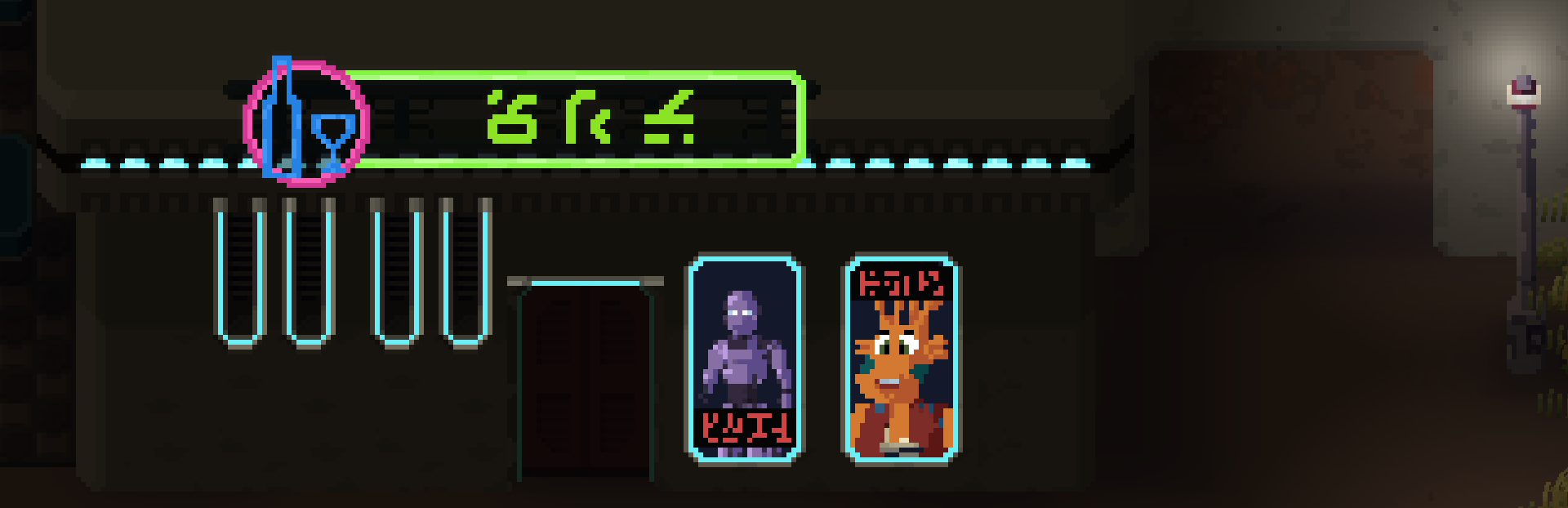
The thing they all have in common though, is their moment to moment behaviour, which is driven by a few factors. Until recently, they have wandered around town with no purpose other than making the town feel alive. That was the first implementation of the NPC. Then I added a weekly schedule, that gives them something to do at particular times of the day and week. They get out of bed at a certain time, go shopping, visit friends, go to the bar, and go home. Everyone has a different schedule based on personality traits. This is working now but needs more depth.
Some NPC like to hang out at the bar in the evening
The other thing that has been working for a while is reactions to aggression. Some people will join a fire fight, while others will run away. It’s basic, but it’s just one iteration of the mechanic. This will continue to be refined and added to.
Soon I will be working on combat behaviour. I look forward to that. The current model is very simple and not very smart.
Something else that will come in a future iteration is ... boring old everyday behaviour. If the NPC goes to the shop to buy something, they will actually buy it and it will be added to their inventory. There will also be more banter between NPCs in the their mini voice balloons.
Quests
I have been working on a simpler to implement and more versatile quest system that will make adding more content easy. Quests for handcrafted NPC used to be different in structure to proc gen NPC, but I’m currently in the process of merging them into a new form. This is partially done, but I’m implementing it gradually so I don’t break things.
Mini games
This is a fun part. Sometimes I need to step back and have a break from working on Orion’s End. So what do I do then? Well, I create a mini game that I can incorporate into Orion’s End, of course. I plan on having a range of arcade games that you can play – cabinet and handheld. The first one in the game so far is inspired by a handheld video game I had as a kid. It really shows my age, and it might not appeal to many people, but the games that will feature in Orion's End won’t be just for fun. I plan on having each one tie into a story, or quest, or location in some way. To give a reason to engage with them, and reward those who do.
Mini games in the form of ... mini games!
Safe Travels
Dave
Source
Changelog.gg summarizes and formats this update. How we read updates.