
Full notes
Full NULLSPACE update
Read the full published notes in a cleaner layout. The original post stays linked below.
Repeated intro
Hey everyone,
What changed
- Gameplay
- Balance
NULLSPACE changes
We’ve been working on Nullspace for a while now, and we want to start sharing more of the world behind it. Let’s begin with the Hegen Republic, and walk you through our visual-first approach: we started with a direction, developed the aesthetics, then built the lore around what the design suggested.
For the Hegens, we were originally inspired by brutalist design, which our concept artist interpreted as bunker-like superstructures and tiered decks that visually reflect a stratified society.
Originally, we intended the ships to be built out of literal concrete, with a sandstone coloured grooved concrete finish ala 1960s British brutalist buildings, or the Harkonnen ships from Villeneuve’s Dune. Extending the British brutalism analogy, we envisioned the ships aging like buildings such as the Tricorn and Barbican: structures that began as spectacular heralds of the future to dilapidated symbols of misplaced optimism. We wanted Hegen ships to share the same aesthetic, reflecting the decay of power.
While the concept art was exciting, it didn’t look right ingame. We found the concrete material didn't look interesting and often gave the ships an unfinished look. After much deliberation, we switched to ordinary metal shading while still retaining the core brutalist aesthetic.
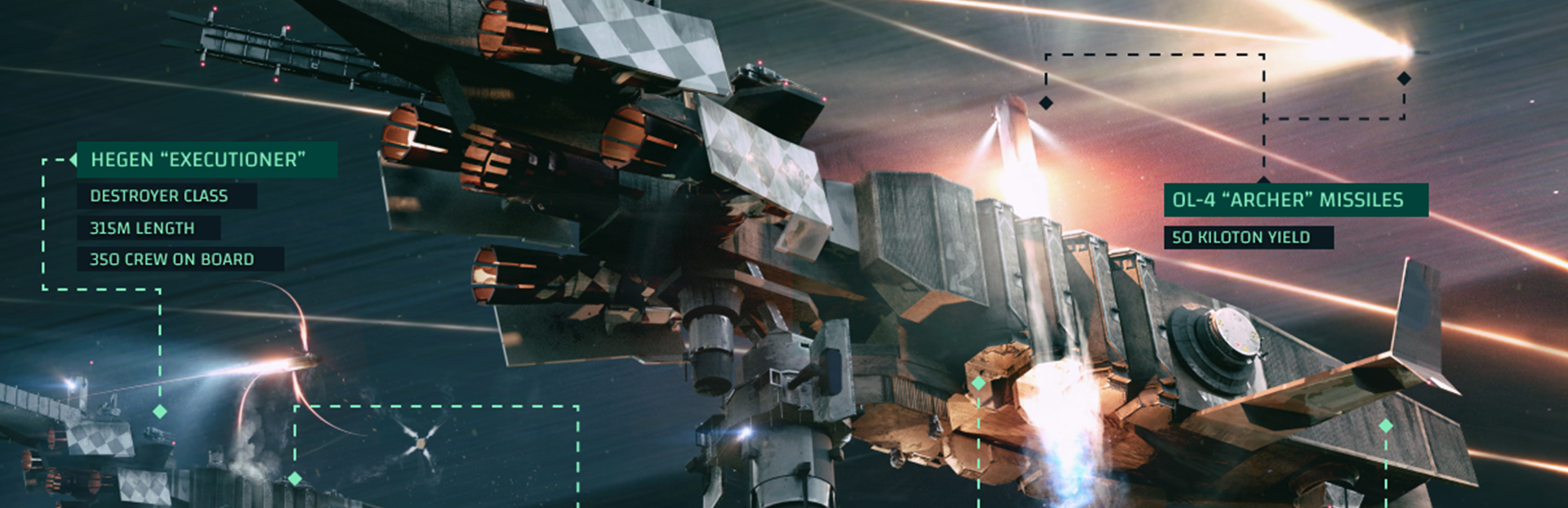
Here is the result: one of the earliest ships we designed for the Hegens.
The Hegen "Executioner"
The Hegen "Executioner" is a 315-meter destroyer with a crew of 350. Built on the “brutalist” idea, it is not meant to look sleek or sophisticated. The goal was to have a ship that keeps working, no matter the situation.
That thinking led the Hegens to prefer missile ordnance over firing massive kinetic rounds. The missiles are less precise but are devastating and offer better battlefield coverage. To maximize carrying capacity, the “Accord” missiles are manufactured on demand from raw materials stored within.
The missile itself, the QL-4 “Archer”, has a 50 kiloton yield. Not especially powerful by today’s nuclear ordnance standards, but this is deliberate: explosions work differently in space, where larger yields are not necessarily more devastating. To maximise effectiveness, much of the missile mass consists of tamping material that converts radiation into kinetic energy.
Their armor follows the same line of thought. Standard Ledger Composites aren’t cutting-edge, but they’re easy to produce. Focusing on missile warfare means that the Hegen Destroyer can take out its enemies from a much greater distance, eliminating the need for heavy plating to withstand direct fire.
The Executioner is Hegen doctrine made metal: practical, standardised, and destructive.
Terra Magna
This is Terra Magna, the capital world of the Hegen Republic. The concept began with a simple question: what kind of world would build ships like the Executioner?
For this, we drew heavily from Ancient Greek history.
Terra Magna has a population of around 371 million, spread across 280 cities built to the same civic plan. Their layouts, infrastructure, and architecture are deliberately repeated. Once something works, the Hegens refine it, standardise it, and scale it.
Energy is generated from Hygropower Harvesters, designed for mass production and consistent output. Given Terra Magna’s high humidity, these harvesters efficiently generate power directly from the atmosphere. This focus on sustainability directly complements their brutalist principles, stemming from Old Earth’s collapse and the rarity of habitable worlds.
At the centre of Terra Magna’s history is First Liberator Magnus, loosely inspired by Solon of Athens.
Magnus led the Hegen colonies to independence around 240 years ago. Since then, the Republic has had 52 Liberators, with Liberator Titus VII currently presiding over the state.
We’ll discuss the politics of Nullspace in a later post. For now, it is worth seeing the other factions first, because the Hegens only fully make sense in relation to the powers around them.
Order, Unity, Liberty
This final image shows their banner and the ideas they’re built on:
Order. Unity. Liberty.
These ideas were there early, but their meaning evolved over time as we developed the faction. They represent structure, coordination, and a system that holds together under pressure.
At the same time, they raise questions about how much flexibility exists within a system where everything is designed to fit. We’re still shaping parts of the Hegen Republic as we go, but this is the foundation we keep coming back to:
A faction that doesn’t see itself as oppressive.
A system that believes it’s doing the right thing.
And a version of the future that, in some ways, actually works.
That’s what makes them interesting for us. Not whether they’re right or wrong, but figuring out how such a group would exist.
We’ll be sharing the other factions soon, and they don’t all see the galaxy the same way.
For now, we’re really curious what you think. Thank you!
The Kaigan Team
Source
Changelog.gg summarizes and formats this update. How we read updates.