
In this update5
Full notes
Full Nightwatch at the Hopkins' Cliffside update
Read the full published notes in a cleaner layout. The original post stays linked below.
What changed
- Performance
- Gameplay
- Events
- Maps
- UI and audio
Nightwatch at the Hopkins' Cliffside changes
Hi everyone!
In this DevLog, I want to talk about the environment and map design of Nightwatch at the Hopkins' Cliffside. Creating a space that feels immersive, functional, and visually interesting has been one of the biggest challenges for me so far, especially since this is my first time designing a large, detailed environment. I had to balance gameplay flow, optimization, and atmosphere while making sure everything fits together in a way that actually makes sense. So, let’s go over some of the game areas and what I’ve learned along the way!
Designing the Hopkins Estate
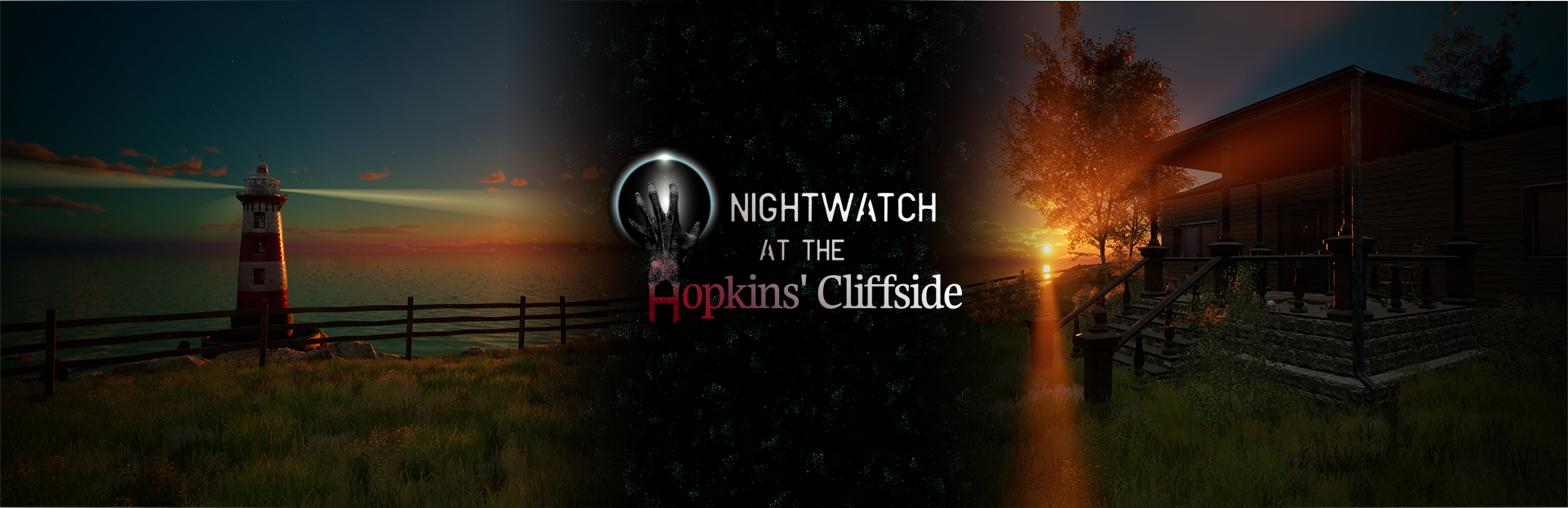
The Hopkins Estate is the main structure in the game, and its layout plays a huge role in gameplay. The house is designed to look semi-realistic while also providing opportunities to loop enemies (which I’ll cover more in the next DevLog). It needed to feel lived-in, eerie, and slightly unfamiliar, even though it's just a simple house.
A small detail I can share is that when deciding on the game's title, another strong contender was Nightwatch at the Hopkins' Estate. However, since a significant portion of the gameplay takes place outside the house, the name Cliffside felt much more fitting.
Since this was my first time designing such a large indoor space, I quickly realized that adding details is a lot more time-consuming than I expected. Something as simple as bookshelves became a challenge—I didn’t want them to look too repetitive, but individually placing books would have taken hours and hours of tedious work. My solution was to create several different bookshelf variations and then mix them up to make the placement feel natural without being too much work.
Another example is furniture arrangement. It was tempting to just throw down assets and call it done, but I wanted the layout to feel natural — like a space Hopkins would have actually lived in. As I mentioned earlier, the corridors and rooms needed to be designed as loops, ensuring the player always has an escape route. When working on the bathroom, I thought, "I can’t just make a hole in the wall and call it a day." Ironically, that’s exactly what I ended up doing.
The Lighthouse
The lighthouse was an interesting challenge to model, mainly because of its staircase. In most games, lighthouses have cylindrical interiors with separate staircases leading between floors, making them functionally similar to towers. I wanted to try something different—a true spiral staircase that narrows as it reaches the top.
It turns out that making a structure like this isn’t as simple as just shrinking the staircase while going upward. The narrowing outer radius created all sorts of alignment issues, and I had to experiment a lot to get it right. It was an oddly tricky challenge, but I learned a lot from it, and I think it adds to the authenticity of the space.
The Cliffside
The cliffs and surrounding landscape play an important role in Nightwatch at the Hopkins' Cliffside. The waves below are calm and peaceful, contrasting with the eerie atmosphere of the night.
On top of the cliffside, there’s a lot of plant life—grass, bushes, and a forest area. Optimizing this flora was a challenge, because I needed the environment to look good both at night (when distant details aren’t as visible) and during the well-lit beginning and end of the game. If the game only took place at night, I could have used more aggressive LoD (Level of Detail) settings to reduce poly count in distant trees without noticeable impact (which basically means that things further away look awful). However, since parts of the game happen in good lighting, the trees needed to have high enough detail to look good from a distance as well. Unfortunately, Unreal Engine doesn’t allow dynamic LoD switching during gameplay, as it would cause giant lag spikes, so I had to find a balance that works throughout the entire game.
One of my favorite parts of the cliffside is Hopkins' old vegetable garden. It's completely overgrown now, but it adds a nice touch of realism—Hopkins must have used it for food while living here. From a gameplay perspective, the fences around the garden also create interesting paths and small looping spots, adding a bit of strategy to the area.
Weather Cycle
To make each nightwatch feel dynamic, I implemented a four-stage weather cycle that progresses throughout the game, indicating how far along the night player is:
Calm Night – A quiet, peaceful start with gentle cricket sounds in the background.
Windy Night – The wind picks up, creating a sense of unease—the calm before the storm.
Rainy Midnight – The atmosphere gets heavier as rain begins to fall, making the night feel colder and more oppressive.
Stormy Dawn – The rain intensifies and occasional lightning appears as the game reaches its climax.
One of the things I paid special attention to was the clouds. They change in gradient and density throughout the night, adding to the atmosphere and making the sky feel alive.
The different stages of the night also affect the anomalies that can appear. Some anomalies only manifest during specific night stages, meaning the longer you survive, the stranger things become. Early in the night, you might notice something subtle, like a few floating rocks. But by dawn, you could be facing massive, reality-breaking disturbances like a wrecked cargo ship flying in the sky.
Final Thoughts
Overall, my goal was to create an environment that feels semi-realistic while also allowing for creative and unsettling elements. I also added a few things just because I thought they were neat and mainly because I could.
That’s all for this DevLog! Next time, I’ll be talking about the enemies in Nightwatch at the Hopkins' Cliffside—what they are, how they behave, and how you’ll need to outsmart them to survive.
Don’t forget to wishlist Nightwatch at the Hopkins' Cliffside on Steam and stay tuned for more updates!
Source
Changelog.gg summarizes and formats this update. How we read updates.