
In this update3
Full notes
Full Lost Ruins of Arnak update
Read the full published notes in a cleaner layout. The original post stays linked below.
What changed
- Gameplay
- Events
- UI and audio
Lost Ruins of Arnak changes
We encountered signs of an advanced civilization on Arnak almost immediately. From the moment we ventured even a short distance from our base camp on the coast, it was clear that this wasn't the untouched wilderness we originally thought it was.
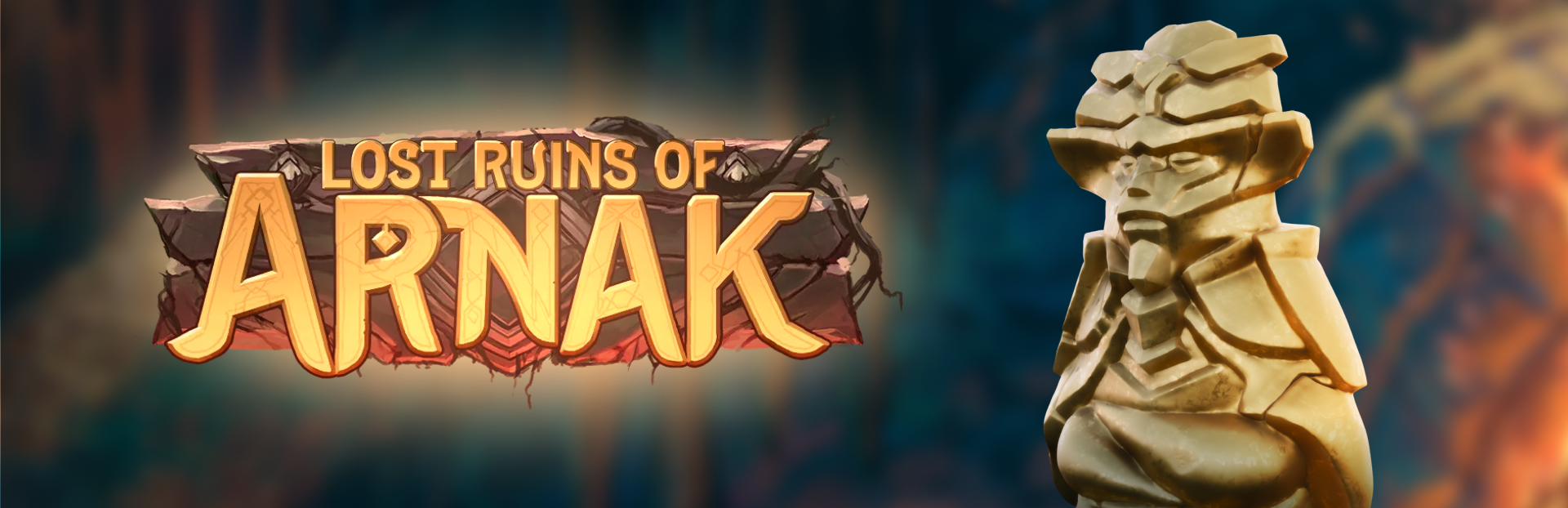
One of the first pieces of evidence of the lost civilization was a small golden statuette. Or rather, I should say statuettes. The first was discovered by Captain Jack Callaham in a modestly furnished cave near the waterfalls, roughly three kilometers from our camp. It rested in a niche carved into the cave wall—likely an improvised altar of some kind.
The figure appears to depict a local deity, a person of high standing, or perhaps an island spirit. We don’t know for certain. What we do know is that we gradually uncovered virtually identical statuettes in several other locations across the island. Wherever we ventured, these golden figures seemed to be watching over the ruins. It is clear they held great significance for the island’s former inhabitants.
For this reason, several specimens were among the first artifacts to leave the island. We hope that archaeologists and religious scholars from prestigious universities will uncover new insights in their research that help us better understand the beliefs and rituals of the people who once thrived in this remarkable place.
In-Game Functionality
In Lost Ruins of Arnak, idols are represented as special tokens that players earn as a reward for discovering new locations. Each idol comes with several benefits.
First, it provides an immediate effect—such as gaining a free resource, upgrading a resource, or exiling a card from your deck.
But that’s not all. Each idol is also worth 3 victory points at the end of the game. And most importantly, at any point later in the game, an idol can be placed into one of the designated slots on your player board to gain one of up to seven rewards. Five of these are shared by all players. If you are playing as one of the Leaders, up to two additional rewards or actions on your board are tailored specifically to your character.
Idols are often the game-changer that allows you to access precious resources and push your strategy forward—not just in temple research. Interestingly, this action is often undervalued by beginners, yet choosing the right moment to activate an idol is one of the core elements of skilled play.
Why a 3D Model?
Unlike resources, the idols in the physical board game are represented by classic double-sided tokens. One side shows the immediate reward for gaining the token, while the other depicts the statuette itself, along with a reminder of the 3 points the player earns at the end of the game.
When creating the digital version of Lost Ruins of Arnak, we decided to stay true to the original while also providing the most pleasant experience possible—both in terms of controls and visual appeal. We looked at every element in the game and considered how it could be improved to make it clearer and more satisfying to use on screen. Where it made sense, we rebuilt elements entirely from scratch.
The idol was one such case. We chose to bring it to life in full 3D within the game interface. Our animator spent roughly two days refining the model before he was satisfied with the result.
Once the model was finished, we thought it would be a great idea to offer it to fans of the game who might want to decorate their gaming tables or shelves with it. We made a few small adjustments so the model would look good even when printed on a home 3D printer.
You can now download the result of our work for free.
It’s an STL file that allows you to print the idol on almost any standard 3D printer. We recommend spraying the finished model with primer—and perhaps even painting it for an extra touch of authenticity. If you decide to go for it, don’t forget to show off your photos. We’re curious to see your creations.
Source
Changelog.gg summarizes and formats this update. How we read updates.