
Full notes
Full Korea. IL-2 Series update
Read the full published notes in a cleaner layout. The original post stays linked below.
Repeated intro
Hello, comrades!
What changed
- Gameplay
- Maps
- Events
Korea. IL-2 Series changes
As promised, this issue is dedicated to nature, virtual nature in "Korea: IL-2 Series."
Nature is a very important aspect of any simulator, because it’s what we see most of the time as we scan the surroundings in search of targets. Nature helps immerse us in the game world when we see it around the airfield at the start, before takeoff. Nature also dictates the rules of combat. That’s why the environment needs to be as realistic, high-quality, and natural as possible.
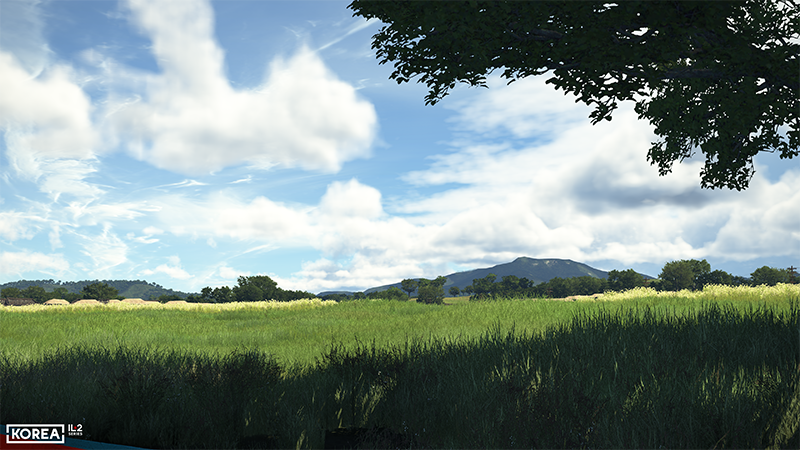
Earlier, in various videos and screenshots, you saw grass and trees in Korea, but those were technical prototypes and temporary solutions. And only now are we finalizing the appearance of the flora in our new simulator.
To achieve this result, we refined numerous aspects of the graphics engine’s various technologies. Additionally, our artists thoroughly re-examined the methods and approaches used in Great Battles. They created new ones for Korea to achieve a more detailed, diverse, and realistic depiction of nature. As a result, the flora in Korea has reached a whole new level of visual quality, detail, and realism.
A lot of work went into finding the right color schemes, proportions, textures, and natural patterns. We had to start from scratch with all of this because of new technologies and lighting. If you look at past Dev Blog issues and Dev Brief videos, you’ll notice that in early screenshots, the ground looks dark and uniform, and objects appear unnatural against that background. This is precisely due to the use of temporary textures and approaches to their color ratios, but new technologies require new parameters. Now, however, the environment features more detail and variety. Nature appears and is lit much more naturally.
It’s also important to note that all of this is the result of manual work, not photogrammetry of the terrain. No matter how good photogrammetry may be as a tool, it does not allow us to obtain data from the past. Therefore, we had to manually create new texture atlases, determining their location and distribution, while relying on both real photogrammetric data and historical aerial photographs. And we had to do all of this across the largest area in the series, with a higher density of detail.
Thus, the quality improvement is evident not only in scale but also in the level of detail applied to every square meter of the surface. Of course, it was crucial not only to add naturalism, variety, and historical authenticity but also to accomplish all of this within a reasonable development timeline. As a result, working on the environment became yet another challenge, requiring us to combine creativity with truly interesting engineering tasks. You can now see for yourselves what we’ve achieved.
The grass is no longer a monotonous carpet; it is now highly varied and depends on where it grows: at the airfield, you’ll see short grass with patches of bare ground, while in wild meadows, you’ll find tall thickets. In rice paddies — rice crops. And everywhere — diversity and an absence of monotony. The grass has become denser; its height depends on the natural context in which it grows, and a variety of species has emerged.
Trees have been given a fundamentally new lighting technology, allowing for a qualitatively new level of realism in the texture of their trunks and foliage. Tree canopies, letting light through, are illuminated not only from the sunny side but also from the opposite side with diffused light. New approaches to creating tree content have made it possible to achieve a level of visual realism previously unattainable.
The increased density of forest stands and the new lighting mentioned above have made the view of forests from above much more realistic and breathtaking. And, of course, the tree species featured in “Korea” were selected in accordance with the natural biodiversity characteristic of those regions. Overall, the entire natural landscape of the Korean terrain differs greatly from anything we’ve done before, which also didn’t make implementation any easier.
Another new feature for us in Korea is the technology for bushes and rocks. These seemingly small elements greatly enhance the detail and natural feel of the landscape in the midground and foreground. Framing forest edges, roads, and rivers with bushes gives them a much more realistic overall appearance. Combined with a new approach to the texturing of road shoulders and riverbanks, this leads to a new level of graphical realism and immersion in the game world. Mountain river rapids, hillside and foothill scree slopes, and some riverbanks are adorned with rock outcrops. These are entirely new natural landscapes for us.
Speaking of nature and the landscape, we must mention the completion of our search for a landscape texturing solution and its successful implementation. A completely new set of textures for wild natural wilderness and agricultural zones has been developed. Whereas previously you could only see prototype solutions in the screenshots, now the entire set of landscape textures — both natural and urban — is practically complete, and you can finally observe a result that is close to the final version.
For the first time, we have applied full-scale additional texturing to road shoulders and significantly revised and refined our approaches to riverbank and coastal design. Agricultural fields have been modeled to match their appearance in Korea in the 1950s, based on available aerial photographs and agricultural data. We have fully implemented color parallax surface technology, which has allowed us to make the textures of field paths, trails, and minor streets more realistic in the foreground and add variety to the appearance of the ground.
In the future, we plan to show you the industrial zones in Korea, and a little later, the different seasons. After all, so far we’ve only shown you summer images, but Korea will have a total of 5 seasons! To make sure you don’t miss these updates — subscribe to our channels and social media YouTube, Facebook, Reddit, X, and Discord, and follow the news. Stay in touch!
Source
Changelog.gg summarizes and formats this update. How we read updates.