
HomeGamesUpdatesPricingMethodology
Steam News9 March 20263mo ago

Developer Log: The Same Dao Before and After

Lately, we have been returning to the same question again and again: If this world is not random, can the player truly see why it becomes what it becomes? For a long time, we were already able to make the systems run.

Full notes

Full Jingjie: Signals update

Read the full published notes in a cleaner layout. The original post stays linked below.

What changed

0 fixes3 additions2 changes1 removal
  • Gameplay
  • UI and audio
addedSo this update is not just about adding more content. It is about trying to reveal causality itself.
removedIn Phase 7, we reworked the Bagua observer into something closer to a true causality monitor. It no longer only shows a dominant trigram, a secondary trigram, or a handful of abstract values. It now tries to answer a fuller question: how a particle’s symbolic state gathered from the past, how it takes shape in the present, and how it leans toward the future. Dominant trigram, secondary trigram, transitions, conflict bands, and modulation gains are no longer scattered indicators. They are being shaped into a readable chain.
addedWe also added a second layer of language here, something older in tone. Not to turn the system into fortune drawing, and not to wrap it in mysticism, but because we think people naturally seek a sentence that can be felt as well as understood. So now the causality axis in Phase 7 carries not only a modern explanation, but also a brief oracle-like line. It does not replace logic. It echoes it. The modern layer explains; the classical layer resonates.
changedIn Phase 8.5, our attention moved to a smaller scale. The question there is not “how does the trigram evolve,” but “why did this particle move this way in this frame?” So we built a clearer execution chain: prior-frame state, neighborhood conditions, P3 parameter shaping, P2 force realization, and finally P4 deterministic perturbation. We want the player to see not only the outcome, but how the outcome is pushed into being, step by step. Not motion as mysticism, but motion returned to an intelligible order.
changedThis has also slowly changed what “awakening” means to us.
addedIt is not suddenly discovering a secret. It is not inventing a new world. It is not forcing a story onto chaos.

Jingjie: Signals changes

addedSo this update is not just about adding more content. It is about trying to reveal causality itself.
removedIn Phase 7, we reworked the Bagua observer into something closer to a true causality monitor. It no longer only shows a dominant trigram, a secondary trigram, or a handful of abstract values. It now tries to answer a fuller question: how a particle’s symbolic state gathered from the past, how it takes shape in the present, and how it leans toward the future. Dominant trigram, secondary trigram, transitions, conflict bands, and modulation gains are no longer scattered indicators. They are being shaped into a readable chain.
addedWe also added a second layer of language here, something older in tone. Not to turn the system into fortune drawing, and not to wrap it in mysticism, but because we think people naturally seek a sentence that can be felt as well as understood. So now the causality axis in Phase 7 carries not only a modern explanation, but also a brief oracle-like line. It does not replace logic. It echoes it. The modern layer explains; the classical layer resonates.
changedIn Phase 8.5, our attention moved to a smaller scale. The question there is not “how does the trigram evolve,” but “why did this particle move this way in this frame?” So we built a clearer execution chain: prior-frame state, neighborhood conditions, P3 parameter shaping, P2 force realization, and finally P4 deterministic perturbation. We want the player to see not only the outcome, but how the outcome is pushed into being, step by step. Not motion as mysticism, but motion returned to an intelligible order.
changedThis has also slowly changed what “awakening” means to us.

Lately, we have been returning to the same question again and again:

If this world is not random, can the player truly see why it becomes what it becomes?

For a long time, we were already able to make the systems run. Particles could gather, patterns could emerge, and certain moments could feel strange, sudden, or even larger than what we originally designed. But the further we went, the less satisfied we were with simply saying, “it happened.” What we wanted to ask next was:

Why did it happen? Where did it come from? Where is it tending to go?

So this update is not just about adding more content. It is about trying to reveal causality itself.

In Phase 7, we reworked the Bagua observer into something closer to a true causality monitor. It no longer only shows a dominant trigram, a secondary trigram, or a handful of abstract values. It now tries to answer a fuller question: how a particle’s symbolic state gathered from the past, how it takes shape in the present, and how it leans toward the future. Dominant trigram, secondary trigram, transitions, conflict bands, and modulation gains are no longer scattered indicators. They are being shaped into a readable chain.

We also added a second layer of language here, something older in tone. Not to turn the system into fortune drawing, and not to wrap it in mysticism, but because we think people naturally seek a sentence that can be felt as well as understood. So now the causality axis in Phase 7 carries not only a modern explanation, but also a brief oracle-like line. It does not replace logic. It echoes it. The modern layer explains; the classical layer resonates.

In Phase 8.5, our attention moved to a smaller scale. The question there is not “how does the trigram evolve,” but “why did this particle move this way in this frame?” So we built a clearer execution chain: prior-frame state, neighborhood conditions, P3 parameter shaping, P2 force realization, and finally P4 deterministic perturbation. We want the player to see not only the outcome, but how the outcome is pushed into being, step by step. Not motion as mysticism, but motion returned to an intelligible order.

This has also slowly changed what “awakening” means to us.

It is not suddenly discovering a secret. It is not inventing a new world. It is not forcing a story onto chaos.

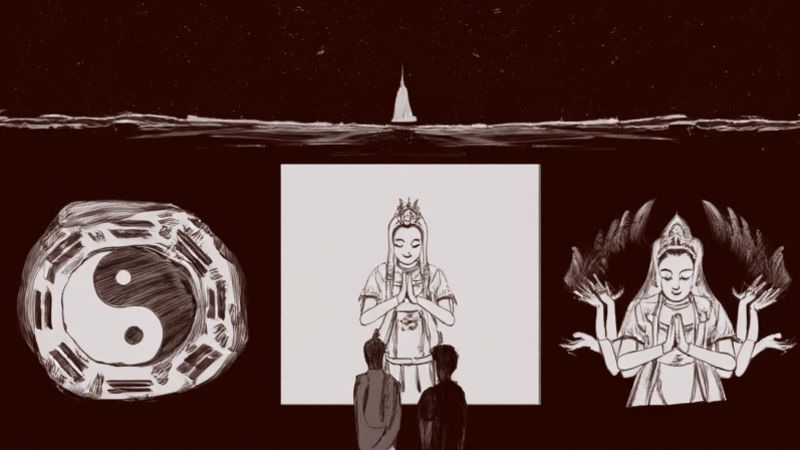
It feels more like a moment when you realize that the Dao of the future and the Dao of the past were always the same line. Awakening is not the creation of order. It is the recognition of order.

This update is still far from that ideal. Many explanations are still rough. Many interfaces are still in motion. Many expressions are not yet close enough to what they are trying to say. But at least we have taken one more step: the system is beginning to answer “why.”

Thank you for continuing to walk with us as we try to move this world from merely running toward being understood.

If you want, I can also turn this into:

  1. a shorter Steam-ready devlog version

  2. a more poetic manifesto-style version

Source

Steam News / 9 March 2026

Open original post

Changelog.gg summarizes and formats this update. How we read updates.