
Full notes
Full ILL update
Read the full published notes in a cleaner layout. The original post stays linked below.
What changed
- Gameplay
- UI and audio
- Balance
ILL changes
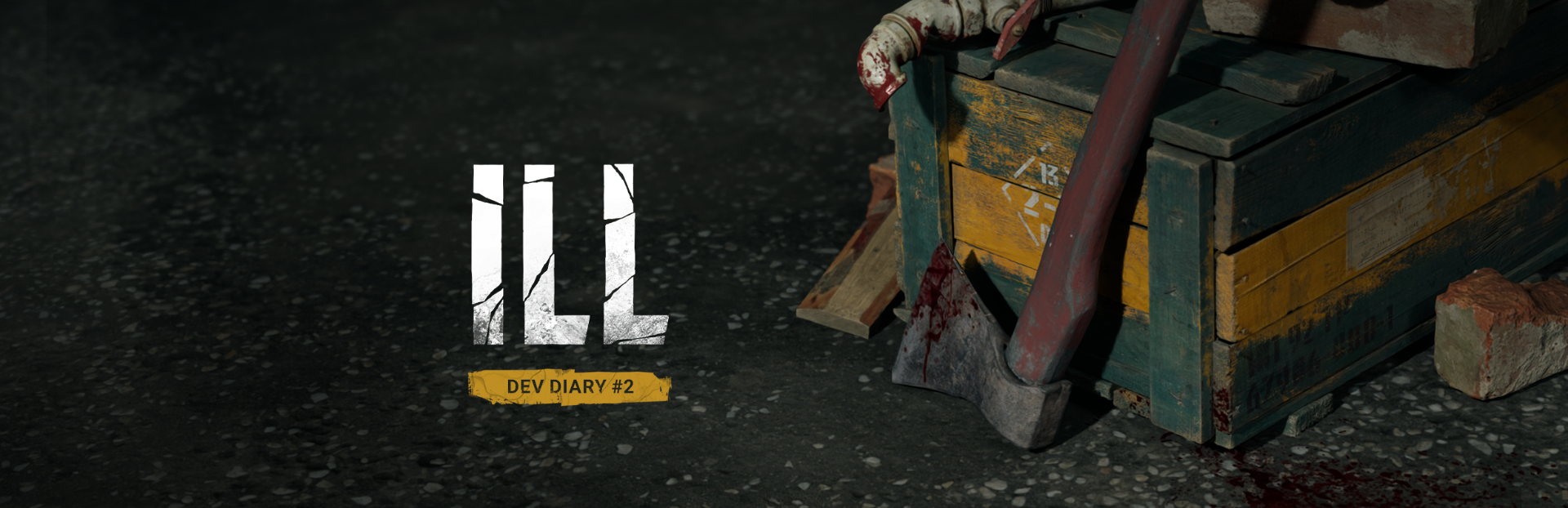
Welcome to the second entry in our Dev Diary series. This time, we’re taking you behind the scenes of melee weapon creation. We start with ordinary real-world objects, break them down - sometimes quite literally - and rebuild them into melee weapons that feel heavy, dangerous, and fully grounded in the world.
Weapons that already lived a life
One of the early decisions that shaped our entire approach was this: you almost never find a “fresh from the factory” weapon in our game.
By the time the player picks something up, it has already belonged to someone or come from somewhere. It might have been a personal sidearm, a trophy, a gift, or simply a tool that was used far past the point of good sense. That history has to be visible: in cracked grips, taped handles, chipped metal, and improvised fixes.
That philosophy has become especially important for melee weapons.
The pipe in the stairwell
If there’s one story that encapsulates our approach, it’s the pipe.
At some point in production, someone on the team sent a photo from the stairwell of the building where they grew up: a classic, slightly grimy, very recognisable vertical pipe running along the corner of a landing. Nothing glamorous, nothing cinematic - just a piece of real, lived-in architecture.
That pipe became our starting point.
We studied its proportions, how it attached to the wall, the dents, the chipped paint, the way it sat in the environment. It was modeled for the game very closely to the reference… and then, eventually, we had to let it go, because we decided to make a better fit for the game’s world. But that is something we’ll elaborate on further.
The original pipe from the stairwell never made it into the game as-is - but it did its job. It anchored us. It forced every later decision about our “pipe weapon” to answer to something real: would this shape exist, would it be mounted like that, could it plausibly break this way?
Tearing the world apart (On a playground)
Another key decision was that melee weapons in our game shouldn’t always be politely waiting on tables and in crates. Sometimes, you have to rip them out of the environment.
To prototype that, we built an internal “playground” level inside the engine: gray blocks, test geometry, a row of pipes bolted to simple walls. There, the combat and level design teams can run around, tear pipes off their mounts, trigger steam bursts, and immediately swing those pipes at test enemies.
From the outside, this playground is far from glamorous. It’s full of placeholders and unfinished materials. But it’s incredibly important, because it allows us to focus entirely on feel:
How long does it take to rip a pipe out?
How loud is the burst of steam?
How many hits can the pipe survive?
How does it look and sound when it finally gives in?
Internally, we’ve joked about how demanding we are even toward this kind of work-in-progress footage. It was irritating how the pipe was being picked up while the character was already holding another one, or how textures were missing - so we had to remind ourselves that this is a playground for testing functionality, allowing us to make changes quickly if needed.
Why weapons break
One of the core principles that came out of these experiments is that melee weapons are not meant to last forever.
Imagine a small encounter: you rush into a room, there’s chaos, debris, and a couple of hostile NPCs. You lunge forward, grab a pipe from a wall, crack it across someone’s head - and after a few heavy blows, the pipe gives out. Now you’re on the back foot, frantically scanning the environment for something else. A loose brick on the floor. A broken board leaning against a damaged wall.
That moment of improvisation is exactly what we’re aiming for.
From a design perspective, it forces you to engage with the environment, not just your inventory. From a narrative perspective, it underlines the idea that everything around you is already damaged and on the verge of collapse. The world is not a static backdrop - it can be your toolbox, but one that can easily run out.
Scanning Reality: Bricks, Boards, and Crates
To keep melee combat grounded, we rely on photogrammetry - scanning real objects and turning them into in-game assets.
A simple brick is a good example. We scanned an intact brick, then physically broke it, scanned the fragments, and captured the internal surfaces. Those pieces were baked into a single texture set and tied into our destruction system, so when a brick shatters in-game, its shapes and materials are based on real reference, not shortcuts.
The same approach applies to boards, pipes, and other everyday props. A scan is often just the starting point: geometry is cleaned up, proportions are adjusted for first-person view, and materials are reworked until everything reads clearly in motion. The result may not always be a perfect replica, but it feels believable.
One of our favorite examples is a military-style crate we sourced from a private surplus collector. It was shipped, scanned, and turned into a flexible base asset we can reuse across different locations. Even small details, like individual nails and chipped wood, ended up feeding into our material library.
Making hits feel heavy
All that real world reference only matters if the weapons feel right in motion. Melee combat is built around the relationship between the weapon, the enemy, and how the player commits to a strike.
Quick swings, charged hits, and heavy blows each trigger different reactions: enemies stagger, lose balance, or get knocked down. We pay close attention to impact response, animation timing, camera movement, and how the weapon itself rebounds after a hit. The goal is simple - weapons shouldn’t feel weightless.
We focus on small, grounded decisions: a brick that actually breaks, a pipe that bends and fails, and tools that don’t last forever.
It’s all very hands-on work. And if, in the final game, you swing a pipe and immediately feel its weight and history, then every broken brick and rough WIP build was worth it.
Keep watching the news closely to prepare yourself mentally for the dark and ruthless world of ILL.
Source
Changelog.gg summarizes and formats this update. How we read updates.