
In this update12
Full notes
Full かくれ鬼: Hide-and-Seek Horror update
Read the full published notes in a cleaner layout. The original post stays linked below.
Repeated intro
Hello everyone, this is the KAKUREONI development team.
What changed
- UI and audio
- Gameplay
- Events
- Store
かくれ鬼: Hide-and-Seek Horror changes
In our previous update, we talked about the character design of the children.
This time, we'd like to discuss a topic that may seem less flashy, but is actually one of the most important aspects of game development.
And that topic is...
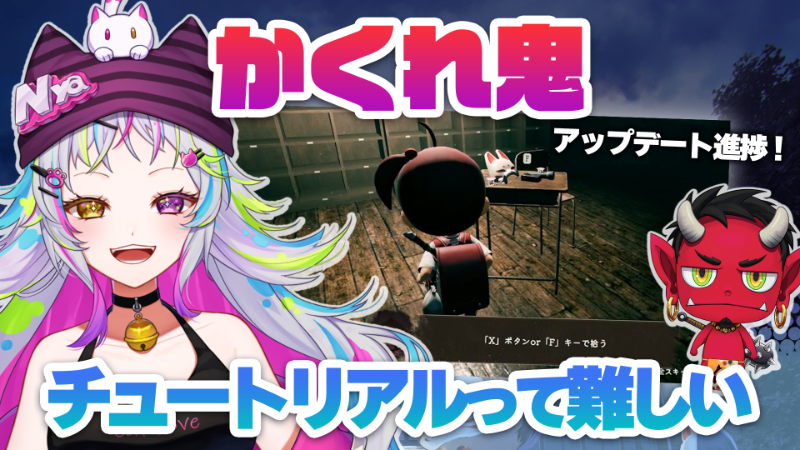
the tutorial
Nobody Likes Tutorials
That might sound a little extreme, but if we're being honest as players ourselves, we think a lot of people can relate…
When you start a new game, you're excited.
You want to jump in, explore, and experience what makes the game fun.
And when a long explanation suddenly appears, it's easy to think:
"Maybe I'll just skip this..."
To be honest, we feel the same way.
That's why, as developers, we're constantly aware of how challenging it is to create a good tutorial.
And Yet, Some Things Have to Be Explained
Every game has its own rules.
And KAKUREONI is no exception.
How to hide
How to avoid being found
How to sense the Oni's presence
How to work around your teammates
The unique tension that comes from more than just running away
Once you understand these things, they start to feel natural.
But at the beginning, you don't know any of them.
And that's where the challenge begins.
The most important mechanics—the very things that make a game fun—are often the things that need the most explanation.
We want players to understand what makes KAKUREONI exciting.
But the more we explain, the more we risk slowing things down.
It's a dilemma we've run into again and again throughout development.
The Game That Always Comes Up When You Study Tutorials
Whenever people talk about great tutorial design, one game always comes up:
“Super Mario Bros”
The original Super Mario Bros, was designed so that players could learn its rules simply by playing.
You jump.
You run into an enemy.
You discover you can defeat it by jumping on it.
You hit a block and something happens.
Before you even realize it, you've already learned how to play.
What's even more impressive is that it was released in an era when game manuals were the norm. Yet it was designed so that players could understand the basics without needing to read.
The more we study it, the more we appreciate just how remarkable its design really is.
Of course, we don't expect to achieve the same level of mastery ourselves.
But that's exactly why it's worth learning from.
So, What Did We Decide to Do?
Our answer was:
"Let players learn naturally through the story's prologue."
As players step into the world of the game, they learn the controls.
As they follow the story, they gradually discover the game's rules.
Many games use this approach, and for good reason—it's one of the most effective ways to teach players without pulling them out of the experience.
We Also Assume Some Players Will Skip It
To be completely honest, we designed KAKUREONI with the expectation that some players will skip the tutorial.
We live in a time where we're constantly surrounded by information—games, videos, social media, and everything in between.
Sometimes, all it takes is a quick glance for players to think,
"Okay, I think I get what kind of game this is."
And honestly, we don't see that as a bad thing. It's just a natural part of how people engage with games today.
That's why, in addition to the story prologue,
we've implemented a system that displays important controls and gameplay information
directly on the game screen when needed.
You can take your time and go through the tutorial.
Or you can skip it and jump straight in.
That's the kind of onboarding experience we're aiming for.
Yesterday's Best Solution Isn't Always Today's Best Solution
One thing this process reminded us of is how much gaming has changed over the years.
The way players discover games, the amount of information they consume, and the pace they expect have all evolved.
That's why, while we continue to learn from the great games that came before us, we're also searching for solutions that fit today's players.
We're still experimenting and refining our approach.
But our goal remains the same:
To make KAKUREONI enjoyable from the very first few minutes.
And to help players naturally reach the moments we truly want them to experience.
As always, we'll keep working hard to make KAKUREONI the best experience it can be.
Full video here👇
Of course, reading about these ideas is one thing—but how they actually feel in the game is another.
We'll be sharing more details in future updates and videos, so we hope you'll look forward to seeing them in action!
And if KAKUREONI has caught your interest, even a little,
we'd love for you to:
Wishlist KAKUREONI on Steam ✅
Join the Community Hub and share your thoughts ✍️
Thank you so much for supporting KAKUREONI!
📢 Announcement!
The game development VTuber group behind KAKUREONI, “Pixelade!”, has officially launched a note blog! 🎉
Pixelade! Game Development Club 📖
https://note.com/pixelade_forces
We’ll be sharing game development stories, behind-the-scenes moments, struggles, and progress updates from our streams in a more easy-to-read format!
So if you don’t always have time to catch our livestreams, we hope you’ll check it out there! Steam post image
Source
Changelog.gg summarizes and formats this update. How we read updates.