
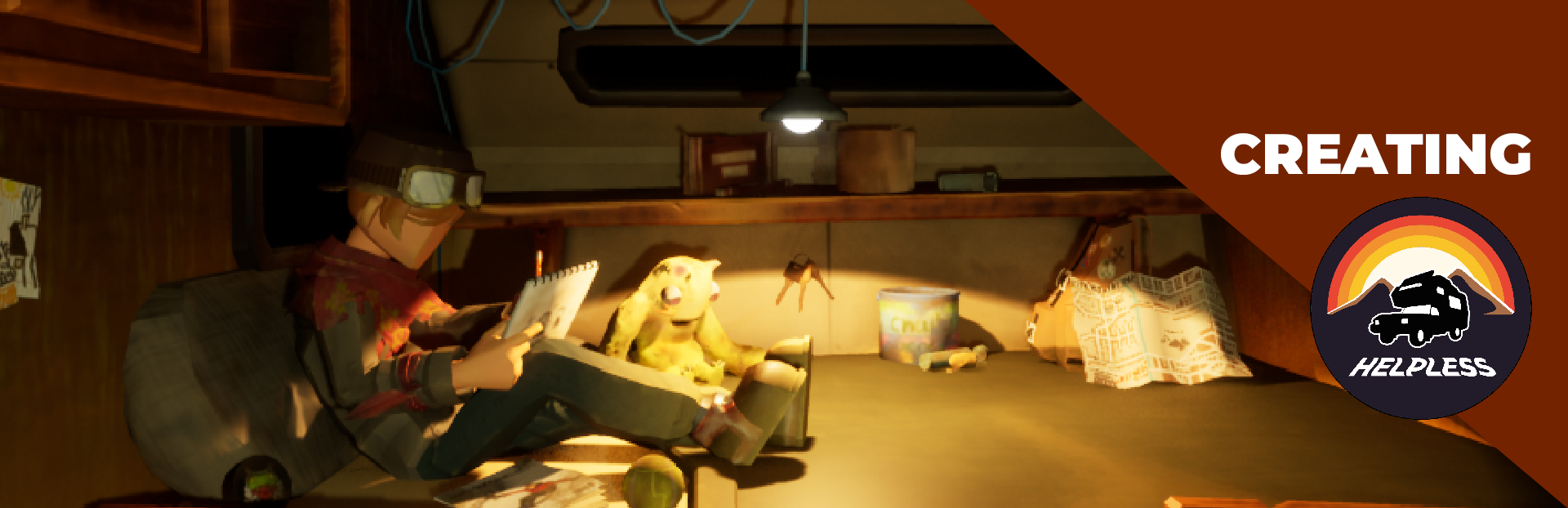
In this update4
Full notes
Full Helpless update
Read the full published notes in a cleaner layout. The original post stays linked below.
What changed
- Maps
- Gameplay
Helpless changes
Helpless is a team of 22 people; 11 artists, 7 designers, and 4 programmers. We are based in Montreal and on our last stretch to graduate. To end our academic journey, the last year of our bachelor’s degree consisted of making a game from start to finish and publishing it to Steam. So here we are, making this article and sharing everything that we went through to make this project happen.
EARLY CONCEPT AND INSPIRATION
The team started with 4 people; Mathieu, Alex, Alexis, and Pier-Alexandre. They had to think of a game with this premise: it had to address interpersonal relationships and also it had to involve the reparation of a broken vehicle. This premise was brainstormed beforehand and served as a creative constraint. After a bit of back and forth on the idea of repairing a vehicle, they reached a point where they thought the reparation of this vehicle should serve as a metaphor for a broken relationship. When initiating this idea, El Hijo - A Wild West Tale and Death’s Door served as references to make their own game.
When first pitching their idea, Helpless was an adventure game in which exploration and combat were a must. Yes, combat in Helpless! Sun wasn’t the only enemy at that time of the ideation, there were supposed to be giant insects that could attack our protagonist. As the idea took form, the team received feedback and realized quickly that the potential that Helpless had was in its story, and giant insects that could kill you weren’t a necessary part of that. This was a turning point for them and they had to mourn an idea that was exciting to them; combat, complicated system, and economic design.
During the final stages of the concept, the team grew from 4 people to 22! From then on, we worked hard to make the final concept a reality.
DEVELOPMENT PROCESS
For the first few months of the conception, the team worked on brainstorming and writing the mechanics, the story, and how all that would come together to make a gameplay loop.
The first phase was making a pitch. They had to choose the genre, the mechanics, and what features could sell the game best. Their first pitch was similar to what Helpless is now except they thought they would make the player explore also at night and fight giant insects.
Later, when their pitch was convincing enough, they had to prove that their idea was well thought out. At that point, 4 new people joined their team. So it was time for the high-level concept. This part involved a lot of documentation and drawing to show that they thought of absolutely everything that would go into making it. Everything was there; the gameplay loop, the level segmentation, the combat, the systems…
Helpless proved itself to be a good idea, so it was time to bring it to a game engine. A few other people joined them at that point to make the project tangible. For a few weeks, the programmers went hard to show how the exploration, the sun system, and the different obstacles in the environment would work. Artists also showed a sneak peek of what the final art direction would look like. Designers kept their word on their concept and gave us a first look at a level that we could potentially explore.
PLAYTESTING AND FEEDBACK
We organized playtests rigorously every week for 3 months with help from other students and teachers from our university. It really helped to have feedback from people all aspiring to make games for a living. Our first playtests were all about the sun system. We had to make sure the players understood the mechanic without putting it too obvious in their faces. We also changed our cameras entirely from our first ideation. Our technical director made a tool to make fun and custom points of view that fits our level design. We had to ask questions to our playtesters about its feel and make a lot of adjustments for the movement to be seamless.
FINAL WORD
During our journey to making this game, a lot happened. Many of us had to change roles on the fly in order to make it happen, which has made us more and more multidisciplinary. Making playtests is also crucial to making something that players will understand and like. Every suggestion has been taken into consideration and our ego had to take a backseat multiple times. Nonetheless, the team is very proud of what we’ve been able to accomplish. By putting in the time and effort to create something polished and engaging, we hope to provide an enjoyable experience for anyone who picks it up.
Source
Changelog.gg summarizes and formats this update. How we read updates.