
In this update2
Full notes
Full HELLBOUND INC update
Read the full published notes in a cleaner layout. The original post stays linked below.
What changed
- Gameplay
- Balance
- Events
HELLBOUND INC changes
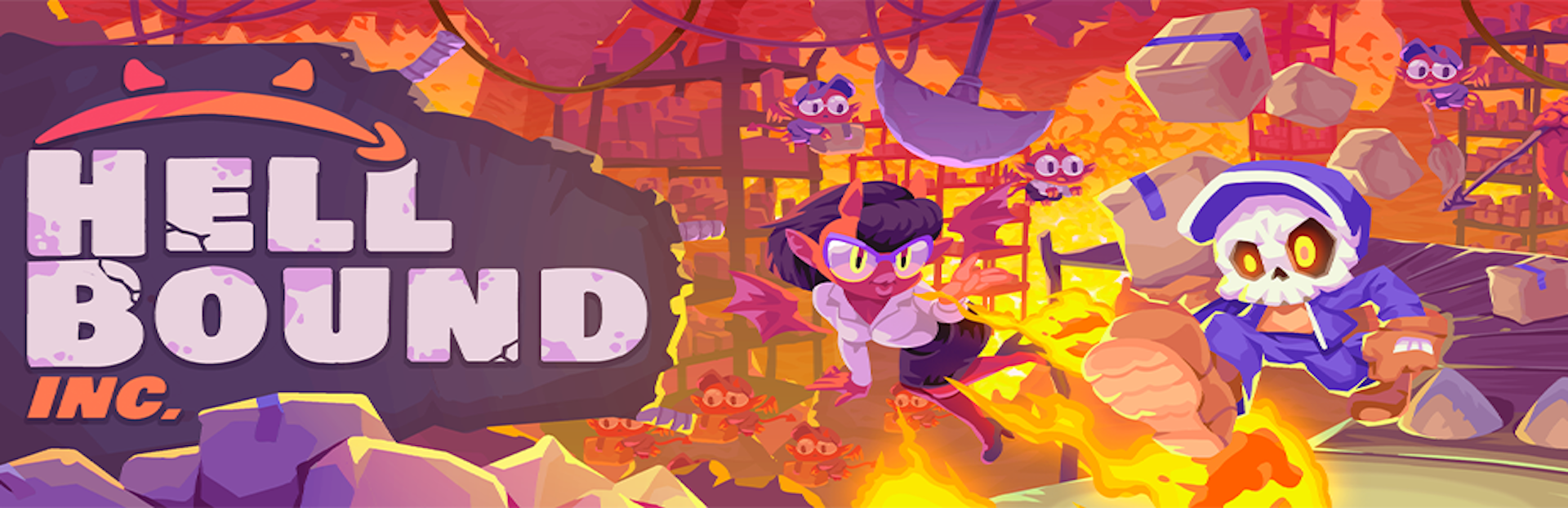
Curious about what went into making Hellbound Inc.? We caught up with Game Lead Abe Morales, to chat about the inspiration behind the game, the challenges of designing a precision platformer, and some of his favorite moments from development.
Here's what he had to say...
Every game starts with an idea. Do you remember the moment Hellbound Inc. was born? Where did the original concept come from?
I'd been deep in rage games with weird, deliberately awkward controllers for a while — Jump King, Getting Over It, Bread & Fred — and I've always been a Sokoban fan on the side. Wilmot's Warehouse was rattling around in my head too. Somewhere in early prototyping those two things collided: what if a rage-platformer's "obstacle" wasn't just a gap you have to jump, but a package you have to carry and deliver? That mix of precision movement and puzzle-logistics is where Hellbound Inc. actually started.
Hellbound Inc. takes inspiration from The Divine Comedy, but it definitely has its own personality. How did you approach reimagining such a classic work into something original?
I didn't want to retell Dante so much as steal his structure and his punishment. Descending through Circles of Hell mapped almost too well onto descending through departments of a company — Limbo becomes onboarding and orientation, and it only gets worse from there. The through-line I kept was endurance: like Sisyphus, you're not trying to "win," you're trying to survive one more shift. Filtering that through a modern, deadpan corporate-hell lens felt like the right way to make a 700-year-old poem feel like a Monday morning corparate call.
Precision platformers live or die by how they feel. How did you approach designing levels that are challenging enough to frustrate players, but fair enough to keep them coming back for "just one more try"?
Instant respawn was the foundation, but the real trick was small, achievable goals within each level. Breaking a level down into bite-sized objectives let players explore, die, retry, and gradually uncover more of the puzzle — instead of facing one big wall of failure, they're always chasing the next small win. That's what kept "fail again and again" from turning into "give up."
You've spent a long time building this world. Is there one level, circle, or moment in the game that you're especially proud of, and why?
Two, actually, back to back. Lust is when the art style really coalesced — that's the point where everything visually clicked into what the game was supposed to look like. Then Gluttony is where the characters and effects came together and the game found its charm — it stopped feeling like a tech demo and started feeling likable.
Hellbound Inc. has a really distinctive visual style. What were some of the biggest artistic influences that helped shape the look of the game?
We didn't have the resources for full 2D animation, so I looked for a style that could read as cartoony and expressive without needing it — things like Pizza Tower and Anton Blast were early references. That's not exactly where we landed; the final art style drifted from that starting point, but it's the DNA it grew out of.
Every game has features or ideas that don't survive development. Was there anything you loved that ultimately had to be left behind?
A full set of levels didn't make it in — along with a fuller Envy level that would've remixed mechanics from across other worlds, and a co-op multiplayer mode for tackling Hell together instead of solo. Some of that could still resurface as DLC.
Despite the challenge, Hellbound Inc. never takes itself too seriously. How did you find the balance between difficult gameplay and keeping the experience fun?
We leaned hard on reward density — extra item quests, funny dialogue snippets, a ton of immediate, bite-sized goals scattered through every level so there's always something to explore even while you're dying repeatedly on the main challenge. The core platforming stays punishing, but the level is never only punishing — there's always a smaller win to chase alongside the big one.
What's been the biggest challenge in developing the game?
Fine-tuning, testing levels and readjusting to feedback. The controller was also a major pain of the whole game. Getting jump arcs and bounce feel exactly right, paired with a guidance system that helps players read what a jump is actually asking of them (to aid players) — that took far longer than anything else. In a precision platformer, the controller basically is the game, so it had to be right before anything else mattered.
When someone plays Hellbound Inc. for the very first time, what do you hope they're thinking after the first 30 minutes?
"I hate this" — followed pretty quickly by little “AHA!” realisations. The moment someone figures out how to use a mechanic or item in their favor instead of just fighting it, that's the hook. We want that first half hour to be the exact pivot from frustration to "oh, I get it now."
Finally, if you had to convince someone to play Hellbound Inc. using just one sentence, what would you say?
Keep grinding — escaping Hell might always be just one room away (In game and in life).
Source
Changelog.gg summarizes and formats this update. How we read updates.