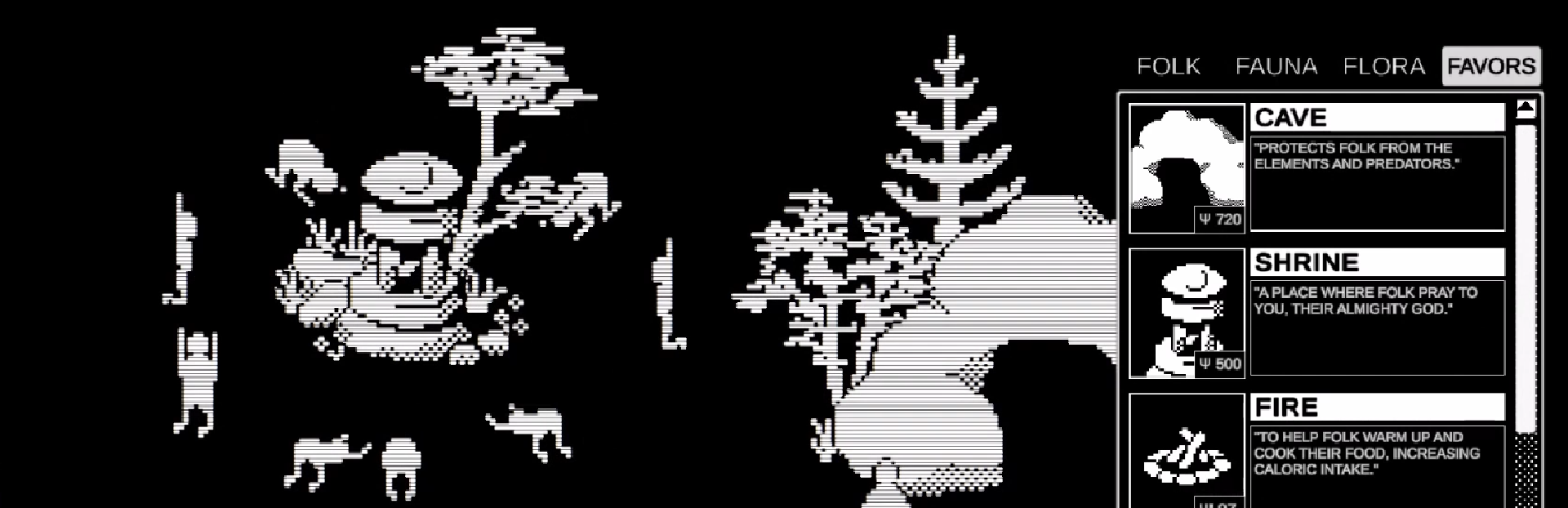
This week I completed a significant milestone: build Tartarus (named by Discord community member Lord Void). This build was a long time coming.
In this update5
Full notes
Full GODBOX update
Read the full published notes in a cleaner layout. The original post stays linked below.
What changed
0 fixes1 addition5 changes0 removals
Server
Gameplay
Balance
Performance
Events
changedThis week I completed a significant milestone: build Tartarus (named by Discord community member Lord Void). This build was a long time coming. Its main purpose is to test out the feasibility of the "rival deities" concept as a core game mechanic. Both the idea of competing with rivals for unlocks in a shared tech tree and the idea of competitive counter-programming are novel, and therefore risky. I wanted to create a small demo such as this with only two deities (death and fertility) before investing more time on an idea that might not work. If you'd like to test out this concept for yourself, please join our discord server! (link at the bottom of this post).
changedTHE GOOD NEWS FIRSTThough it took longer to complete than I expected, the build is done! Despite coding AI agents being outside of my comfort zone, I have proved it is technically viable. Not only that, but a big chunk of the work that would go into coding these AI entities and how they interact with the world (buying blueprints, adapting their code, unlocking domains) is complete! That means that if (or when) I figure out how to make their gameplay fun and engaging, expanding these systems will be much easier.
changedTHE CHALLENGES SO FARMOMENT TO MOMENT GAMEPLAY - The biggest problem I have found with Tartarus is a gap in moment to moment engagement. It would be easy for players to - after some brief moments of coding - spend a lot of time just watching the simulation at max speed. There is not enough to do between these coding sessions.
addedTHE CHALLENGES SO FARBALANCE AND RUNAWAY OPTIMIZATION - I took some time to directly code the many different behavior graphs that the AI rival deities can use on their plants and animals. They were coded to survive and reproduce optimally, which means that the map got flooded instances of especially fertile species (like dandelions). In theory, I believe that more systems that apply survival pressures (like the planned hydration and temperature systems) would naturally curb this. However, I don't want these mechanics to act as band aids. Ideally, I would like them to further add to the fun and complexity to the game.
changedTHE CHALLENGES SO FARSHALLOW RIVALRY - Rival deities feel shallow. They don't feel like real competitors yet. It is hard to read what they're doing or to care about them. I think having more ways to influence their strategy and interact with them could be a solution.
changedPOSSIBLE SOLUTIONSOk. It's not all bad. I already have some ideas on how I might tackle those challenges I mentioned above. For example, I might introduce real-time crises / events that pull the player out of spectating and force reactions. Giving the player more opportunities to engage with these rival deities could also be a way to introduce more personality while also giving players more things to do between coding sessions. What if players could complete missions for these rivals in order to gain favor with them? This favor could allow players to then influence these other deities strategies, perhaps asking them to choose to unlock one domain over another, or ask them to avoid using certain unkind blocks in their code.
GODBOX changes
changedThis week I completed a significant milestone: build Tartarus (named by Discord community member Lord Void). This build was a long time coming. Its main purpose is to test out the feasibility of the "rival deities" concept as a core game mechanic. Both the idea of competing with rivals for unlocks in a shared tech tree and the idea of competitive counter-programming are novel, and therefore risky. I wanted to create a small demo such as this with only two deities (death and fertility) before investing more time on an idea that might not work. If you'd like to test out this concept for yourself, please join our discord server! (link at the bottom of this post).
changedThough it took longer to complete than I expected, the build is done! Despite coding AI agents being outside of my comfort zone, I have proved it is technically viable. Not only that, but a big chunk of the work that would go into coding these AI entities and how they interact with the world (buying blueprints, adapting their code, unlocking domains) is complete! That means that if (or when) I figure out how to make their gameplay fun and engaging, expanding these systems will be much easier.
changedMOMENT TO MOMENT GAMEPLAY - The biggest problem I have found with Tartarus is a gap in moment to moment engagement. It would be easy for players to - after some brief moments of coding - spend a lot of time just watching the simulation at max speed. There is not enough to do between these coding sessions.
addedBALANCE AND RUNAWAY OPTIMIZATION - I took some time to directly code the many different behavior graphs that the AI rival deities can use on their plants and animals. They were coded to survive and reproduce optimally, which means that the map got flooded instances of especially fertile species (like dandelions). In theory, I believe that more systems that apply survival pressures (like the planned hydration and temperature systems) would naturally curb this. However, I don't want these mechanics to act as band aids. Ideally, I would like them to further add to the fun and complexity to the game.
changedSHALLOW RIVALRY - Rival deities feel shallow. They don't feel like real competitors yet. It is hard to read what they're doing or to care about them. I think having more ways to influence their strategy and interact with them could be a solution.
This week I completed a significant milestone: build Tartarus (named by Discord community member Lord Void). This build was a long time coming. Its main purpose is to test out the feasibility of the "rival deities" concept as a core game mechanic. Both the idea of competing with rivals for unlocks in a shared tech tree and the idea of competitive counter-programming are novel, and therefore risky. I wanted to create a small demo such as this with only two deities (death and fertility) before investing more time on an idea that might not work. If you'd like to test out this concept for yourself, please join our discord server! (link at the bottom of this post).
THE GOOD NEWS FIRST
Though it took longer to complete than I expected, the build is done! Despite coding AI agents being outside of my comfort zone, I have proved it is technically viable. Not only that, but a big chunk of the work that would go into coding these AI entities and how they interact with the world (buying blueprints, adapting their code, unlocking domains) is complete! That means that if (or when) I figure out how to make their gameplay fun and engaging, expanding these systems will be much easier.
THE UGLY TRUTH NEXT
The Tartarus demo is not very fun. At least, not to me. It is possible that I've cheated myself out of the fun of it by knowing how these rival entities work by heart, and by having coded with the Hiveforge engine (the logic block engine used in the game) for so long. Until I have had more people try it out, it's hard to know. One thing is certain, though. Competing with rival deities to unlock domains and reacting to how they code is not enough to carry GODBOX alone.
THE CHALLENGES SO FAR
MOMENT TO MOMENT GAMEPLAY - The biggest problem I have found with Tartarus is a gap in moment to moment engagement. It would be easy for players to - after some brief moments of coding - spend a lot of time just watching the simulation at max speed. There is not enough to do between these coding sessions.
BALANCE AND RUNAWAY OPTIMIZATION - I took some time to directly code the many different behavior graphs that the AI rival deities can use on their plants and animals. They were coded to survive and reproduce optimally, which means that the map got flooded instances of especially fertile species (like dandelions). In theory, I believe that more systems that apply survival pressures (like the planned hydration and temperature systems) would naturally curb this. However, I don't want these mechanics to act as band aids. Ideally, I would like them to further add to the fun and complexity to the game.
SHALLOW RIVALRY - Rival deities feel shallow. They don't feel like real competitors yet. It is hard to read what they're doing or to care about them. I think having more ways to influence their strategy and interact with them could be a solution.
These are but a few of the concerns I found just by playtesting myself. I have yet to have anyone try out Tartarus, and I imagine many more issues will pop up when they do.
POSSIBLE SOLUTIONS
Ok. It's not all bad. I already have some ideas on how I might tackle those challenges I mentioned above. For example, I might introduce real-time crises / events that pull the player out of spectating and force reactions. Giving the player more opportunities to engage with these rival deities could also be a way to introduce more personality while also giving players more things to do between coding sessions. What if players could complete missions for these rivals in order to gain favor with them? This favor could allow players to then influence these other deities strategies, perhaps asking them to choose to unlock one domain over another, or ask them to avoid using certain unkind blocks in their code.
IN CONCLUSION
I still think the idea of rival deities has potential, but while I've (for the most part) overcome the technical hurdles of implementing it, I'm still figuring out how to design a game that makes good use out of such mechanics. The truth is that it will be impossible to figure that out for myself. I need people to try out this build! So if you're reading this and are invested in the project, please join the discord community and try out Tartarus. It is the single best way to help! https://discord.gg/8qWrUvqYZa