
Full notes
Full Glaciered update
Read the full published notes in a cleaner layout. The original post stays linked below.
Repeated intro
Hello. I'm Shibuya from Studio Snowblind, the developer of Glaciered. It's been a while since my last devlog, but the development of Glaciered is going along smoothly.
What changed
- Gameplay
- Balance
- Events
Glaciered changes
Today, I would like to introduce to you the Seeker's Hideout, which will be your main base, and the Pui, a trusty companion who will accompany you on your harsh journey across the seas.
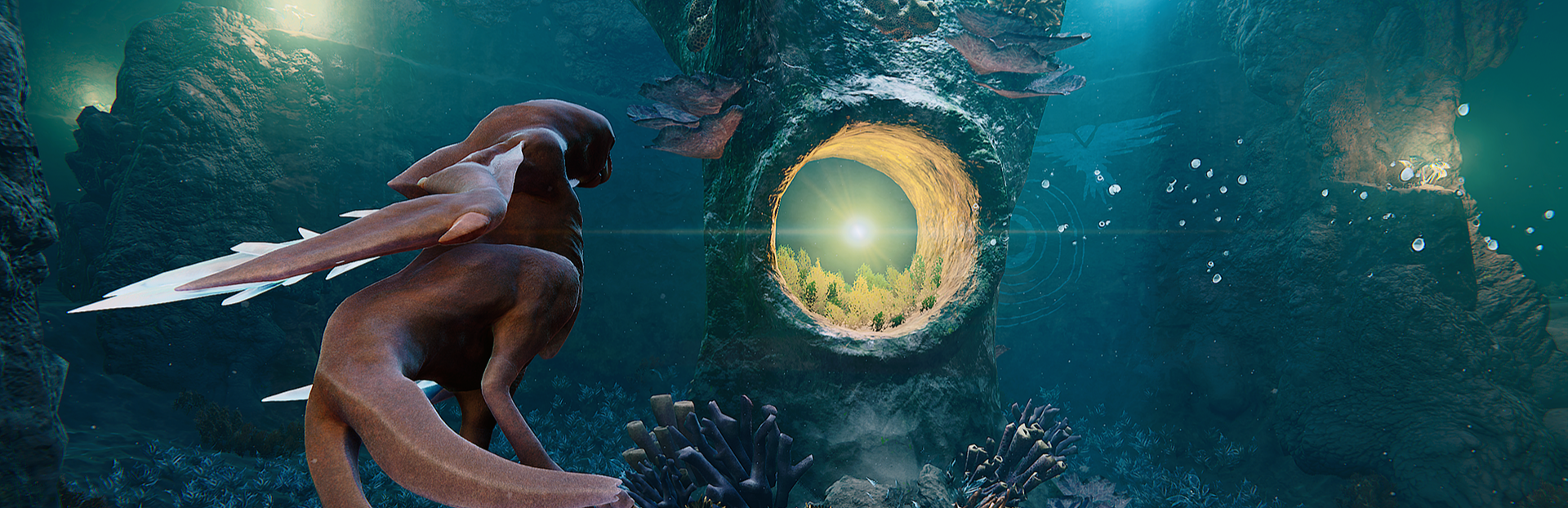
You will encounter the Seeker early on in the game, who will later let you use the Seeker's Hideout as your base of operations. Here you will find all sorts of facilities you can use to strengthen yourself. You can rest, eat a meal, strengthen your wings (equipment), trade, and raise your companion, who I'll introduce later on in this devlog.
This particularly large crystal is the Great Glacium Crystal, which is the equivalent to a smithy or workbench you may be familiar with in other games. Here you can spend materials to craft new wings or strengthen old ones, or use rare items to draw out the hidden abilities of your wings.
Crafting your very own unique wings and making them as powerful as possible is one of the aspects of the game you can sink many hours into if you really dig deep into the system.
In the center of the hideout is the Fossil Tree, which is where you can go to sleep to rest your wounds, as well as consume meals to prepare for the next part of your journey.
When hunting other creatures you meet in the sea, you will sometimes obtain parts of their bodies as items. These items can be consumed before bed and will grant you powerful buffs. It's unwise to fight against strong foes without getting enough food and sleep.
Resting is one of the most important mechanics in the game.
You can also stash items in your resting place.
Whenever you're defeated in battle, you'll drop all of your held items where you were slain, but anything you have in storage will be safe. It's a good idea to stash anything important or rare in your storage before heading out.
With this giant slate, you can take part in Memory Trading. During your travels, you will be able to find Tuai memories, which you can trade in here to obtain knowledge on how to create new wings (i.e. blueprints), mutations (i.e. customizable passive skills), additional stash space, and more.
Search every crevice under the sea, or clear missions given to you by the Seeker to collect Tuai memories and trade them for your own growth.
During your journey, you will be accompanied by a trusty companion called the Pui. It's a creature evolved from the pufferfish, and it has an organ on its forehead that can produce light, making it particularly reliable in the dark depths at night.
(That's right: the sea in Glaciered goes through a day-night cycle in real time, and completely different creatures will appear depending on the time of day!)
Use the Pui to light your way as you explore the sea at night, or in dark caves where no other light reaches. However, the Pui isn't just a fancy living torch. It can follow your orders and participate in battle as well.
By feeding the Pui different food at the hideout, it can learn different abilities based on the creature its food comes from. For example, by eating the electric organ of a Reega, a carnivorous fish that utilizes electric attacks, it will gain the ability to discharge a burst of electricity around itself, which will let it fight alongside you against hostile creatures.
But be careful; just like you, the Pui will also be knocked out if it takes too much damage. You'll have to keep a close eye on its condition and protect it when necessary.
As a bonus, this game includes a photo mode. You can stop time whenever you want to take a picture of the underwater world 65 million years in the future. And if you manage to photograph specific creatures, the Seeker might have a reward for you...
I would love to also tell you about other game features such as the fast travel system, the wide range of passive skills, and new formidable bosses, but this will be all for today's devlog.
By the way, I'm currently discussing with the publisher PLAYISM about the possibility of releasing a demo for the game.
Obviously I would love to get valuable feedback from you all as soon as possible in order to polish the game even further, but at the same time, I want to share a demo that's as well-made as it can be, so we're still trying to figure out the best timing to release the demo.
When we're ready to release a demo, we'll announce here on Steam as well as on social media, so please wishlist the game and follow us to get the latest updates!
Source
Changelog.gg summarizes and formats this update. How we read updates.