
Full notes
Full Frequency: Chernobyl update
Read the full published notes in a cleaner layout. The original post stays linked below.
What changed
- Gameplay
- UI and audio
- Store
Frequency: Chernobyl changes
Thanks for tuning in, everybody! You are listening to Drunkard Racoons and today we invite you to take another look at the history of our first project — Frequency: Chernobyl.
While the bulk of the team is busy working on the GUI, designing in-game locations, and composing dialogues, we would like to introduce you more thoroughly to the game's narrative as well as the types of puzzles that one should expect to encounter during their playthrough.
Why the number stations? Before we answer that, let us take a little detour. The game was originally envisioned to have a somewhat different setting: taking place during the Cold War and focusing mostly on espionage, with puzzles based on the outdated ciphers used during WWII, the "Enigma" code and the Turing machine, etc.
Old Soviet posters, screenshot from Frequency: Chernobyl
Over time, however, the idea has evolved. We figured that there were a great many games with a similar premise, such as the iconic Call of Duty series, and the likelihood of getting lost among those giants would be too great. It was decided that we should play around with the game's concept some more and look at it from a wider range of angles.
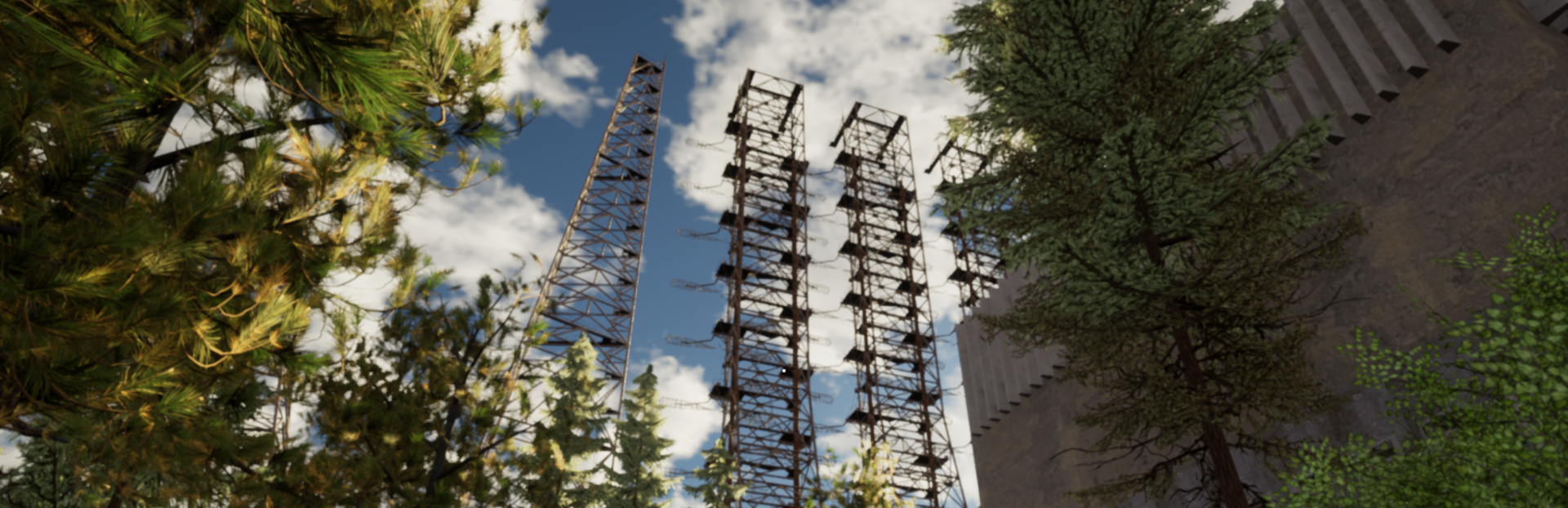
We then came across a long article on the OTHR "Duga" — one of the fairly well-known and commonly mythologized symbols of the Cold War (click here to read more about this Soviet-era artifact in our previous article).
OTHR "Duga" historic photo, source: Wikimapia
Further down the road, we stumbled upon the mystery of the number stations as well as a huge community of radio amateurs from different countries who discover new encrypted transmissions on a regular basis.
A cipher or just white noise? The so-called number stations first appeared at the dawn of the XX century. They are secret transmitters that do not have an official call sign. They go live without prior warning, transmit an encrypted message, and just as suddenly fall silent, only to sometimes resurface again many years later.
Radio enthusiasts we contacted informed us that it is possible to come across rhythmic hissing and other incomprehensible messages on the air that seemingly have no meaning, like the sounds of tapping or repeated whistling. It is easy to dismiss such occurrences as mere speculation or urban legends until you hear them for yourself.
There is a plethora of materials, such as declassified documents and other publications devoted to numbers stations, as well as the OTHR "Duga." The topic is rather popular among a narrow circle of radio amateurs and Chernobyl stalkers but is virtually unknown to the general public.
OTHR "Duga", screenshot from Frequency: Chernobyl
Number stations are still in use these days, and radio amateurs around the globe are still puzzling over their messages. As it turned out, there was not a single game devoted to radio encryption and the riddle of the numbers stations... until now.
Ham radio One of our goals is to popularize amateur radio tinkering among the current generation. Whenever regular communication systems collapse — for example, due to a natural disaster or during an armed conflict — old-fashioned radio can become the only channel connecting the affected region to the outside world.
Volna-K radio receiver, screenshot from Frequency: Chernobyl
The game will equip the player with a basic understanding of the inner workings of shortwave radio transmitters and this knowledge might come in handy if the world is suddenly hit with a zombie apocalypse tomorrow. :)
We hope that you enjoyed reading this article and that it managed to stir up your interest towards the game and its subject matter.
Add Frequency: Chernobyl to your wishlist and follow the project on social media!
https://store.steampowered.com/app/1415600/Frequency_Chernobyl/
Source
Changelog.gg summarizes and formats this update. How we read updates.