
Full notes
Full Freight Misconductor update
Read the full published notes in a cleaner layout. The original post stays linked below.
What changed
- Maps
- Server
- Gameplay
One of the features I've wanted to have in the game for a long time, and one which really makes this game unique among train games, plays into the backstory of railroading on planet Gymnome: Dual Gauge switching.
In the distant past, north/south wagonway paths were used for migrating between different biomes as the planet's climate changed throughout the course of a 30-year-long "Omicycle," described previously in the FAQ. These wagonways became the first railways, but each was a different gauge.
When the railways developed steam traction and started expanding east and west, they would merge with the smaller railways, but eventually they would meet another large network. There would invariably be a break of gauge, where the spacing between the rails differs between two railways, and at that point it would be irreconcilable--both railways would be just too big to regauge.
This repeated at various different longitudes across the planet, so there's several incompatible gauges. (This happens on Earth too, but it's even more widespread on Gymnome)
The SLYM--the main setting of the game--is a narrow gauge railway with a gauge of about a meter. But it is a subsidiary road of a larger (in both gauge and scale) roughly 1.8 meter broad gauge railway.
In order to run trains between narrow and broad gauge locations without stopping to trans-load, there's a lot of overlap in the form of a dual gauge railway, which uses three rails to provide track of two gauges.
The railyards are considerably more complex, as there is still plenty of underlap in the track plans of each gauge.
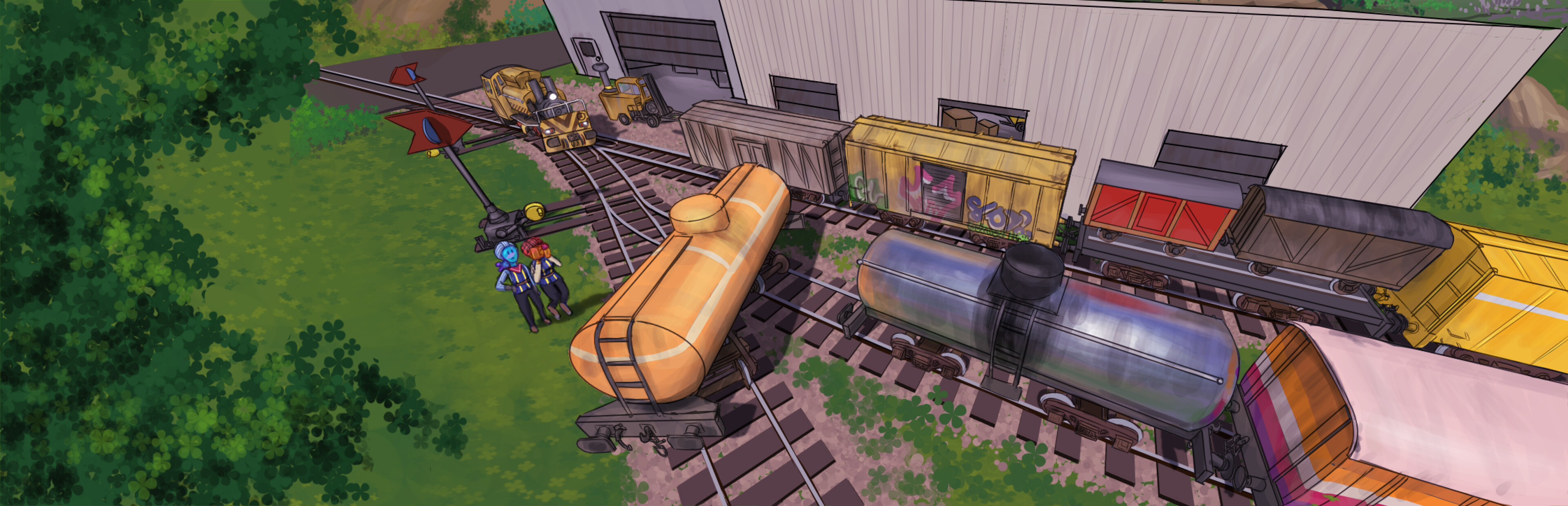
Steam post imageThe Broad Gauge introductory level, showcasing a situation where the cars can go places the loco can't--the switch is only a switch for the broad gauge cars, the whole track is linear for the locomotive.
Another new feature that plays into this is...
Loco Transfer! There can be multiple locomotives per level, and they can be switched between using the key on the control stand.
Steam post imageOne of the most important concepts in Train Misconductor is that of a facing versus a trailing switch. A Trailing switch is one where the loco can push the cars back into the siding, and a facing switch is one where the loco would have to pull into the siding, trapping itself in there. Running around cars is one of the central mechanics in Train Misconductor, and many of the mechanics are just new interesting ways to accomplish this. Case in point--this level would be very challenging to complete with a single loco, as it lacks a runaround loop. But with two locomotives, it isn't too hard.
Steam post imageThis plays well with a level like this, which is a sort of a variation on an inglenook where each loco only has access to two out of the three sidings, but since they share one of them, cars can be traded between them.
The final piece of the puzzle, brand new as of writing (so there aren't many levels featuring it yet), is the Broad Gauge Garratt! Garratts are articulated locomotives which have the boiler slung between two engine units, atop which are water and fuel tenders.
Steam post imageHere's a digital artwork I made of the new locomotive!
And here's a video of it in-game:
Steam post imageAs you can see, it's much larger than the little tank engine, and it's 6 times more powerful as well. Pulling large numbers of broad gauge cars can be grueling or impossible for the tank engine, but the Garratt will make quick work of anything.
There's still more to do on the Garratt--error codes on the computer to replace the safety interlockings on the tank engine's control stand, rudimentary steam pressure simulation, and making the key actually work--but it feels great to have it in and working with the new, very different controls.
Source
Changelog.gg summarizes and formats this update. How we read updates.