Hey again-- Lee here, developer of FE. Another year has somehow come and gone again, and when I’ve gone back to evaluate the last 12 months of development it’s fairly clear that a).
In this update2
Full notes
Full Fragile Existence update
Read the full published notes in a cleaner layout. The original post stays linked below.
Repeated intro
Hey again-- Lee here, developer of FE. Another year has somehow come and gone again, and when I’ve gone back to evaluate the last 12 months of development it’s fairly clear that a). sometimes you just try things and they don’t stick or feel quite right, b). there’s always tinkering under the hood going on that never fails to sound a bit dull, and c). I’m still not really any better at predicting how long things take to put together.
What changed
0 fixes5 additions4 changes0 removals
UI and audio
Maps
changedHey again-- Lee here, developer of FE. Another year has somehow come and gone again, and when I’ve gone back to evaluate the last 12 months of development it’s fairly clear that a). sometimes you just try things and they don’t stick or feel quite right, b). there’s always tinkering under the hood going on that never fails to sound a bit dull, and c). I’m still not really any better at predicting how long things take to put together.
changedThe 2025 RetrospectiveI know the year isn’t quite over yet, but it definitely feels like I spent most of this past year working on the UI in some form or another. Moreover, with most of the ‘in-universe’ mechanics already working these days, from planet generation, to pathfinding and combat and salvaging and all those good things-- I felt like it was time to really hone in on making the UI work the best it possibly could to support all the core mechanics. And this does matter-- the player has to manage multiple capital ships and numerous smaller vessels or ground-based units (whether deployed or not), and everything is highly modular in composition. Every unit has it’s own inventory, and every item is physicalised in the sense that it exists somewhere-- and needs to be transported to get somewhere else. Its a lot to keep track of, and the UI has to do some serious heavy-lifting to make sure it’s very clear where everything is, and allow the player to quickly find what they need. For example, if the population aboard one ship (perhaps orbiting a desolate moon all on its own) are suddenly without food, we kind of need to a). know about that before it’s too late to do anything about it, and b). know how we can actually move food to that location without feeling a bit lost. Which is the closest ship? Does the closest ship even have food stored? Which ship across the fleet just has tons of food available that we can draw from, and what are the options are getting that to the right place?
changedThe 2025 RetrospectiveYou end up wanting a UI that is somewhat context-aware, and presents things ordered under the relationships that you actually care about. And it has honestly just taken time to play with these things: there isn’t a ton of precedent to lean on in the fleet survival RTS genre. You could argue for streamlining things to reduce complexity, but then you’re left making a potentially very different game. We actually did start doing this a bit, though, eventually moving to more discrete units of measurement for certain things rather than have the player be inundated by floating point values (like, say, a certain module can install up to 3 “unit volume” of components, and the components come in sizes of 1, 2, or 3 such units, so you can install one size 3, or three size 1, etc.). The trick is to realise what the actual fun or interesting decisions that a player needs to make are, and enable those kinds of actions to be straightforward to employ whilst also offering enough depth to fine-tune things if needed.
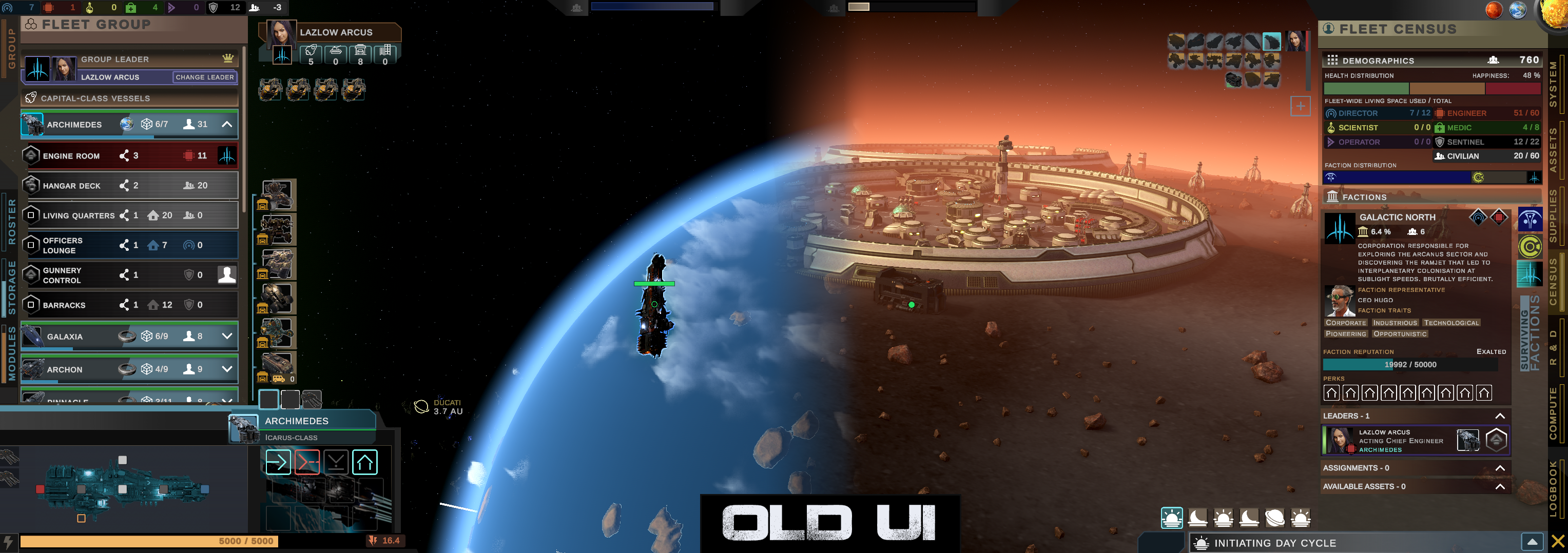
addedThe 2025 RetrospectiveSo, yeah, admittedly this has all taken longer than anticipated. And whilst I was working through all of this (and actually moving forward into parts of the UI I hadn’t even touched before-- like the Faction hub that showed all the available faction missions, and your progress on building reputation with each faction), later in the year I met with a specialist UI designer, and they ultimately helped me make a few realisations about what was working well and what was not. This also coincided with them presenting me with a fresh overhaul of the entire UI, finally bringing some modernisation and overall cohesion that had been much absent beforehand (since I’d essentially just been patching new bits onto the existing framework over the years of development).
addedThe 2025 RetrospectiveImplementing a new UI design is pretty fun. You’re given a blueprint to follow and you slice up the typically vector-based imagery into optimised chunks and just kind of get on with it. None of that game design stuff getting in the way. But it does take a while, since you end up having to write entirely new interfacing code, and everything needs refinement and interactivity added, and maybe even a bit of animation where it makes sense. You kind of polish things as you go along because you know that this is the final UI you’re going to ship with, and it feels like it really matters now. And, honestly, I’m still going. The essentials are in, but I’m still working through swapping everything out for the new overhaul. Maybe I would have been ready to move on by now had we not decided this was necessary, but it honestly was, and I hope we can appreciate that the new style is much more fit for purpose.
addedThe 2025 RetrospectiveOne of the cooler additions is the ‘Commander’s Log’ which is something of an in-game encyclopedia, listing information about every item, faction, unit, structure and planet you have access to or come across. I hadn’t considered the value of a more ‘full-screen’ panel until recently, trying instead to squeeze everything into the two side-panels which slide in and out and provide easy access to various components. Moving all of the faction-related information to the logbook makes much more sense, and I even added a Journey/system map page so that we can see where the fleet has been, and which system options are available-- as well as chronicle all the information you’ve acquired on each celestial body you’ve encountered thus far, helping to make exploration feel more engaging, with discoverable points of interest spread throughout the system.
Fragile Existence changes
changedHey again-- Lee here, developer of FE. Another year has somehow come and gone again, and when I’ve gone back to evaluate the last 12 months of development it’s fairly clear that a). sometimes you just try things and they don’t stick or feel quite right, b). there’s always tinkering under the hood going on that never fails to sound a bit dull, and c). I’m still not really any better at predicting how long things take to put together.
changedI know the year isn’t quite over yet, but it definitely feels like I spent most of this past year working on the UI in some form or another. Moreover, with most of the ‘in-universe’ mechanics already working these days, from planet generation, to pathfinding and combat and salvaging and all those good things-- I felt like it was time to really hone in on making the UI work the best it possibly could to support all the core mechanics. And this does matter-- the player has to manage multiple capital ships and numerous smaller vessels or ground-based units (whether deployed or not), and everything is highly modular in composition. Every unit has it’s own inventory, and every item is physicalised in the sense that it exists somewhere-- and needs to be transported to get somewhere else. Its a lot to keep track of, and the UI has to do some serious heavy-lifting to make sure it’s very clear where everything is, and allow the player to quickly find what they need. For example, if the population aboard one ship (perhaps orbiting a desolate moon all on its own) are suddenly without food, we kind of need to a). know about that before it’s too late to do anything about it, and b). know how we can actually move food to that location without feeling a bit lost. Which is the closest ship? Does the closest ship even have food stored? Which ship across the fleet just has tons of food available that we can draw from, and what are the options are getting that to the right place?
changedYou end up wanting a UI that is somewhat context-aware, and presents things ordered under the relationships that you actually care about. And it has honestly just taken time to play with these things: there isn’t a ton of precedent to lean on in the fleet survival RTS genre. You could argue for streamlining things to reduce complexity, but then you’re left making a potentially very different game. We actually did start doing this a bit, though, eventually moving to more discrete units of measurement for certain things rather than have the player be inundated by floating point values (like, say, a certain module can install up to 3 “unit volume” of components, and the components come in sizes of 1, 2, or 3 such units, so you can install one size 3, or three size 1, etc.). The trick is to realise what the actual fun or interesting decisions that a player needs to make are, and enable those kinds of actions to be straightforward to employ whilst also offering enough depth to fine-tune things if needed.
addedSo, yeah, admittedly this has all taken longer than anticipated. And whilst I was working through all of this (and actually moving forward into parts of the UI I hadn’t even touched before-- like the Faction hub that showed all the available faction missions, and your progress on building reputation with each faction), later in the year I met with a specialist UI designer, and they ultimately helped me make a few realisations about what was working well and what was not. This also coincided with them presenting me with a fresh overhaul of the entire UI, finally bringing some modernisation and overall cohesion that had been much absent beforehand (since I’d essentially just been patching new bits onto the existing framework over the years of development).
addedImplementing a new UI design is pretty fun. You’re given a blueprint to follow and you slice up the typically vector-based imagery into optimised chunks and just kind of get on with it. None of that game design stuff getting in the way. But it does take a while, since you end up having to write entirely new interfacing code, and everything needs refinement and interactivity added, and maybe even a bit of animation where it makes sense. You kind of polish things as you go along because you know that this is the final UI you’re going to ship with, and it feels like it really matters now. And, honestly, I’m still going. The essentials are in, but I’m still working through swapping everything out for the new overhaul. Maybe I would have been ready to move on by now had we not decided this was necessary, but it honestly was, and I hope we can appreciate that the new style is much more fit for purpose.
The 2025 Retrospective
I know the year isn’t quite over yet, but it definitely feels like I spent most of this past year working on the UI in some form or another. Moreover, with most of the ‘in-universe’ mechanics already working these days, from planet generation, to pathfinding and combat and salvaging and all those good things-- I felt like it was time to really hone in on making the UI work the best it possibly could to support all the core mechanics. And this does matter-- the player has to manage multiple capital ships and numerous smaller vessels or ground-based units (whether deployed or not), and everything is highly modular in composition. Every unit has it’s own inventory, and every item is physicalised in the sense that it exists somewhere-- and needs to be transported to get somewhere else. Its a lot to keep track of, and the UI has to do some serious heavy-lifting to make sure it’s very clear where everything is, and allow the player to quickly find what they need. For example, if the population aboard one ship (perhaps orbiting a desolate moon all on its own) are suddenly without food, we kind of need to a). know about that before it’s too late to do anything about it, and b). know how we can actually move food to that location without feeling a bit lost. Which is the closest ship? Does the closest ship even have food stored? Which ship across the fleet just has tons of food available that we can draw from, and what are the options are getting that to the right place?
You end up wanting a UI that is somewhat context-aware, and presents things ordered under the relationships that you actually care about. And it has honestly just taken time to play with these things: there isn’t a ton of precedent to lean on in the fleet survival RTS genre. You could argue for streamlining things to reduce complexity, but then you’re left making a potentially very different game. We actually did start doing this a bit, though, eventually moving to more discrete units of measurement for certain things rather than have the player be inundated by floating point values (like, say, a certain module can install up to 3 “unit volume” of components, and the components come in sizes of 1, 2, or 3 such units, so you can install one size 3, or three size 1, etc.). The trick is to realise what the actual fun or interesting decisions that a player needs to make are, and enable those kinds of actions to be straightforward to employ whilst also offering enough depth to fine-tune things if needed.
So, yeah, admittedly this has all taken longer than anticipated. And whilst I was working through all of this (and actually moving forward into parts of the UI I hadn’t even touched before-- like the Faction hub that showed all the available faction missions, and your progress on building reputation with each faction), later in the year I met with a specialist UI designer, and they ultimately helped me make a few realisations about what was working well and what was not. This also coincided with them presenting me with a fresh overhaul of the entire UI, finally bringing some modernisation and overall cohesion that had been much absent beforehand (since I’d essentially just been patching new bits onto the existing framework over the years of development).
Implementing a new UI design is pretty fun. You’re given a blueprint to follow and you slice up the typically vector-based imagery into optimised chunks and just kind of get on with it. None of that game design stuff getting in the way. But it does take a while, since you end up having to write entirely new interfacing code, and everything needs refinement and interactivity added, and maybe even a bit of animation where it makes sense. You kind of polish things as you go along because you know that this is the final UI you’re going to ship with, and it feels like it really matters now. And, honestly, I’m still going. The essentials are in, but I’m still working through swapping everything out for the new overhaul. Maybe I would have been ready to move on by now had we not decided this was necessary, but it honestly was, and I hope we can appreciate that the new style is much more fit for purpose.
One of the cooler additions is the ‘Commander’s Log’ which is something of an in-game encyclopedia, listing information about every item, faction, unit, structure and planet you have access to or come across. I hadn’t considered the value of a more ‘full-screen’ panel until recently, trying instead to squeeze everything into the two side-panels which slide in and out and provide easy access to various components. Moving all of the faction-related information to the logbook makes much more sense, and I even added a Journey/system map page so that we can see where the fleet has been, and which system options are available-- as well as chronicle all the information you’ve acquired on each celestial body you’ve encountered thus far, helping to make exploration feel more engaging, with discoverable points of interest spread throughout the system.
It wasn’t all UI, though, and throughout the year I also dove back into some more foundational stuff-- optimising old code (I was not as good a programmer back when I started this project, I think that’s fair to say), and introducing smarter approaches to handling the clipping/culling of objects in the scene so that we only render what we need to. These kind of things need somewhat unique solutions when you’re dealing with spherical worlds, and I guess that’s become a bit of a motto of the project by this point-- planets are tricky to work with! I’ve also been doing work to increase how much multi-threading I use for the most time-sensitive parts of the codebase. Plus I began to develop a more robust replacement for the custom physics system, but it was taking up too much time so I had to move on for now-- the basic framework is pretty solid, though. More visually, the node-based scripting language built into the game and used to create the scenarios themselves continued to mature. I still haven’t locked down the feature set there, because I’m still finding things that I want the scripting system to handle, and we need to be relatively sure that any campaign-mission type thing we want to be able to do is added in before we decide to wrap that up. For example, faction-provided missions currently can’t span more than one solar system-- is this okay, or should it be possible to have narratives that involve multiple systems? More complexity is introduced with the latter choice, sure, but maybe it’s worth the up-front effort to accommodate.
Whilst the new UI conception was going on in the background, I also took some time to have another look at our key fleet assets-- many of which have been placeholder for a number of years now. I’d still like to flesh out a more cohesive vision for the Fragile Existence universe, with deliberate and believable spaceship and ground unit designs that lean at least somewhat into potential future realism (without necessarily sacrificing coolness to do so). I’ve been exploring some potential production pipelines to achieve this, and put some models together to start to plan this kind of process out, but whether I end up working on this myself or finding someone else to follow through with this particular project remains to be seen.
Steam post image
Going into 2026
In terms of what is left to finalise ahead of more broader testing, the UI overhaul is still the main focus for the immediate future. I'm also working on some fighter escort code that will allow smaller craft to shadow a selected capital ship, whilst also being able to detach completely and explore the wider system ahead of the main fleet as well. There are some final decisions to be made about scripting support, but then we start building out scenarios to make sure everything works the way we’d like. I’d imagine that we then start thinking about trying to solidify stat values across the range of units, modules and components; and fleshing out combat with more types of weaponry around this point too (it’s currently all projectile-based and I think we can do a lot better than that). A lot of what is left to work on after that is more content-oriented-- mission writing and environment detailing, more VFX and sound design, and perhaps the suggested overhaul of the player fleet assets as well. I know it’s all taking a while to get to the finish line, and I don’t always communicate as effectively as perhaps I should be, but I’m just trying to get it done, and that’s what continues to be my focus. Thanks for taking the time to read all of this :)