
In this update15
Full notes
Full Exanima update
Read the full published notes in a cleaner layout. The original post stays linked below.
What changed
- Gameplay
- Maps
- Fixes
- Balance
- Performance
- UI and audio
Exanima changes
Before we get into everything that's in this update, we need to address the elephant in the room. Most of you don't closely follow the game's development, and this was to say the least an unusually long time between updates. Exanima is an unusual game, filled with features you won't see elsewhere, probably because no other developer is stupid enough to attempt them, let alone all of them at once. It has grown far beyond its original scope, with layers of complexity that create an organically rich experience, but also multiply into something extremely difficult to develop and inevitably flawed in some ways. We've toiled endlessly to remove the flaws while making it richer still, in response to the desires of our players and the varying ambitions of our team pushing the envelope further. It's been a chaotic growth, but it doesn't have to make sense, this isn't just some game to us, it's our life's work and consuming passion. We built this game entirely from scratch, our own engine, asset and world building tools and everything to fulfil our unique purpose. It's an insane endeavour, especially for a team as small as ours, but it's also what makes it special, and we hope you can appreciate that.
With that out of the way, let's talk update. Bear with us, it would probably be easier to talk about what hasn't changed. This is the last major update before the 1.0 release, there are huge content additions, but also huge foundational changes to try to address every major problem we ran into throughout the game's development, deliver on things promised, pave the road for the complete game and beyond, and solve those "inevitable flaws" as best we can. Many flaws can be easily dismissed for a game in development, but that in development status must end soon, and we have big ambitions for what comes after. Big or small, if there was a problem we hadn't solved yet, it's because it wasn't easy and probably required big changes and different approaches. Even this far into development, some of our major goals still seemed like faraway dreams, but it was time to make them a reality, and one thing we've learned by now is that if we do something we need to do it right the first time so we don't have to redo it again later.
IMPORTANT: you must begin a new game to experience new content and changes. Existing saves have not been wiped, but will experience many content issues. Your arena saves should be patched and safe.
Changelog for Exanima 0.9.5
This is a highly condensed changelog. There are far too many specific changes to list in once place, so many things are grouped and summarised. If some specific changes are more important to you, you can find more detailed changelogs in our public testing threads and other information on our Discord.
Massive new map: The Gardens
4 new encounter types
Over 60 new or fully redesigned items
New NPC thaumaturgy domain
Acquisition of new powers on defeat of NPC shapers
Large expansions of Catacombs map
Complete graphical overhaul of Golems map
Overhauled terrain and ground system, all new assets
New grass and small plant system
Visual overhaul of many assets throughout the game
Overhauled undead with procedural exposed flesh
Remastered several non human encounters
New outdoor arena
Fully functional role system
Many new NPC interactions and behaviours
New dialogue and dialogue mechanics
Extensive improvements to NPC emotion system
NPCs can now loot and discard items independently
NPCs can equip themselves with found items
NPCs can call out items they think may be useful to allies
Improved character and clothing deformations
New procedural item generation features
New procedural weapons, new variations and materials
Improved armour set bonus functionality
Improved character simulation and animation
Improved muscle function for smoother, more precise motion
More realistic, smoother and consistent footwork and movement
Greatly improved ability to negotiate uneven and steep ground
Improved prone recovery behaviour and speed
Improved crouching behaviour
Improved designed motions for all weapons and creatures
Improved and fixed many combat mechanics
Improved general impact and fall damage mechanics
Fixed many general animation issues
Improved pathfinding system
Improved NPC navigation behaviours
Improved combat AI and tactics
AI can now smartly negotiate multiple opponents at once
Better Scaling of combat AI based on skill level
AI better understands and avoids hazards and abilities
More purposeful and deliberate AI combat behaviour
AI better understands weapon characteristics
Improved AI special ability tactics and strategy
Huge core physics engine overhaul
Greatly improved collision behaviour
Greatly improved stacking behaviour
Improved friction simulation
Advanced cloth and soft body simulation
Greatly improved physics engine performance
Added and improved physics based sound interactions
Improved player interaction behaviour and performance
Improved rendering engine capabilities
Improved global illumination quality and detail
Displacement detail shadowing from all lights
Improved contact shadows and shadow quality
New material and visual effects
Improved procedural materials
High performance vegetation materials
Significant GPU and CPU performance improvements
Improved performance scaling based on settings
Advanced compositing features for complex effects
Improved post-processing
Improved "supersampling" image quality
The game is now 64 bit
Massively improved loading times
Content load and generation streaming
Much faster character and item UI interactions
Inventory now opens without stutters
New interaction and narration features
New and improved fading of objects obstructing view
Improved shader pre-compilation (WIP)
Added skill UI Images
Improved item icon quality
Improved font quality
Many, many fixes
THE GARDENS
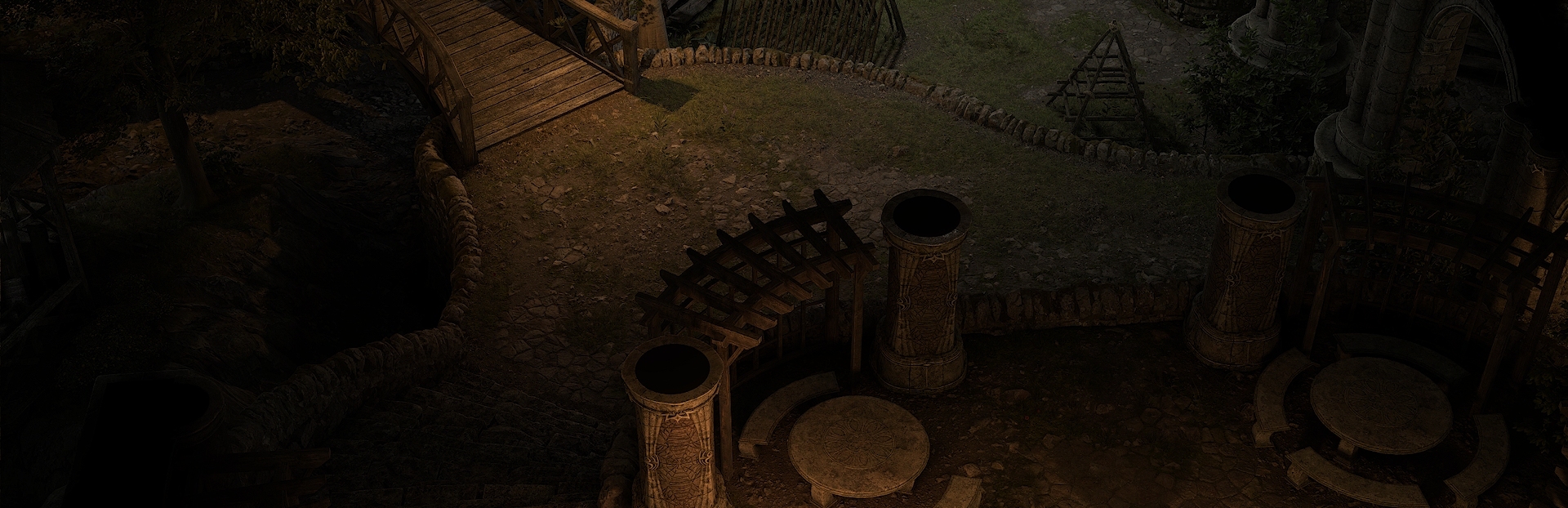
The biggest content addition yet, a huge and varied new area to explore that will play a major role in the game's story when it reaches its conclusion. As the name implies, this area features plenty of vegetation, but also open spaces and complex environment elements unlike anything in the game so far. It also features the greatest variety of encounters, and our most spectacular and fun battle yet.
We've come a long way from the early days of flat, grid based corridors, this represents the final evolution of our environments, where we no longer feel constrained by our engine's capabilities, though we do still have some tricks up our sleeve. A lot went into making this function, play and perform well on all fronts. World building and exploration are extremely important things to us, environments shape many parts of gameplay and the experience, defining what's possible, and we no longer feel we need to compromise.
GROUND AND TERRAIN
Steam post image New terrain features and overhauled assets allow us to make much more convincing and detail rich environments. The terrain and ground system has undergone a major rework, with a richer material system, support for more materials with more advanced blending, better 3D detail, displacement mapping with detail shadows and a better grass and small plant system and rendering, all of which comes with a complete overhaul of all related assets. Exanima's view means the ground is usually most of what you see, ground that is rich in detail, depth and variation is perhaps the most critical element of the visuals.
In addition to improving the visuals of terrain we've greatly expanded our tools and engine functionality with advanced sculpting features, the ability to cut precise holes in terrain and design complex procedural brushes with interactive results and more. This gives us more freedom and allows us to make better looking terrain and environments and do it faster. Steam post image Close up of our new 3D grass system and assets, featuring advanced lighting which gives it more depth.
EXTENSIVE CONTENT OVERHAULS
While Gardens is the largest content addition, almost everything in the game has been updated to take advantage of new features, the Catacombs map is greatly expanded, the golem map has been completely remastered, undead received a big visual update with exposed flesh, various other encounters were remastered, countless items were fully redesigned and more. This is part of an ongoing process to update our thousands of assets after our previous big graphics engine update and the newer features added recently, as well as just getting everything up to the same high quality standards.
Steam post image New procedural character features with exposed flesh and bones on undead, giving each one a unique and gruesome appearance.
ROLE SYSTEM AND NPC BEHAVIOUR
Perhaps our most ambitious goal for the game was the "role system". We're all about organic interactivity and emergent gameplay, and the role system was meant to fulfil that goal in the behaviour of NPCs. We built a system of emotions to drive the decisions of NPCs, and then a very simple version of roles that did little more than assign basic behaviours and nudge dispositions, but the role system as we imagined it was still a huge open ended problem, that grew in complexity as our community told us everything they hoped NPC interaction could be.
This also makes it very hard to describe, but here's the problem we're trying to solve: when games feature a designed narrative it typically follows a few rigid paths, it can't respond to dynamic events, changes in circumstance or the actions of the player, only a few scripted choices. We want both, and roles would provide carefully designed behaviours and dialogues that tell a specific story, as well as many common ones that fit the many activities, interactions and responses to events within our world. Characters can have many roles, changing dynamically as they engage in different tasks and become involved in events and plots. Roles respond to emotions and evolving relationships and remain with characters as a memory of everything they've done and said before, to draw from for further interactions.
That probably still sounds vague, and that's the nature of the complex open ended problem. But we finally buckled down and committed to a design that supports what we need to model these behaviours. We developed the structures and systems that drive these roles and relations and how they interact with everything, the tools to design them, a scripting language for our engine to support complex decision making and outcomes, a more dynamic dialogue system and more. We've been using this to create more complex dynamic behaviours and replacing our hard coded ones with these new systems, much more versatile and also open to modders. As we introduce more NPCs and move beyond the confines of Exanima these roles will drive everything.
We've also been expanding our core behaviours for AI. A prominent addition here is that NPCs can now independently search and loot the environment, containers and corpses. They can evaluate items and understand how they might fit with their equipment or be useful later. They can also do this for allies and call out when they find items that may be useful to them. Your companions are both more independent and able to assist you in searching the game's cluttered environments.
NEW THAUMATURGY
We've added a new thaumaturgy domain, and while this is a subset of powers mostly limited to NPCs, a lot of work went into developing features to support its mechanics and effects. We don't want to spoil what they are so you can experience it in game, but it involved some interesting development challenges in terms of physics, rendering and more which expand our engine's functionality in very useful ways.
We've also added the ability to absorb powers from defeated shapers. This means that when you defeat one you can learn powers from domains other than your innate one, expanding your repertoire of abilities and providing a new progression and reward system.
COMBAT AI AND TACTICS
Another thing to receive a significant overhaul is combat AI. The combat system can be highly dynamic and full of nuanced detail, but without good opponent AI it amounts to little. Exanima's combat requires complex prediction with a great many variables involved. Making AI that can feel smart and engaging to a skilled player is very difficult, and precise predictable behaviour is trivial and boring to counter with experience. AI must also vary greatly in skill, so that common encounters aren't a tedious struggle and the skilled AI stands out as such. This also allows for NPCs such as companions to progress greatly in their proficiency with experience.
Getting these things and this careful balance right has been an ongoing struggle, and as we add new larger and different creatures the rules change and the need for new behaviours arises. We have some ideas on how to enhance combat AI in many ways, but before we make additions we have to get the basics right. We had some long standing fundamental problems to solve, and we wanted a more advanced system that could produce more varied combat behaviour, such as more slow and deliberate large creatures, or just changes that reflect the personality and state of mind of different AI, not just skill, while still being effective.
Our redesigned combat AI does these things, while providing a higher skill ceiling for AI and a better scaling that makes low skill AI feel easier to beat, but not just completely stupid and ineffective. AI is now also able to smartly tackle multiple opponents rather than fixating on one, quickly switching targets to fend off an attack or use an opportunity, and making more advanced tactical decisions in general. They're also more aware of hazards, including drops, obstacles and special abilities, trying to dodge and avoid them in the heat of combat. The tactics system for using abilities is also improved, with AI that are given a random assortment of powers being able to better prioritise and plan ahead for how to use them strategically.
APPAREL AND ITEMISATION
Steam post image Just a few examples of the 60+ new and overhauled items.
Our layered and slotless apparel and armour system is designed to mimic real life, placing no restrictions on what items can be worn, in what combinations and their design, so long as they physically fit together. You can wear up to 5 items on your head alone. This has been a very difficult system to maintain as we add new items and give our character artist almost complete freedom. The number of possible combinations is incomprehensible, and yet all these items must somehow be wearable in any combination and adapt to it. There's roughly 350 wearable items in the game, and a single item could be made from over 500 meshes that are dynamically combined to create countless shape variations. Despite these efforts the game was still riddled with issues of items clipping when layered together. New items kept multiplying the rules and combinations and it just got too complex to work with.
We've long talked about a "Human 2.0", an improved system designed with the hindsight and experience of having worked this way for so long. This includes many things, but at the core of it was an improved system and tools to simplify this complex layering system and the work involved in creating items. This part we've developed now, creating a much simpler workflow for our artists, solving countless difficult clipping problems, improving how clothing and armour deforms with motion and also improving performance by better removing parts of apparel hidden under other layers. This also came with a complete rework of almost every clothing item in the game, many pieces of armour and at least some refinements to just about every item. As well as solving many issues, the redesigned items and improved features really improve character visuals.
We also improved our procedural materials which are applied to all equipment in the game, particularly with better damage and dirt effects. As well as improving existing items, we've added many new items in every category and new ones, new weapons, new elements for procedural weapons with new features there too. This includes our first batch of highly ornate procedural weapons which are the most modular and advanced yet. Our armour set encumbrance bonus system was also improved, now allowing large sets that include many variations to provide bonuses when any combination of items are worn in a way that connect with each other. Steam post image Some examples of new ornate weapons leveraging new procedural item features.
PHYSICS ENGINE
View store page Our physics engine is very much at the core of all gameplay and interaction. It is a completely custom and very unique engine designed to handle complex interactions between intricate objects while remaining stable and performant on even low end systems. Difficult interactions can be largely solved by high simulation rates, but this costs performance and is not friendly with our eventual plans for multiplayer, where stability under infrequent updates and errant behaviour is also critical. It is of course also critical in our unforgiving and perfectly persistent game world, where a physics glitch isn't just amusing or inconvenient, but game breaking.
There were two key issues we felt we needed to solve despite our modest simulation rate. One is what the community refers to as "phasing", where two colliding objects could pass through each other. This is very important especially in more advanced combat interactions. The other was stacking, basically being able to pile objects up such as books etc. which is a notoriously difficult problem, especially with lower simulation rates, and was in a particularly sorry state.
Our engine already featured Continuous Collision Detection, which means that no matter how fast or far between time steps objects moved, collisions would still be detected, but our problem was more with solving collisions when strong dynamic forces were applied to thin objects such as weapon hafts, a common occurrence with parries and grappling fighters. This and stacking both required a fundamental redesign of how our engine handled collisions and other interactions, and by extension many other things. This led to basically a full re-write of our physics engine, which involved a lot of optimisation work, but also the opportunity to include important new features. Despite its enhanced capabilities, our physics engine performs better than ever (more on that later).
One important new feature was an advanced cloth and soft body simulation system. When "human 2.0" finally comes (this will be after Exanima reaches version 1.0), we want to include simulated clothing which needs to handle complex dynamic cases, cloth has many other applications, and soft bodies will be used in fleshy environment elements, creatures, vegetation and more.
CHARACTER PHYSICS AND ANIMATION
View store page There have been many big improvements to character physics, on the back of a big overhaul of our physics engine (more on that later) and new requirements that arise with new content. Combat feels better than ever, all character motion is smoother and more precise and characters are able to negotiate things like stairs far better. There are a host of more specific improvements, many problems and clumsy things were fixed and the game just feels better to play. Character physics are at the core of all gameplay and how you interact with the world.
The steep learning curve of fine grained control over a fully simulated character will never go away, it can't and therefore shouldn't, but as characters become more competent and consistent in how they perform actions it gets easier and more comfortable. Of course it's not flawless, there's a reason a whole industry still uses basic animation and not fully simulated characters after 30+ years. We've got just one programmer developing the whole game and engine, but even if we spent 10 more years working on character physics it wouldn't be perfect, but we will keep ironing out the kinks.
After the physics engine overhaul we went through a public testing phase that inevitably became focused on combat, various core changes were made. This meant having to revisit all our designed motions, which with all the weapon setups and creatures means 100s of difficult physics based animation. We later introduced new creatures which deviated more in size and proportions to the anatomically plausible humans we built our physics on. This to our great dismay did not work at all, and led to a big overhaul of character physics from basic muscle function and structure to all the dynamic animation that keeps characters balanced and negotiating the environment etc. Once again all our designed motions no longer fit and had to be redone. These were big foundational improvements that might still need some polish, but will support the game as it continues to grow and evolve.
RENDERING ENGINE
Steam post image We've made extensive improvements to lighting, materials and added new features.
We have made several improvements and additions to our rendering engine to better support new environments and effects as well as generally better visuals. We've also improved our tools which we use to create in game assets and the many procedural materials that are used extensively throughout the game.
Our global illumination, lighting and shadows were all improved to better capture scene detail and materials, we also added displacement map shadows from all lights which add a tonne of detail and depth to details and complex surfaces making them look much more convincingly 3D. These things not only greatly improve the look of the game, but really help with your visual perception of the environment in the game's dim lighting. We've added vegetation rendering features and a few others besides to support new features and elements.
Our graphics engine focuses heavily on performance, image quality and everything being dynamic. These things are an absolute priority to us, the game must run smoothly and look crisp above all else, without steep hardware requirements. We find our own novel solutions to include advanced features and improve visual fidelity without compromising on these fundamentals and remaining highly scalable so that even low end systems can run the game well. The Gardens put a particular strain on performance due to dense vegetation combined with our many dynamic shadow casting lights, a much more costly scenario than an outdoor environment where you'd usually find vegetation. With the addition of this more taxing content and graphical enhancements we also made extensive optimisations and improved scalability so that the game runs better than ever while looking better too.
One place where we don't spare performance is our "supersampling" (for lack of a better term, it actually does much more), which received some fancy new processing to further improve image quality and motion, to better capture our detailed art. Our constantly evolving asset creation tools and procedural materials also play an important role in delivering consistent high quality, with further work going into improving the quality of our dynamically rendered item icons.
New displacement mapping with full shadows adds lots of detail and depth to objects and surfaces.
64 BIT
We've always tried to support even the oldest and most humble PC configurations, but it's been some time since we began development and now everyone is dropping support for 32 bit, including the Steam platform itself. It was time to move on and switch to 64 bit. This is a pretty big deal, in 32 bit we were limited to using a puny 3GB of RAM, a limit we've been struggling with as we keep making larger and richer content, despite our optimisation efforts. Importantly though we're now targeting much more modern CPU architectures, which gives us access to more advanced features and significant low level optimisations. Basically we can do the same things, but a lot faster, and use resources more efficiently.
Porting software to 64 bit isn't always a big deal, but in our case this meant our entire engine, game and all our development tools, an enormous code base. Our engine also includes very extensive low level optimisations, strictly designed memory layouts of data and huge amounts of hand written performance critical assembly code (this is code that deals directly with hardware / CPU level instructions) which had to be redesigned and completely rewritten for the different 64 bit instructions, data types and capabilities. This was a massive undertaking, and with it came many opportunities to revise a lot of fundamental engine systems which had to be leveraged.
We did not take this decision lightly because of the massive amount of work involved, but it was necessary to break free of that 3GB RAM limit and by leveraging 64 bit capabilities we were able to improve our engine's capabilities while also improving performance. This played a critical role in the important enhancements to our physics engine in particular.
LOADING TIMES AND STREAMING
A big addition to our engine is a new content streaming system and optimisations which dramatically improve loading times and allow content to be loaded and procedural content to be generated as you play without the game even stuttering. This was a difficult task that drastically changed these pipelines and affected many parts of the game and engine, but it represents an important foundation that enables us to do many things.
Greatly improved loading times means we can transition between areas almost instantly, giving us more freedom in design and eventually allowing things like falling into a hole to appear in another area. It also allows NPCs, and eventually other players, to travel and enter areas seamlessly, without the game having to pause to load their various assets and many procedurally generated items. When we move to massive streaming and populated environments these features will be critical, but we also hope to leverage them to basically eliminate loading of any content. In the short term it's a great quality of life improvement, transitions are snappy, the inventory can be opened without the game stuttering and every interaction and interface that involves characters and items is much faster or works seamlessly.
TOOLS, TOOLS, TOOLS
While most basic modelling work is still done in 3rd party programs, everything else we do in entirely our own tools. This includes textures, materials, level design, rigging, skinning, animating, designing roles, writing dialogue and many other things besides. This is the reality of using a completely custom engine, especially with unique approaches to many things. Far more work goes into making tools and the back end than the game itself, and reportedly this is why the industry is leaning heavily into pre-made engines, not so much for the engines, but the tools that come with them.
It's far too much to get into here, but we have been investing heavily in more and better tools, they define what we're able to do, how well and how much work and time goes into everything we do. It requires a lot work up front, but pays off big. We still have so much we want to do, and we're also working towards polished, user friendly tools that we can release to modders, already we've been working with them to create more versatile and open systems to support their work too.
WHAT'S NEXT?
As mentioned previously the following major update will be 1.0 and bring the game to its conclusion. This will include one final area and several features, but no more major engine or systems work. The game currently exists in a sort of limbo, where the core gameplay is good, but things still lack a purpose because without all the content in place they can't play their role yet. Many things that we have gradually introduced will begin to make sense, tie together and provide real objectives for the player. New NPCs will also make an appearance and drive the story forward.
Not all the features we want to add are dependent on the last bits of content being added, so we will endeavour to add some of these in smaller intermediate updates. Though recently we've limited intermediate updates to the public testing branch, we don't see the need to do this or wait for bigger updates when we don't have major system reworks resulting in engine downtime. The game should hopefully be able to survive in a good working state from here on, we've tried to make sure of this.
A lot more will come after Exanima reaches 1.0, but that's a topic for another day.
Best,
Bare Mettle
Source
Changelog.gg summarizes and formats this update. How we read updates.