
HomeGamesUpdatesPricingMethodology
Steam News22 May 20261mo ago

Dev Blog #9 - Concepting Wonder: The Art of Alderwood

Over the course of development, we’ve shown you glimpses of our creative process. From world building to narrative design, we’ve unpacked nearly every layer. But what about the very beginning?

Full notes

Full Equinox: Homecoming update

Read the full published notes in a cleaner layout. The original post stays linked below.

What changed

0 fixes3 additions4 changes0 removals
  • Events
  • Gameplay
  • Balance
  • Maps
changedBefore Florian puts pen to tablet, conversations happen. Designers, level leads, and narrative teams share their vision. Often, the space already exists in people’s minds - emotionally, mechanically, or structurally. Florian’s role as a concept artist isn’t just to visualise it, but to challenge it. Different perspectives bring different expectations. Through deep conversations about intentions, themes and feelings, those ideas begin to mesh. Part of this process involves identifying key words, themes and emotional anchors.
added“There's always this moment at the start of a new project where I'm super intimidated because I'm not sure what everyone wants. That’s a huge part of the process because then we figure it out together.” - Florian Zenz
addedWhen starting on a new area, Florian starts from a brief - a focused explanation about what the space needs to accomplish. This includes considerations about navigation, narrative context, landscape requirements, and perhaps most importantly: emotion. No matter what we’re working on, our team likes to think about what we want players to feel, to experience, and to resonate with. Curiosity? Unease? Comfort? Tension?
changedFor Florian, sketching isn’t immediately about finding the perfect design. It’s about getting the obvious ideas out first, pushing past comfort zones, experimenting, and seeing what sticks. Artists naturally favour familiar shapes and styles, but according to him, breaking that habit leads to the most interesting results.
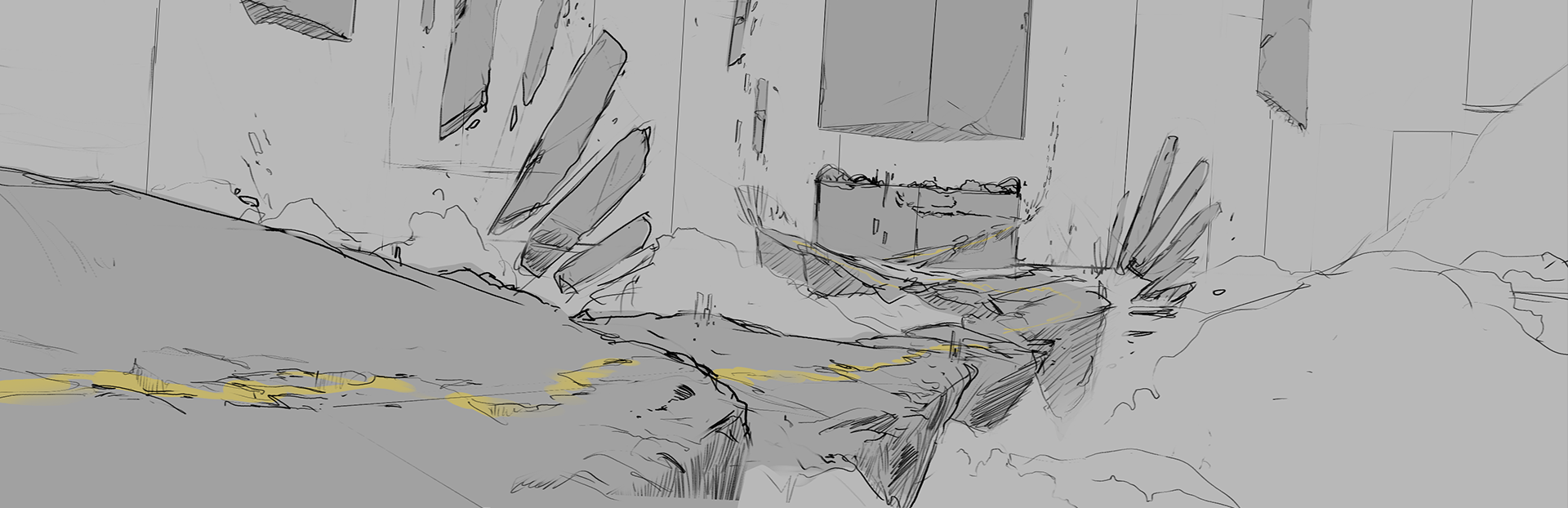
changedEarly sketches may look rough. Placeholder elements - like a grayed out horse or rider - are used to establish scale and presence. At this stage, clarity and experimentation matters more than polish.
changedThis balance is especially important in our newest zone. The goal isn’t to make players feel hopelessly lost. Instead, it’s to create a sense of wonder around a place that feels strange, even slightly unsettling, but still full of possibility and adventure.

Equinox: Homecoming changes

changedBefore Florian puts pen to tablet, conversations happen. Designers, level leads, and narrative teams share their vision. Often, the space already exists in people’s minds - emotionally, mechanically, or structurally. Florian’s role as a concept artist isn’t just to visualise it, but to challenge it. Different perspectives bring different expectations. Through deep conversations about intentions, themes and feelings, those ideas begin to mesh. Part of this process involves identifying key words, themes and emotional anchors.
added“There's always this moment at the start of a new project where I'm super intimidated because I'm not sure what everyone wants. That’s a huge part of the process because then we figure it out together.” - Florian Zenz
addedWhen starting on a new area, Florian starts from a brief - a focused explanation about what the space needs to accomplish. This includes considerations about navigation, narrative context, landscape requirements, and perhaps most importantly: emotion. No matter what we’re working on, our team likes to think about what we want players to feel, to experience, and to resonate with. Curiosity? Unease? Comfort? Tension?
changedFor Florian, sketching isn’t immediately about finding the perfect design. It’s about getting the obvious ideas out first, pushing past comfort zones, experimenting, and seeing what sticks. Artists naturally favour familiar shapes and styles, but according to him, breaking that habit leads to the most interesting results.
changedEarly sketches may look rough. Placeholder elements - like a grayed out horse or rider - are used to establish scale and presence. At this stage, clarity and experimentation matters more than polish.

Over the course of development, we’ve shown you glimpses of our creative process. From world building to narrative design, we’ve unpacked nearly every layer. But what about the very beginning?

Today our senior concept artist, Florian Zenz, shares how Equinox: Homecoming evolves from an idea into the Alderwood Island we all know and love. The concept pieces we're looking at today are a sneak peak at an exciting upcoming level…

“The interesting thing about being a concept artist is that you get a different perspective on something that people have formulated in their mind already.” - Florian Zenz

Before Florian puts pen to tablet, conversations happen. Designers, level leads, and narrative teams share their vision. Often, the space already exists in people’s minds - emotionally, mechanically, or structurally. Florian’s role as a concept artist isn’t just to visualise it, but to challenge it. Different perspectives bring different expectations. Through deep conversations about intentions, themes and feelings, those ideas begin to mesh. Part of this process involves identifying key words, themes and emotional anchors.

“There's always this moment at the start of a new project where I'm super intimidated because I'm not sure what everyone wants. That’s a huge part of the process because then we figure it out together.” - Florian Zenz

When starting on a new area, Florian starts from a brief - a focused explanation about what the space needs to accomplish. This includes considerations about navigation, narrative context, landscape requirements, and perhaps most importantly: emotion. No matter what we’re working on, our team likes to think about what we want players to feel, to experience, and to resonate with. Curiosity? Unease? Comfort? Tension?

Steam post image

For Florian, sketching isn’t immediately about finding the perfect design. It’s about getting the obvious ideas out first, pushing past comfort zones, experimenting, and seeing what sticks. Artists naturally favour familiar shapes and styles, but according to him, breaking that habit leads to the most interesting results.

Early sketches may look rough. Placeholder elements - like a grayed out horse or rider - are used to establish scale and presence. At this stage, clarity and experimentation matters more than polish.

“Our job is to make the coolest possible version of what we're given.” - Florian Zenz

In our newest chapters, players will find themselves in a place unlike anything seen before and Florian played a foundational role in shaping that experience. To create tension without overwhelming, he leans into a concept borrowed from architecture: spaces should offer both refuge and prospect. Refuge provides safety, grounding. Prospect offers openness, something distant, something hidden, something that propels you forward. When those two ideas coexist, a space becomes emotionally charged.

This balance is especially important in our newest zone. The goal isn’t to make players feel hopelessly lost. Instead, it’s to create a sense of wonder around a place that feels strange, even slightly unsettling, but still full of possibility and adventure.

“I want players to experience what I love in games; The sense that they thought they were in a place that they grasp, but don't… really hope that players get this moment of it’s scary, but also I wonder where this wild ride will go… As a concept artist that's always the dream.” - Florian Zenz

With Chapter 5, players will finally have the chance to explore this new space for themselves, and we can't wait for you lose yourself within the mystery.

Equinox Homecoming

Source

Steam News / 22 May 2026

Open original post

Changelog.gg summarizes and formats this update. How we read updates.