What changed
0 fixes1 addition6 changes0 removals
- Store
- Events
- Gameplay
- Balance
- Server
- Maps
changedAbout Mother Machinehttps://store.steampowered.com/app/1555980/Mother_Machine/
changedAbout Mother MachineIt’s pretty wild when you think about the shift in genre, but I was eager to apply our knowledge of procedural generation to the more immediate, physical gameplay that platformers offer. At its core, Mother Machine still shares a lot with the Curious Expedition games we've made before. You explore a procedurally generated world filled with obstacles, dangers, and rewards to overcome. We also wanted to keep the gameplay loop short and engaging, structuring it around runs that provide a satisfying experience within 15 to 30 minutes.
changedAbout Mother MachineFrom the very beginning, we knew we would once again rely heavily on a sophisticated procedural world generation system to create an extremely replayable game structure. However, this time, players will use the roguelite repetition to master their platforming abilities and experiment with mutations, special active abilities that let them personalize their movement and define their role in a multiplayer group.
changedAbout Mother MachineWith this article, I'm trying to give a not-too-technical overview of how our procedural generation is set up. Bear in mind that I'm not a programmer—my role in procedural generation has always been to focus on conceptual design and then tune and balance the systems. There’s a huge part of the coding side missing from this, but it would take my partner in procedural crime, Isaac Ashdown, the technical director of Mother Machine, to write that part.
changedFrom Splines to ChunksSince our game revolves around exploring the caves of an alien planet, we refer to our levels as "caves." A cave typically has a starting and ending point and follows a mostly sequential structure. However, we incorporate branching paths and loops that can reconnect different routes. The structure of a cave also varies depending on its goal type. There are six different goal types in the shipping version of the game. For now, I'll keep things simple, as these aspects are not essential to explaining the procedural setup.
changedFrom Splines to ChunksChunks are created by drawing simple splines in the Unreal Editor. This approach allows us to achieve organic shapes, long slopes, rounded corners, and other features that would be difficult to create using pre-made building blocks. Another advantage of using splines to define the shape is the ability to iterate quickly on the geometry. Adjusting the 2D spline and hitting play instantly updates the level, making it easy to test how the shape interacts with gameplay mechanics and how it feels spatially, an aspect I care a lot about.
Curious Expedition changes
changedhttps://store.steampowered.com/app/1555980/Mother_Machine/
changedIt’s pretty wild when you think about the shift in genre, but I was eager to apply our knowledge of procedural generation to the more immediate, physical gameplay that platformers offer. At its core, Mother Machine still shares a lot with the Curious Expedition games we've made before. You explore a procedurally generated world filled with obstacles, dangers, and rewards to overcome. We also wanted to keep the gameplay loop short and engaging, structuring it around runs that provide a satisfying experience within 15 to 30 minutes.
changedFrom the very beginning, we knew we would once again rely heavily on a sophisticated procedural world generation system to create an extremely replayable game structure. However, this time, players will use the roguelite repetition to master their platforming abilities and experiment with mutations, special active abilities that let them personalize their movement and define their role in a multiplayer group.
changedWith this article, I'm trying to give a not-too-technical overview of how our procedural generation is set up. Bear in mind that I'm not a programmer—my role in procedural generation has always been to focus on conceptual design and then tune and balance the systems. There’s a huge part of the coding side missing from this, but it would take my partner in procedural crime, Isaac Ashdown, the technical director of Mother Machine, to write that part.
changedSince our game revolves around exploring the caves of an alien planet, we refer to our levels as "caves." A cave typically has a starting and ending point and follows a mostly sequential structure. However, we incorporate branching paths and loops that can reconnect different routes. The structure of a cave also varies depending on its goal type. There are six different goal types in the shipping version of the game. For now, I'll keep things simple, as these aspects are not essential to explaining the procedural setup.
About Mother Machine
After working for 10 years on games that rely heavily on procedural generation, we are about to release our latest game, Mother Machine, on March 26th. Unlike our previous games, which were tile-based strategy games, Mother Machine is a 2.5D multiplayer platformer with a strong emphasis on exploration.
https://store.steampowered.com/app/1555980/Mother_Machine/
It’s pretty wild when you think about the shift in genre, but I was eager to apply our knowledge of procedural generation to the more immediate, physical gameplay that platformers offer. At its core, Mother Machine still shares a lot with the Curious Expedition games we've made before. You explore a procedurally generated world filled with obstacles, dangers, and rewards to overcome. We also wanted to keep the gameplay loop short and engaging, structuring it around runs that provide a satisfying experience within 15 to 30 minutes.
From the very beginning, we knew we would once again rely heavily on a sophisticated procedural world generation system to create an extremely replayable game structure. However, this time, players will use the roguelite repetition to master their platforming abilities and experiment with mutations, special active abilities that let them personalize their movement and define their role in a multiplayer group.
With this article, I'm trying to give a not-too-technical overview of how our procedural generation is set up. Bear in mind that I'm not a programmer—my role in procedural generation has always been to focus on conceptual design and then tune and balance the systems. There’s a huge part of the coding side missing from this, but it would take my partner in procedural crime, Isaac Ashdown, the technical director of Mother Machine, to write that part.
I would like to give a shoutout to Derek Yu’s Spelunky and Darius Kazemi’s Spelunky Generator Lessons, which were, of course, very influential in shaping the initial starting points of our procedural design.
From Splines to Chunks
Since our game revolves around exploring the caves of an alien planet, we refer to our levels as "caves." A cave typically has a starting and ending point and follows a mostly sequential structure. However, we incorporate branching paths and loops that can reconnect different routes. The structure of a cave also varies depending on its goal type. There are six different goal types in the shipping version of the game. For now, I'll keep things simple, as these aspects are not essential to explaining the procedural setup.
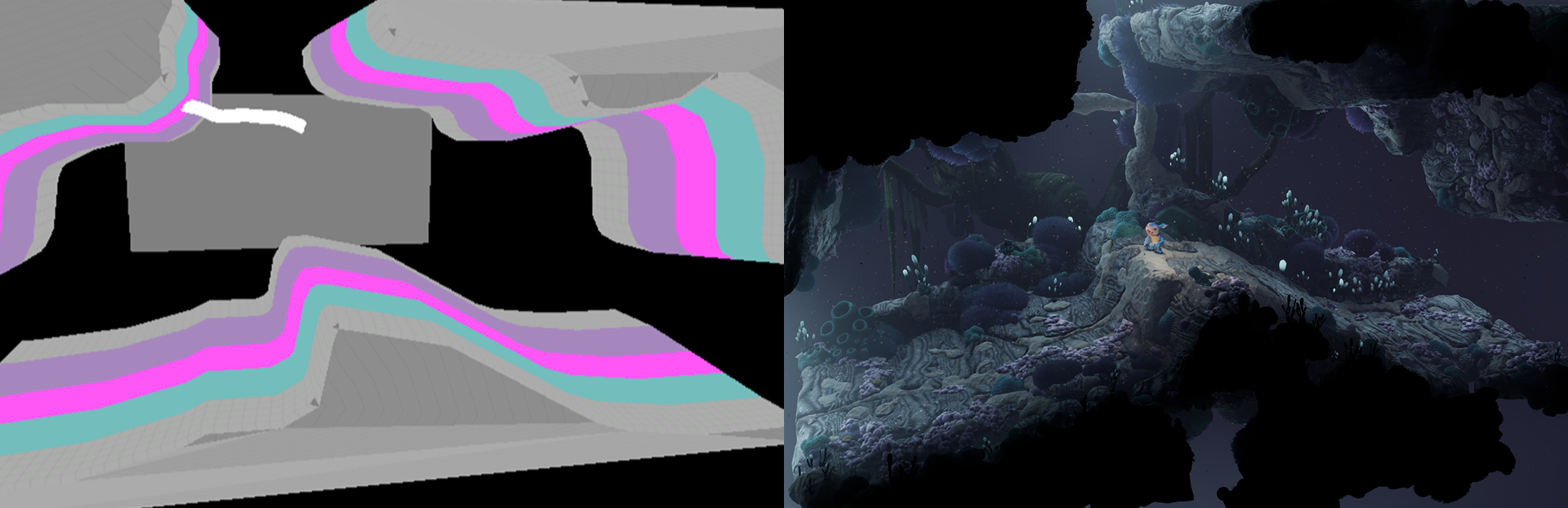
The basic building blocks of our caves are called "chunks." A chunk is a hand-designed piece, similar to a puzzle piece, that contains a set number of what we call "anchors." These anchors allow chunks to connect seamlessly to other chunks with matching anchors.
Chunks are created by drawing simple splines in the Unreal Editor. This approach allows us to achieve organic shapes, long slopes, rounded corners, and other features that would be difficult to create using pre-made building blocks. Another advantage of using splines to define the shape is the ability to iterate quickly on the geometry. Adjusting the 2D spline and hitting play instantly updates the level, making it easy to test how the shape interacts with gameplay mechanics and how it feels spatially, an aspect I care a lot about.
Another advantage of using splines is that they allow us to generate any type of geometry. This means that all designed chunks can be used in any biome of the game. As a result, creating additional chunks benefits all biomes, regardless of when they are released.
The process of generating 3D geometry