
In this update15
Full notes
Full Crisis Cabinet update
Read the full published notes in a cleaner layout. The original post stays linked below.
What changed
- Gameplay
- Maps
- UI and audio
- Events
- Balance
Crisis Cabinet changes
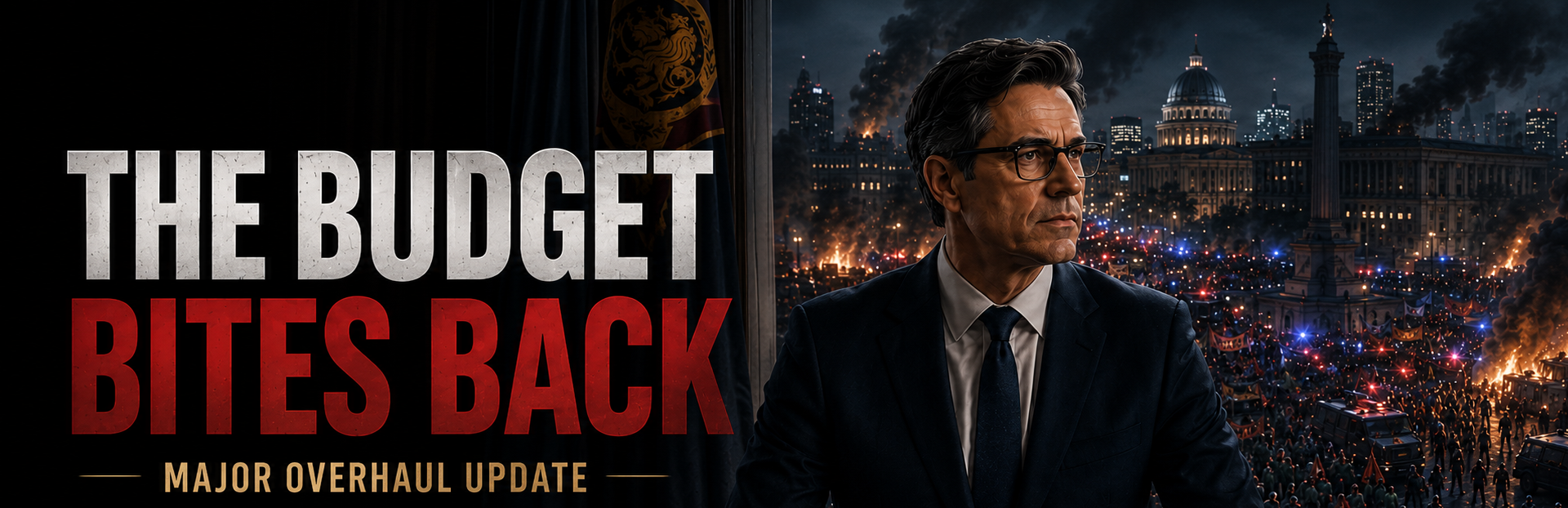
The Budget Bites Back
This week, we have completed one of the largest gameplay overhauls to Crisis Cabinet so far.
The national budget is no longer just a collection of sliders and numbers. Every investment, cut, emergency intervention and questionable political compromise can now create consequences that unfold over several turns.
Some results will be immediate.
Others may take time to appear.
And some will return later to make you deeply regret your earlier confidence.
Every Pound Has Somewhere to Go
The entire financial system has been rebuilt so that the national budget now fully reconciles every turn.
Government spending is calculated from its real components, including:
Departmental budgets
Debt interest
Existing policy commitments
Emergency spending
Corruption and financial leakage
This means there should be no more phantom expenditure, unexplained Treasury gaps or mysterious changes hidden behind the simulation.
When the country runs out of money, you will be able to see exactly where it went.
Unfortunately, knowing where it went will not necessarily help you get it back.
Decisions Now Create Consequence Chains
Every departmental budget change can now generate a chain of connected outcomes.
For example, increasing healthcare funding may improve services immediately, reduce working days lost to illness several turns later and eventually place additional pressure on pensions and long-term public spending.
Cutting a budget may provide instant savings, but the real cost might not become apparent until much later.
Consequences are divided into three stages:
Immediate effects happen when the decision is made.
Delayed effects appear after an investment or reform has had time to work.
Secondary pressures develop as the wider consequences begin affecting other parts of the country.
Your decisions no longer disappear once you press the button. They remain part of the simulation and may continue shaping events long after you have forgotten making them.
Draft Your Budget Before Committing
Changing a departmental budget now creates a draft rather than immediately applying the decision.
The game will show a live preview of:
The additional cost or saving each turn
Immediate statistical changes
Benefits expected in future turns
Secondary pressures that may develop
The political capital required
Selecting Apply Budget opens a final confirmation showing the full before-and-after impact, including effects scheduled for later turns.
Selecting Cancel restores the previous budget completely. No action is recorded, no consequences are created and nothing quietly changes behind the scenes.
Even the civil service has been instructed not to process the wrong paperwork.
Why Did This Change?
Every major statistic now includes a? button that reveals exactly why it moved.
The breakdown shows:
The decision or event responsible
The precise increase or decrease
Why the change occurred
Whether it was immediate, delayed or secondary
When the original decision was made
The value before and after the change
If public confidence suddenly collapses, you will no longer have to guess whether it was caused by the tax rise, collapsing public services, a political scandal or something you approved three turns ago.
The evidence will be available.
Whether you accept responsibility is entirely up to you.
Political Capital Is Now Visible
Political capital gains and losses are now displayed live in the top bar.
When a decision costs political capital, the exact deduction appears immediately. Gains and losses are animated and colour-coded so you can clearly see the political price of each move.
A policy may be affordable financially but impossible politically.
Alternatively, it may be popular, inexpensive and an absolute catastrophe for the country.
Choose carefully.
A Better End-of-Turn Report
The post-turn report has been redesigned to explain how the consequences of your decisions are developing.
Each report is now divided into three sections:
What Just Happened
The immediate effects applied during the current turn.
What Is Beginning to Work
Delayed benefits from earlier investments and reforms that are now producing results.
What Pressure Is Building
Secondary problems developing beneath the surface, often creating new decisions that will require your attention.
The aim is to make each turn feel like a developing political story rather than a wall of unexplained statistical changes.
You will be able to see which policies are succeeding, which problems are getting worse and which apparent victories may be creating tomorrow’s crisis.
Emergency Spending Is Now Properly Tracked
Emergency actions and crisis responses have also been rebuilt.
Emergency expenditure is now recorded separately within the national budget, allowing you to see exactly how much each crisis has cost.
The game also safely records emergency decisions before updating the interface, preventing actions from becoming disconnected from the underlying save.
Active crises will no longer trap the game indefinitely unless the situation is genuinely critical, such as an imminent coup or revolution.
Less severe crises can continue developing if ignored.
This prevents softlocks while preserving your constitutional right to pretend a problem does not exist.
Stronger Save Protection
The save system has received a significant reliability overhaul.
Ironman mode will now stop the game if saving fails, rather than allowing you to continue with progress that may not have been recorded.
The game can now:
Detect corrupted save files
Offer recovery or deletion options
Upgrade older saves to newer versions
Display saving, saved and error states
Retry failed saves
Preserve future consequences after reloading
The consequence system also prevents duplicate effects, meaning reloading a save or reprocessing a turn will not cause the same outcome to be applied twice.
Your previous decisions will still return to haunt you.
They will simply do so once.
Policies Now Follow Proper Rules
Policies have been reorganised into clear lifecycle types.
The game now distinguishes between permanent reforms, temporary emergency measures, repeatable actions, ongoing policies, tax changes and decisions that cannot easily be reversed.
This gives every policy a clearly defined route through the simulation and creates a much stronger foundation for future content.
Unknown or incorrectly configured policies will now produce a proper validation error rather than quietly doing something unpredictable.
Additional Improvements
We have also improved:
Budget slider clarity
Draft and committed value displays
Warning colours for dangerous statistic levels
Consequence previews beside each department
Advisor briefing behaviour
Overlapping and hidden modal windows
Crisis resolution
End Day restrictions
Directional indicators for statistic changes
Consequence tracking across saves
Behind the scenes, the new systems are protected by more than 500 automated tests, including complete browser-based tests that play through the full budget cycle from campaign creation to delayed benefits and secondary pressures.
What This Means for Players
Every major financial decision now has visible, traceable and potentially long-lasting consequences.
You can see where the money went, why a statistic changed, which earlier decision caused it and what new pressure may be developing beneath the surface.
The goal is not simply to make the simulation more complicated.
It is to make it more understandable, more strategic and far more reactive to the choices you make.
You will still have to make impossible decisions.
You will just have fewer excuses when they go wrong.
Source
Changelog.gg summarizes and formats this update. How we read updates.