
Full notes
Full Chickenhare and the treasure of Spiking-Beard update
Read the full published notes in a cleaner layout. The original post stays linked below.
What changed
- Balance
- Gameplay
- UI and audio
- Events
Chickenhare and the treasure of Spiking-Beard changes
When we think of a game designed to be accessible for children, the first reaction is often: “So, it’s going to be easier, right?” After all, when you design at a child’s level, you need to strike a balance between learning and frustration, freedom and guidance — with gameplay that’s simple to grasp. But the reality is far more subtle: making a platformer accessible doesn’t mean removing challenge, depth, or difficulty.
It’s first and foremost about introducing difficulty the right way and making adjustments that work for all kinds of adventurers, as explained by Lucie Deschamps:
“The speed at which a puzzle is solved doesn’t depend on whether the player is a child or an adult, but rather on whether they’re used to playing games or not. The way people think, between those who play often and those who don’t (or barely do), can be very different, because it’s a different perspective. So, to make sure all types of players could succeed at puzzles, we opened up the space in those areas and added clear environmental hints on how objects function. This way, everyone can solve them if they pay attention, even if it takes longer for those less used to playing.”
For example, a tutorial that can be intuitively understood by both adults and kids clears visual clutter and reduces frustration, without altering the difficulty. It’s about designing the interface, choosing precise wording without infantilizing players, and carefully timing when tutorials appear.
As for difficulty itself, while there’s no golden rule, progression is key. In Chickenhare and the Treasure of Spiking-Beard, progression is both gradual and, as expected from a non–open world, linear. Théo Pottier outlines the structure:
“Each world in the game is made up of three different levels. Each level has adaptive difficulty to help the player learn the new mechanics of that world:
Level 1: introduction to the world + new mechanics
Level 2: mastering those mechanics
Level 3: increased challenge through enemies and platforms.”
This triptych structure allows kids to learn and ease into the game without frustration, while more experienced players can still enjoy the mechanics and have a good time. After all, that’s the essence of platformers, which remain lighter than the “die and retry” mechanics of Souls-likes: here, death or mistakes aren’t designed as punishments or sources of frustration.
The team also worked on rewarding players for experimenting, even if they didn’t succeed on their first try.
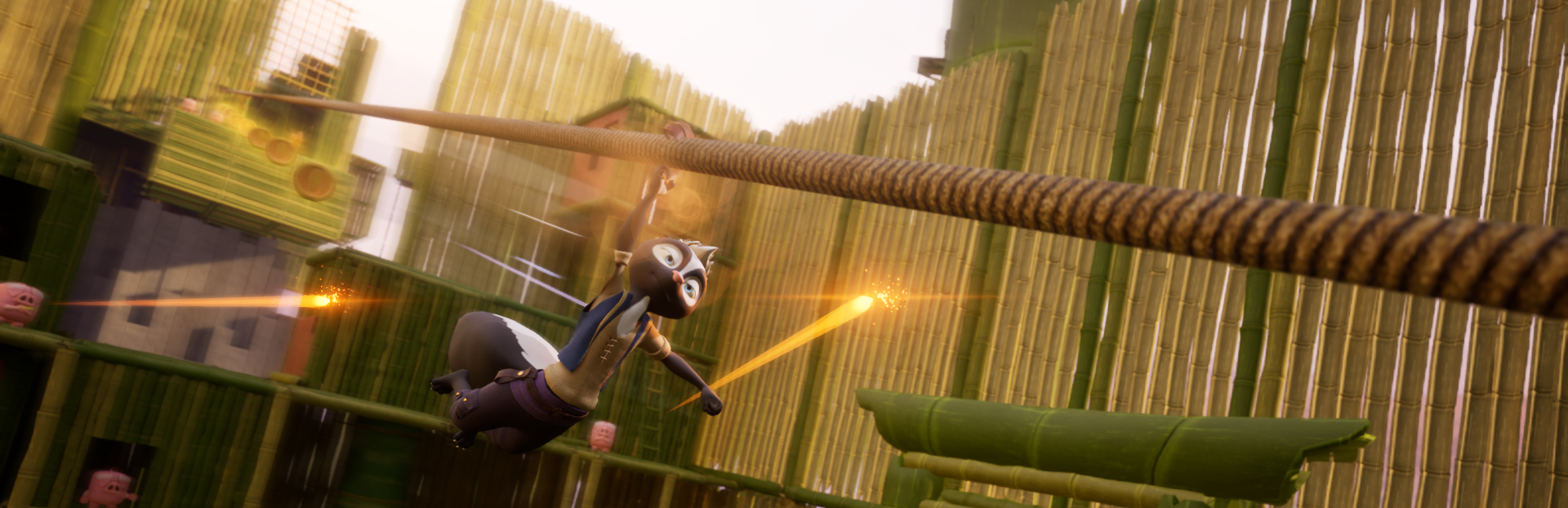
“The main mechanics of the three heroes were defined by how fun they were to use. Once validated, we built level elements that would react to them. There are many elements that respond to the whip (a mechanic shared across the three characters), and objects that can be broken (by Meg’s punches or Archie’s shell). With so many interactive elements spread around, every player action brings some sort of reward. This encourages players to test these mechanics on anything they can find in a level,” explains Lucie.
Through equipment like the whip, which can also serve as a grappling hook, or the unique traits of each character, the inaccessible becomes accessible — as long as the player experiments, asks questions, and seeks to understand their environment. Even a failed jump with Hopper can turn into a learning moment, thanks to his gliding ability:
“For Hopper, for example, a simple jump can trigger the gliding mechanic. Not only does it fit the character, but it also reduces frustration tied to jumps that require more precision,” Théo adds.
Guiding players is essential, but it shouldn’t overshadow gameplay itself: there needs to be room for error, experimentation, and correction — much like the 2D games of our childhood. Olivier Pignol-Guidicelli reflects on how this shaped the design:
“Where necessary, we placed several visual indicators, like arrows, in levels to guide players. In the tutorial, for example, conveyor belts were added to help players retrace their steps.”
Playtests further refined these initial concepts, especially when faced with real player habits — kids and adults alike. In fact, playtesting with children often challenged some assumptions. Arthur Rogery recalls one striking anecdote:
“We were exploring different options for Chickenhare’s glide controls: either assigning it to the same trigger button as the other characters’ special actions, or pressing the jump button a second time in mid-air. During a playtest, we saw a child using his left hand to reach over and press the trigger, twisting his whole body to pull it off. From that moment, the decision was obvious!”
In this case, accessibility wasn’t about simplification or lowering difficulty, but about fluidity, so that the game stayed fun and approachable for all body types.
Conclusion: Accessibility Redefines Difficulty
The team never set out to make an “easy” platformer. They wanted a game that teaches, rewards curiosity, and grows with the player. The challenges are there, but they’re designed to be inviting rather than discouraging.
In short: accessible doesn’t mean effortless. It means that every adventurer, young or old, can experience this virtual journey at their own pace!
Source
Changelog.gg summarizes and formats this update. How we read updates.