
In this update3
Full notes
Full Canvas City update
Read the full published notes in a cleaner layout. The original post stays linked below.
What changed
- Gameplay
- Maps
- Balance
- UI and audio
Canvas City changes
Painting Outside the Lines: Designing New Tactics RPG Classes
Most tactics RPGs inherit their classes from fantasy games; Knights, Archers, Rogues, Clerics, Mages… and these archetypes exist for good reason. Players immediately understand what role they play and how to best utilise them - you’re not about to send your cleric to the front or move your assassin around in a big group.
But Canvas City started not from a “lets build a fun tactics game” premise, rather we were wondering if you could marry a game mechanic built around time and strategy with a theme that is all about continuous movement and flow - i.e. skating games.
On paper, it’s a bit of a design doozy; skating games are usually about momentum, movement, and timing, whereas tactics games are turn-based, crew-based, and often combat-focused. Could those two even fit together?
We were curious enough to prototype, and something really clicked with what we made - watching players deciding which combination of ramps, and rails could get their skaters half way across the map in one turn, which building top would give them the best advantage to launch an attack or what tricks to use to get them that bit further that turn to take a tag spot from the enemy.
Breaking Formation
Once we were committed to the idea the question of classes came up pretty early, though it was a while before we really figured them out. Breaking down RPG combat into roles is a very well understood structure; at its simplest you usually have tanks soaking up damage, damage dealers that can’t take much punishment themselves, and support units trying to keep out of the action, darting in to provide healing and buffs to their allies.
But that doesn’t naturally fit either our skating theme or the faster paced experience we were targeting - a tank standing still and soaking damage doesn’t really fit a game built around movement and expression.
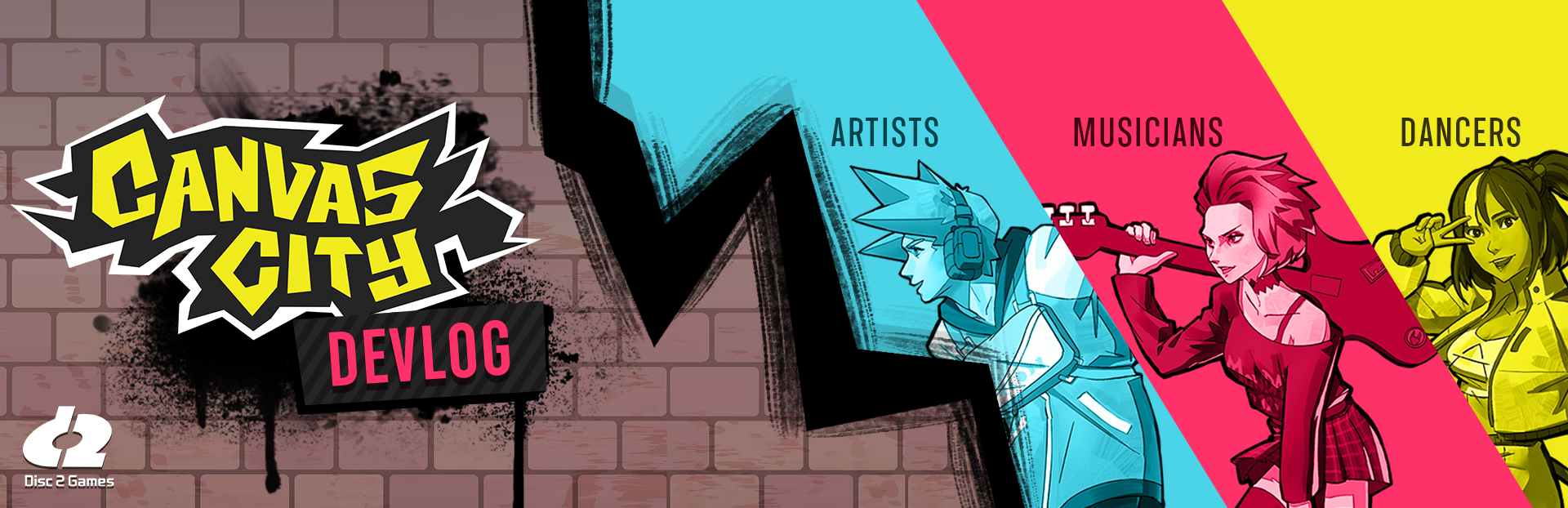
So we started to wonder about creating our own classes and what their roles and identities would be. We felt they needed to be familiar for players to quickly understand them, but designed specifically for the world and mechanics of our game. We landed on Dancers, Musicians and Artists.
Dancers
For a while we thought Dancers would be our tank-type class, drawing in enemy units and keeping them occupied with sick floor spins and damage debuffs, but it became clear in playtesting that the fun part of Canvas City was always being on the move and that tied nicely into one of our core mechanical designs; movement and actions are not separated into rigid phases - in Canvas City you can move, attack, reposition, use multiple abilities and keep moving again as long as you have the resources to do it.
Once we flipped Dancers into a support role, things clicked into place. Because the game encourages you to spread your crew out across wide, vertical environments, it can be pretty difficult to keep everyone grouped together. Dancers being mobile and having access to AOE heals and buffs balances naturally against that.
Musicians
Musicians as our ranged units made a whole lot of sense thematically - we can’t tell you exactly how they manage to pinpoint and target their aural creations from such a range, but go with it. Musicians become a really useful tactical tool in a game so heavily focused on verticality. Since moving uphill costs MOV and travelling downhill awards it, positioning and elevation become a huge part of how battles play out. Musicians can help equalise some of that by still applying pressure from difficult positions or across large gaps in the environment.
Artists
Artists specialise in close-range damage and aggressive positioning, acting as the crew’s primary melee attackers. While Musicians can pressure enemies from afar and Dancers support the wider crew, Artists are usually the ones diving directly into contested spaces and shifting the flow of SPs (Style Points) by claiming and retaking tag spots.
Shedding the Uniform
RPG classes have built up a very strong visual language over the years and across countless games; you see a character in plate armour carrying a shield and immediately understand they are probably defensive, a figure in robes standing at the back of the group is likely providing healing or ranged support. A huge amount of information is communicated before the player even presses a key.
But our whole premise is a crew of young creatives brought together by a shared frustration with the increasingly controlled and sanitised world around them, and having units all look and move the same kind of breaks that premise.
But this is where our remix of classes really started resonating in playtests. Without traditional silhouettes and costumes players didn’t have preconceived notions of how to play those characters. Rather than immediately trying to map characters onto familiar archetypes, players explored the difference, working out the strategic benefits and flaws to each character and class.
We did still need players to understand what each character actually did in battle though, and so we found ourselves leaning much more heavily on Ability identity and behaviour. Every class has a free Ability that acts as an anchor point for the player’s general understanding of that role; Brand is a close-range attack for Artists, Sonic Blast is a ranged attack for Musicians, and Cheer is a healing ability for Dancers.
Freestyle
By now we were really leaning into how the themes of skating and artistry were naturally evolving our game mechanics from its traditional tactics base, and so decided we didn’t want class boundaries to become too rigid. While Dancers are the game’s primary support class, many also unlock offensive abilities depending on how you build them. Some Musicians specialise in long range pressure while others lean toward disruptive AOEs or close-range attacks. Artists tend toward aggressive close-range combat, but some become stronger isolated away from the group while others are at their best embedded within the crew supporting nearby allies.
That flexibility ended up becoming really important for the broader tone of the game because these characters are not supposed to feel like military units fulfilling a battlefield role. They are skaters, performers, painters, and creative weirdos trying to express themselves in different ways. Our class structure needed to support tactical play, but also needed to leave room for personality, and we’re excited to see how the wider RPG community interacts with this new class spin on team tactics.
Source
Changelog.gg summarizes and formats this update. How we read updates.