
In this update6
Full notes
Full Call to Arms: Panzer Elite update
Read the full published notes in a cleaner layout. The original post stays linked below.
What changed
- Maps
- Gameplay
- Balance
Call to Arms: Panzer Elite changes
Hello Tank Commanders!
Welcome back to another installment of our dev diary series for Call to Arms: Panzer Elite!
Today, we’re taking you behind the scenes of one of the most challenging and rewarding parts of development: map production. Every battlefield you fight on has a story, and creating those maps is where history, research, and gameplay all collide.
Research Comes First
Our process always begins with research. From famous operations to smaller but equally dramatic engagements, we look for moments in history that can inspire compelling missions. Archival photos, maps, veteran accounts, and even on-site visits all shape the foundation of a map.
But we also learned early on that reality doesn’t always fit inside our maps. Technical limitations mean we can’t reproduce every hill, town, and valley of a real battlefield at full scale. Many locations cover vast areas, full of unique challenges and details that simply wouldn’t fit into a single level.
Instead, we distill the essentials of the terrain. We take the most interesting features -the chokepoints, ridges, crossroads, and strongholds - and bring them together into one playable area. This way, players can experience a wide variety of tactical challenges inside a relatively compact battlefield, without losing the authentic feel of the original location. Steam post image
From History to Gameplay
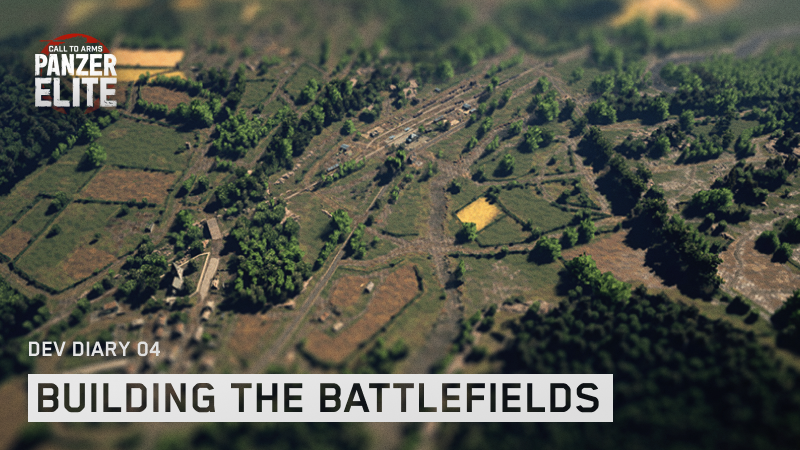
Take our Mortain mission as an example. The real battle in August 1944 was defined by German forces attempting to recapture the heights around the town. Instead of focusing on the town center, we decided to highlight the surrounding high ground and a railway station - a setting that naturally creates choke points, ambush sites, and room for armored maneuvers.
This balance of authenticity and design freedom gives us both the atmosphere of Normandy and the intense gameplay you expect from the tank battle game. Steam post image
Walking the Ground
To truly capture the feel of these locations, our team even traveled to Normandy. Standing on the ridges, walking through the bocage, and visiting Mortain itself gave us invaluable perspective. Photographs can only take you so far - experiencing the terrain in person helps us recreate the mood and flow of the battlefield in a way that feels real, not artificial.
During these trips, we also took hundreds of reference photos of landmarks, terrain, and structures. From bridges to old farmhouses, many of these details found their way directly into the game. Whenever you cross a narrow bridge under fire or push through a hedgerow, chances are it was inspired by something we stood in front of and documented ourselves. Steam post imageSteam post image
Iteration, Iteration, Iteration
Map design doesn’t happen overnight. Early sketches are tested, refined, and sometimes completely rebuilt. We brainstorm, block out terrain, and playtest repeatedly until the battlefield feels just right. Each map goes through multiple iterations before it reaches the balance of historical inspiration + engaging gameplay.
To support this process, we’ve built our own set of tools. These allow us to quickly block out interesting positions for the player, populate the battlefield with life, and shape the environment so it feels authentic. On top of that, we developed entirely custom mission tools that let us control the flow of each scenario - from the pacing of enemy attacks to the timing of reinforcements. Together, these systems help us transform a rough sketch into a living, breathing battlefield. Steam post image Steam post image
Experiencing It All
Of course, all this effort - the research, the trips, the tools, the iterations - has one goal: to create a battlefield you can truly feel. We want every map to be more than just a stage for combat; it should be an experience that puts you into the boots of a tank commander. Whether you’re holding the line on a ridge, ambushing through the bocage, or storming across that bridge we photographed, the aim is for you to live history while shaping the outcome yourself.
What’s Next?
Thanks for sticking with us! We can’t wait for you to experience everything we’ve been working on and to appreciate the battlefields firsthand. Every trench, ridge, and farmhouse was crafted with care to challenge your tactics and immerse you in the struggle of World War II.
See you on the battlefield - and as always: Happy tanking!
Source
Changelog.gg summarizes and formats this update. How we read updates.