
In this update5
Full notes
Full Body of Work update
Read the full published notes in a cleaner layout. The original post stays linked below.
What changed
- Gameplay
- UI and audio
Body of Work changes
Six months ago, Body of Work was a small idea inspired by a lecture about embodiment and play. Today, we’ve reached the end of our MVP phase, and have playable versions of all of our key systems. This post is a look back at how we got here.
Uncertain beginnings
The original concept of Body of Work came out of a lecture I taught to first year game development students in August 2025. We discussed embodiment, immersion, and the relationship between players and the characters they play.
At the time, the game was scoped as a tiny solo project. I wanted to make something experimental but contained, focusing on what I could do within my skillset. I've been making games for over a decade and although I know some basic logic, programming will always feel like wizardry to me, so that was my primary limitation.
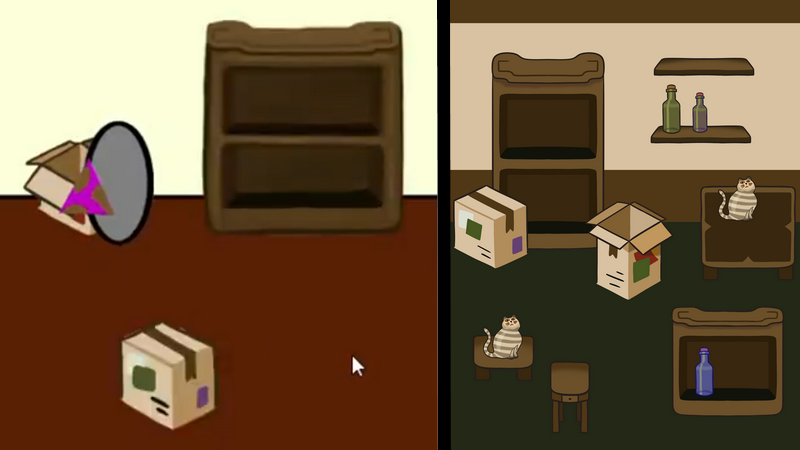
My first prototype was made with visual scripting and included this pink dirty triangle in place of antiques.
Convincing Pontus
Coincidentally, during this time, Pontus and I started speaking about our past projects and how we missed working together. Our individual circumstances meant Horned Llama had to be put on hiatus for a while, but we were suddenly in a position where we could finally work together again. But what were we going to make?
Well, I had an idea.
I showed Pontus my design documents and silly prototype, and somehow he saw the vision. Horned Llama was so back, baby!
This shift reshaped the project in a few key ways. The core idea remained the same, but the possibility space expanded. I may think of programming as wizardry, but Pontus is a wizard! This meant features and systems that had previously felt unattainable were now firmly on the table.
What MVP meant to us
Our first task as a team was to figure out all of the core systems and story beats we wanted represented in our MVP, and the steps we would need to take to get there.
Over the last six months, we have made prototypes of:
Item unpacking and placement systems
Antique interactions, including cleaning, opening, combining, and animating
Diverse NPCs with branching dialogue systems (using Yarn Spinner)
Dynamic music
Gamefeel elements like SFX, particle effects, and other feedback
The end result is a playable prototype made in Godot that has allowed us to prove the viability of our game concept and test our complete game loop.
[carousel]
[/carousel]
What’s next
Now that the MVP is complete, our focus is shifting to:
Integrating systems so we can experiment with the ways they interact
Refining features so they feel smooth and intentional
Expanding content within the systems we've built
We've also learned that it's much easier to accidentally introduce friction for a player than to create interactions that feel natural and satisfying. Players can sense when something feels "off" even if they can't articulate why. Tracing that feeling back to specific design decisions will be one of the hardest and most important parts of ongoing development.
Follow along
If you’re interested in how Body of Work continues to evolve, wishlist on Steam!
Follow for future updates as we move toward demo and release.
Alayna Cole
Creative Director
Horned Llama
Source
Changelog.gg summarizes and formats this update. How we read updates.