
Full notes
Full Agent of Strange update
Read the full published notes in a cleaner layout. The original post stays linked below.
What changed
- Gameplay
Agent of Strange changes
Hi! This is Sever Studio.
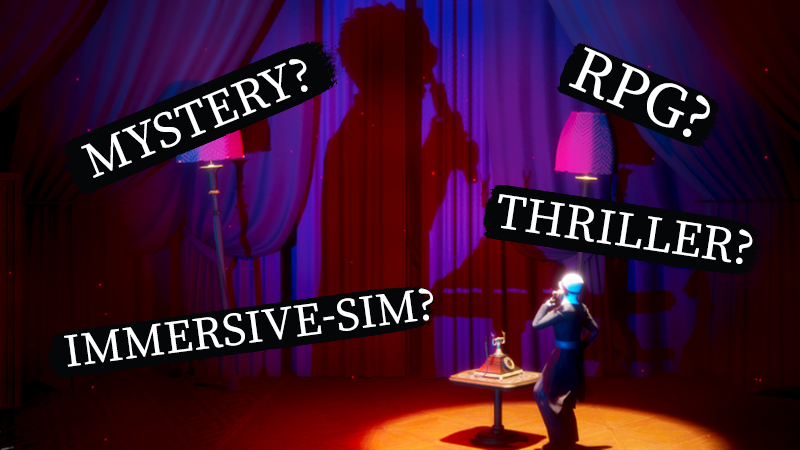
Today we’d like to talk about the genres Agent of Strange belongs to — and how those genres actually take shape in the game.
The first and core genre is RPG — and in the most literal sense of the word. A role-playing game as the freedom to play a role you create for yourself. Our goal as authors is to give players as much room for self-expression and role-play as possible, and to ensure that the world reacts to how you act. We deliberately avoid imposing a predefined personality or a “correct” way to behave — this principle lies at the very foundation of the game.
It’s also important that you are not an abstract adventurer. Your character has a real social role and exists within an urban society. You are a Conspirato r with your own hidden objectives, but you operate inside the system, not outside of it. You must maintain your cover, appear as an ordinary citizen, fulfill everyday duties — such as going to work — while simultaneously advancing your secret agenda. This is why Agent of Strange can be described as a social and narrative RPG.
Do we have classic RPG elements like combat? Yes — but we frame them as conflicts.
Every conflict in the game is first and foremost a narrative situation, heavily shaped by circumstances: who you’re facing, in what context, and how you choose to handle the situation. There are many possible resolutions, all of which depend on your decisions, your character’s parameters, and the current state of the world.
Your character is defined not only by their social role, but also by a broad set of parameters. We’ve worked hard to keep this system intuitive, avoiding overloading it with terminology and hidden mechanics. It’s important what you can do, what you’re prepared for, your past, and your current condition — all of this is communicated directly. Other characters in the world follow the same principles, which makes interactions feel consistent and believable.
Stylistically, Agent of Strange sits at the intersection of thriller, mystery, and detective fiction. At the same time, immersive-sim elements are extremely important to us. The game remains strongly narrative-driven, but within individual missions we aim to provide freedom of interaction with the world, the environment, and other characters — allowing for unexpected solutions, sometimes even surprising us as developers. We treat each mission as a narrative sandbox: it has story boundaries, but within those boundaries you’re free to act in different ways, combine approaches, and arrive at different outcomes.
Player actions never exist in a vacuum. Every decision has consequences that accumulate over time and begin to interact with one another. Time also progresses in the game — days pass, and with them, the City itself changes.
Source
Changelog.gg summarizes and formats this update. How we read updates.