
In this update8
Full notes
Full Above: Colonies of the Mist update
Read the full published notes in a cleaner layout. The original post stays linked below.
What changed
- Performance
- Gameplay
- UI and audio
- Balance
- Server
- Maps
Above: Colonies of the Mist changes
Hey Explorers,
The world of ABOVE: Colonies of the Mist is an unforgiving place. Crisscrossed by deep valleys with jagged spires of land dominating the skyline, a travel agent would describe the place as ‘unique’ or ‘dramatic’. The colonists who’ve crashed there would be more practical, likely choosing less flattering adjectives.
If surviving an airship crash and building a camp with no hope of rescue is already a struggle, then trying to cross a canyon under those conditions becomes downright daunting. The terrain is fragmented and the drifting mist makes any descent fraught with danger. Every journey between them is a risk. That’s the world you’ll be stepping into.
The Gameplay
So far we’ve been talking about the thematics of the world. But we’re posting this on Steam, it’s a dev blog, there’s gameplay to consider. Let’s talk about why we’re doing this.
Colony Builders vary massively from the early game to the late game. Early game, you’ve got a tiny handful of buildings available and this enormous, blank canvas. You’re throwing things in with wild abandon, full of hopes for what the future holds. It’s creative and chaotic in equal measure.
Later, with tonnes of options, the canvas shifts. All of the foundations you lay in the early game are still around and now you’re building around and on top of them. The handful of colonists you started with are now a thriving metropolis.
Both phases are fun, but they hold different appeals.
Common Gotchas
Feedback is the most important aspect of game development. It’s one of the reasons we want to be running this series of blogs, so we can start a conversation with you about what the game is and how we can make it better.
We’ve had these conversations with people already, as well as internally, and we’ve noticed there are three broad topics that tend to come up. They’re not the only three - the conversation is huge! - but we’d be foolish to ignore what players are already saying about the genre.
“I wish I hadn’t placed that building there.”
This gets said whenever we make a smart decision in the first phase that comes to bite us in the second phase. The next time you play the game you’ll know not to place the blacksmith next to the house because the sound of nocturnal hammering will make the residents unhappy, but in that first playthrough? The reduced commute time was too tempting.
“The game takes a while to get going.”
Don’t get me wrong. This can be said about slow games – slow games do exist. But it might also be that the player just really enjoys the second phase more. They’re not looking for that chaotic early game environment; they’re after the deep, complex systems with lots of moving pieces and endless opportunities to optimise.
“The game gets bogged down.”
Of course, there are those of us who love the early game. They enjoy the blank canvas, the improvisation, and the sense of discovery. For them, the late game can feel like a chore with too many moving parts, too much micromanagement, too much pressure to optimise, but the genre traditionally funnels everyone toward the same late‑game complexity whether they want it or not.
How ABOVE: CoTM Handles This
We want to give you a game that appeals to you, that you can play how you want to play. Our solution is to evolve the genre from a Colony Builder to a Colonies Builder.
The single, large map is naturally divided by valleys and Mist, creating a patchwork of isolated plateaus. Each one has the capacity to become its own micro-colony, which we’re calling Outposts, with its own constraints, opportunities, and personality, all present in the same map. There’s no abstract view or loading screen at play here. This changes the experience in a few key ways.
First of all, you can’t connect everything immediately. We’ll talk about how Expeditions from one area to another work in a later blog, but the essence is simple; You’ll be equipping brave teams of Colonists to venture to new lands where they’ll uncover secrets, rescue other survivors, and establish fresh colonies.
Everyone is working toward a greater goal. Ultimately, your colonists want to find a way home, but until they can chart enough of the world, and decode the mysteries of the ruins, they’ll have to make the most of their situation. The Outposts you build aren’t in competition with each other, but rather, supporting each other.
For example - early on you might find yourself with an Outpost in the grasslands. It’s lush, fertile territory, and your gatherers can have a literal field day collecting berries. Before long their depots are overflowing. They fill their bellies and, with night approaching, make their way to their makeshift shelter to sleep on a sheet on the ground, dreaming of the beds back home.
Meanwhile, another Outpost is in the mountains. They’re mining stone, metal, refining them down and generally being incredibly industrious. They live in beautiful houses and eat… Nothing. Nothing grows on the mountain.
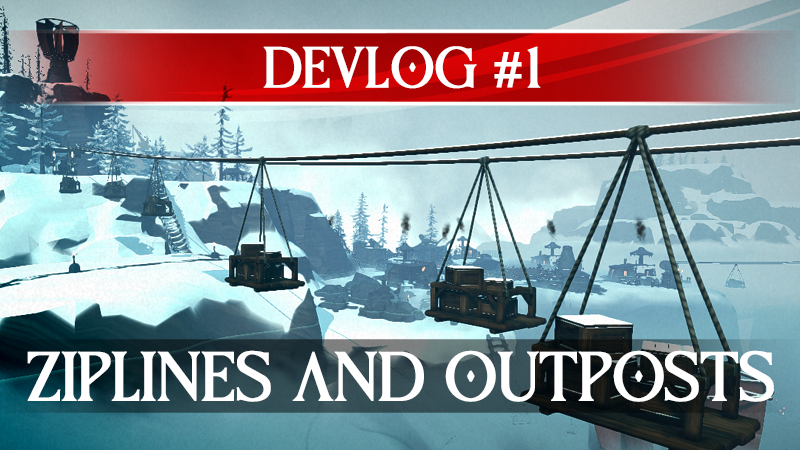
The answer is a zipline. Stretching safely over the mist, your miners can send bricks and iron bars to the farmers, and the farmers can send back berries. Everybody wins. Your colonies are trading with each other, and that allows for an emergent economy to form, all backed by the sight of resources flying down ropes.
While ziplines will help these colonies exchange resources, it will be some time before your settlements can link up. Early choices matter, but you’re never locked into a single mega-layout.
As the mist shifts, safe zones will shrink and new opportunities will become available. You’re encouraged, sometimes pushed, to expand outward rather than endlessly re-optimise one single base. Every time you expand you’re given a fresh opportunity to optimise the new, armed with the knowledge of what’s gone before. You get that fresh canvas, and the opportunity to min-max the complex systems.
Finally, each colony becomes a chapter. Instead of one settlement that grows forever, or spirals toward oblivion, your network of interdependent colonies each get their own stories. Some thrive. Some fail. Some become specialised hubs supporting the greater effort. And some become abandoned relics; places that served their purpose once, and are now just a memento of the past.
Looking Ahead Together
We want this to be a game that preserves the joy of early-game creativity throughout the whole experience, while still providing that essential late-game complexity, without forcing the compromise.
Above all (not just the mist!) this project is being built with the understanding that colony builders thrive when players help shape them. Your feedback across our channels has already influenced how ABOVE: Colonies of the Mist is designed, and it will continue to guide us as the game grows.
We’re incredibly excited to share this world with you. Just like the Colonists looking out across the foreboding landscape they find themselves in, charting a course to the horizon, we’re doing the same. We hope you’ll come along with us on the journey.
Stay tuned for more and join the expedition today!
Best,
The Docklight Games Team
Looking for more?
Check out the Forklift Interactive publisher page and follow it to see new games and updates as they arrive.
Source
Changelog.gg summarizes and formats this update. How we read updates.