
In this update4
Full notes
Full A Line Held Tight update
Read the full published notes in a cleaner layout. The original post stays linked below.
What changed
- UI and audio
- Gameplay
A Line Held Tight changes
Video version of this post above ^^^ Hi, I’m Cel Davison, from Humble Grove: a worker owned video games making co-operative.
Recently we revealed A Line Held Tight. I wanted to talk about our approach to making it, what we’re doing and why. The visuals, the music and the writing: what’s it all in service of?
A Line Held Tight is a dynamic sci-fi visual novel that follows The Canary, a member of a mining colony on a far-off planet. Out there, cut off from the rest of humanity by a vast expanse of space, tensions both political and personal start to rise.
As a strike boils over you will help The Canary to decide where their heart and their loyalties lie. A branching narrative weaves its way through the deep tunnels of the mine to meet the characters within it as outside influences make themselves felt.
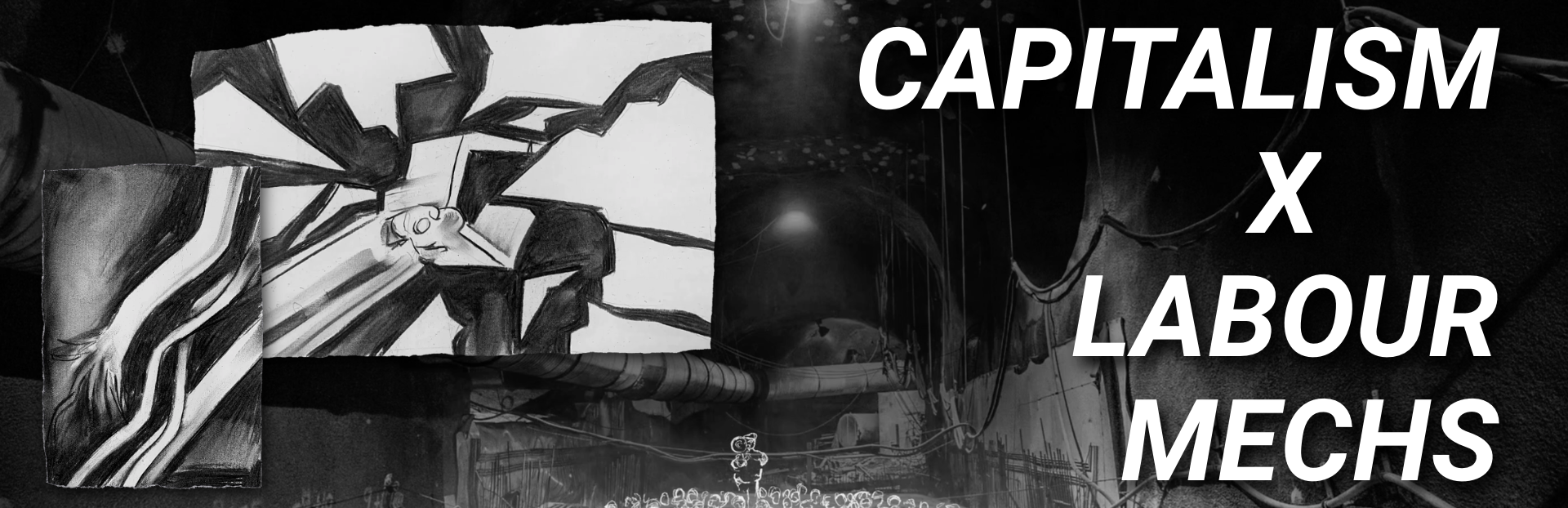
A Line Held Tight is a game about miners strike, capitalism and labour mechs. In the year 3100, in humanity’s furthest reaches into space, workers are mining fuel with heavy machinery known as ‘rigs’. The rent on the nearby colony is rising, the workforce is short-staffed and mega-corporation Brightworld are the ones to blame.
It might sound like I’m joking, but in complete seriousness the idea for this project germinated in my mind with the thought: “what would it look like if Arthur Miller wrote a Gundam?” & “what if we moved away from the genre's traditional focus on military conflicts?” I want to know about the ‘mini-mechs’ often in the background of Gundam movies, more about the labour mechs in Patlabor. Utilitarian machines piloted by the proletariat. With those thoughts percolating I decided to lift the three act structure from Miller’s A View From the Bridge, in order to write a story about masculinity and class struggle.
The Team
We’re a team of three people: Poppy Tilbury, Beck Michalak and myself. We’re making the game in Narrat, an open-source visual novel/interactive fiction game engine. Poppy is responsible for the technical side of things, all the Narrat specific scripting and building features like the database that compiles all of the mechs in the game so you can read all the nerdy specs. Beck is lead writer and artist, all of the wonderful hand drawn charcoal panels are drawn by them. I’m project lead, I’m the secondary artist and I’m the editor for all the text in the game.
Visuals
As visual novels tend to be, A Line Held Tight is very text heavy. At the time I’m writing this the word count stands at 130,000 and by the time we finish it we expect it’ll be a lot higher. With that in mind we also wanted to make sure A Line Held Tight also had a strong visual identity too. Despite the limits that come from making a visual novel with 2D art, we want to make the player feel as though they are inhabiting Brightworld mine, a place with a distinct character. Even though the player doesn’t literally walk through the mine’s tunnels, in the way you might if it were a 3D environment we still want them to feel like they have. And for the people they meet in it to also have their own distinct personalities expressed through their portraits.
The portraits are inspired by Frank Auerbach’s charcoal portraits. He used a technique of drawing then erasing the entire thing multiple times. Doing this would leave ghostly impressions of the previous drawings. I’ve lifted this process for the portraits in the game and I really love the effect: how it captures my own thinking over time. I think it has a way of making the portraits feel more dynamic.
We use the panels to fill out details in the world, call attention to action and of course to show off the game’s mechs. They often make scenes feel much more kinetic, especially when accompanied with sound. Since the backgrounds aren’t hand drawn the panels do a lot of the work that, say, painted backgrounds might do in a more traditional visual novel, building out a sense of place.
Our backgrounds are made using photos, some of them taken by us and some we’ve found under creative commons, that we’ve photoshopped and then drawn over. In order to make them feel more alive we tricked them into believing they’re 3D and then added lighting, particle and fog animations in Blender. I’ll write up a post about this process in the coming months.
Music
A Line Held Tight’s soundtrack is being recorded in house by Beck and I, and it’s made up entirely of traditional folk tunes from around the British isles and other parts of the world. I think using folk tunes provides the game with a more down to earth feel, adding some warmth to a setting that could feel overly techy. While this is a story set in the future it’s also about a struggle that exists now and has existed long before we were all born.
In terms of instrumentation Beck plays guitar and I play the mandolin. I’m also trying my hardest to play melodeon. We’re both involved in our local folk scene, regularly attending folk sessions and running a beginners’ session together. Most of the tunes on the soundtrack are collected from musicians at the sessions in our area, some of which we’ll doubtlessly invite to guest on the soundtrack. You’ll have already heard Dan Capon playing the recorder in the trailer music. If you’re not familiar with folk tunes and would like to hear more, contemporary bands like Leveret, Shovel Dance Collective and Goblin Band are fantastic places to start.
Writing
Our games are narrative first. Everything is in service of the story. Given that it might not surprise you to hear we’re huge worldbuilding nerds.
The setting of the game is one started developing working backwards from another game we’d been working on Twilight Array (unreleased). Twilight Array is Beck’s baby and the two of us expanded and developed on the world together. One of the ways we approached worldbuilding was through the TTRPG Microscope by Ben Robbins. Inspired by actual play podcasts like Friends and the Table we used Microscope to develop a timeline of our world. One of those points along our timeline was about a series of trade union struggles. I became really interested in exploring this period in our world in more detail and zooming in on one in particular: The Post-frontier Miners Union and its merger with a larger union, Riggers Moor, and the consequences that followed.
A Line Held Tight is also a game about choice. Choices that drive action, choices that drive conversation and how the choices you make affect the central struggle. Like in real life, how you choose to treat people changes how those people feel about you and how you act is remembered. You can expect conversations to go in entirely different directions depending on your earlier actions. The Canary isn’t a complete blank slate, they have their own flaws and way of viewing the world, but there’s a lot of room for expressing what kind of person you want The Canary to be, as well as the kind of person you want them to become.
But why did we choose to write this story specifically? Well to me it just feels inevitable. Over the past 5 years we’ve seen tens of thousands of layoffs in the video game industry. Over the last few decades we’ve seen a rise in facism, a decline in workers’ rights, as well as a decline in living conditions. We’ve witnessed world powers inflict violence and genocide and the role tech has played in that. We’ve pledged not to accept funding from, or publish our future projects on Xbox/Microsoft services over their involvement in Isreal’s genocide of the Palestinan people. I’m not sure what other game we’d be making right now. Making A Line Held Tight wasn’t a conscious choice to make something topical or politically relevant and we certainly don’t expect to change the world with it, there’s just no way to avoid the current climate from making its way into the games we make.
Hopefully some of what I’ve talked about resonates or excites you. I’m really excited for people to be able to play A Line Held Tight and you can expect it to be released towards the end of this year.
Cheers,
Cel@humblegrove
Source
Changelog.gg summarizes and formats this update. How we read updates.