
Full notes
Full 命运游戏2:百年之约 update
Read the full published notes in a cleaner layout. The original post stays linked below.
Repeated intro
Hello everyone,
What changed
- Gameplay
- Events
- Balance
- Maps
- UI and audio
- Server
命运游戏2:百年之约 changes
As August 6th approaches, our anti-Japanese espionage drama game PatriotMemoirs – Today, We Also Work Hard to Kill Traitors is being polished with full effort. We are striving to refine the work to a sufficiently good level in these final days, to present it to the veteran players and new players who have been eagerly awaiting our work.
As a work with a mainstream, positive energy theme, although our plot and characters are fictional interpretations, many of the deeds and historical figures are based on real historical prototypes – which is a common creative technique for this type of work. We hope the work fits the aesthetic tastes of contemporary users, while also staying true to the core of history. Through this work, we want to help people understand that era, those people, and even personally participate in completing those events! The Tokyo Trial ultimately missed some key culprits.
During the past year of developing Kamikawa Past, we have consulted a vast amount of historical materials, newspapers, and documents, striving to improve the level of detail and authenticity in the creation of many stories. In the coming period, this official account will periodically serialize true historical accounts and information from around 1939 in the occupied areas. These articles are collected from enthusiastic players. Although the content may not be strongly directly related to our work, understanding these background events will greatly help players better appreciate PatriotMemoirs.
We also welcome other players to submit their own writings. If we find them suitable and well-written, we will republish them.Email:
First installment: [Den of Spies No. 76: The Cancer of Traitors in Shanghai during the War of Resistance] – Author: Anonymous Submission
second installment: [Pushing Open the Gate of History – Marking the 80th Anniversary of the Tokyo ] Author: Doki
Third installment: [Why Shanghai Became the Key Battlefield Behind Enemy Lines During the War of Resistance Against Japan] Author: LiuN_刘念
Forth installment:[Decoding the Shanghai Spy War Archives] Author: LiuN_刘念
Fifth installment: [Shanghai Undercover: The Infamous No. 76]- Author: LiuN_刘念
Sixth installment:[The Real Undercover Work – Excerpts] -Author: Anonymous Submission
Seventh installment:[Half Occupied, Half Glamorous: Gangsters and Human Tragedy in Wartime China] -Author: 其乐龙融
Main text:
Most people understand the history of the War of Resistance only through the grandeur of frontline gunfire and soldiers’ bloodshed. But the real chaos was far more complex and biting than the battlefield. It lay hidden in the daily suffering of ordinary people, in the extreme pulls on human nature, and above all in the absurd fragmentation of one nation under three different worlds.
During the full-scale War of Resistance (1937–1945), the land of China was brutally cleaved into three starkly distinct living spaces. The puppet state of Manchukuo in the Northeast was a colonial cage under total Japanese control, leaving no room to breathe; the Japanese-occupied areas within the Pass saw the collapse of law and order, black and white reversed, becoming a quagmire of peril for all; the Shanghai International Settlement as a "lone island", surrounded by raging flames of war, nevertheless sustained a false prosperity of nightly song and extravagant dissipation.
Beyond the grand war narrative, what is most worth pondering is the choices made by ordinary people in that chaotic era. When national sovereignty was lost and social order crumbled, the good and evil in human nature were magnified without limit: some abandoned their country and kin for power and wealth, becoming underworld traitors who clung to foreign invaders; others, deeply immersed in the vanities of high society and facing coercion from powerful forces, nevertheless held fast to their national conscience, keeping a faint light shining in the darkness.
This article focuses on China during the chaotic years around 1939. By examining the moral degradation of the underworld and the struggles and steadfastness of entertainers at the Paramount Ballroom, it leads you to understand the deep price of territorial subjugation and to see, amid the rise and fall of national fortunes, the most real destinies of ordinary people—adrift and tossed about.
I. Manchukuo: The Completely Controlled Northeast, Where Gangs Became the Japanese Army’s "White Gloves"
"Manchukuo" Imperial Palace
The puppet state of Manchukuo, established in 1932, was a carefully crafted colonial deception by Japan. Puyi’s enthronement and the puppet government apparatus were all a façade; the true purpose was to realize Japan’s strategy of"using Chinese to control Chinese"and to permanently enslave the Northeast. Unlike the scattered occupied areas within the Pass, this land had no concessions to check Japanese power and no external intervention; colonial control was thorough and brutal.
Inauguration Ceremony of the "Manchukuo Executive"
Economically, the Japanese army, relying on the puppet regime, plundered strategic resources such as coal, steel, and grain on a massive scale, draining the industrial and agricultural foundations of the Northeast to fuel their war of aggression. Culturally, they imposed extreme assimilation education—rewriting textbooks, forcing the spread of Japanese, and erasing historical memory—in an attempt to uproot national identity at its source. Under this high-pressure control, sporadic anti-Japanese resistance never ceased among the people, but it could not stand against the fully armed invaders.
Students receiving instruction in Manchu, Japanese, and Mongolian languages
School teachers and students participating in a distant worship ceremony
To reduce governance costs and avoid popular resentment caused by direct suppression, the Kwantung Army implemented a venomous strategy of ruling the people through gangsters and suppressing good with evil, vigorously backing local gangs in the Northeast. Modern Northeast China had numerous gang factions, woven together from vagrants, remnants of old warlord forces, and urban underworld elements. They originally observed a rough code of martial honor and rarely harmed civilians wantonly. But under the Japanese military’s protection and the lure of profit, all codes of brotherhood and national integrity completely collapsed.
Many gang leaders voluntarily surrendered to the Japanese army, the special police (Tokko), and the puppet police stations, offering their loyalty in exchange for license to commit evil legally, becoming the most hidden"white gloves"of colonial rule. In political control, the gangs set up surveillance networks, spying on people’s words and deeds, screening for progressives, and reporting patriots. Any expression of anti-Japanese sentiment or private discussion of national affairs among the populace led to arrest and interrogation, breaking countless families and intensifying the reign of terror in Northeast society.
In economic plunder, the gangs acted with utter ruthlessness. They monopolized opium trafficking, gambling dens, brothels, and cross-border smuggling in the Northeast, handing over part of their profits to the Japanese puppet regime in exchange for privileges and pocketing the rest. Even more appalling was their trade in human beings: they tricked and kidnapped commoners and sent them to mines and munitions factories as unpaid forced labor. At that time, the factories and mines in the Northeast were akin to hell—laborers had no wages, no rest, no protection, working day and night under brutal conditions; those who died from exhaustion, starvation, or disease were countless, and most were buried in mass graves, nameless and forgotten.
This was the most absurd reality of Manchukuo: foreign enemies seized national sovereignty from the top, while local underworld thugs bled their compatriots dry from below. With the collapse of national law and sovereignty, honest and law-abiding commoners suffered endless oppression, while sycophantic villains could profit and rise through power. These Northeast gangs that clung to foreign invaders were never chivalrous heroes, but merely opportunists in times of chaos. They deepened the fourteen years of colonial suffering in the Northeast and, with the fall of the puppet regime, were forever nailed to the pillar of national shame.
II. The Japanese-Occupied Areas within the Pass: Total Collapse of Order, Gangs Swarming to Become Traitors
If Manchukuo was an airtight high-pressure prison, then the Japanese-occupied areas in North, East, and South China—within the Pass—were a quagmire of utter chaos. After the Battle of Shanghai in 1937, core cities such as Beijing, Tianjin, Shanghai, and Nanjing fell one after another. With limited troop strength, the Japanese army could not control everything directly, so they propped up puppet regimes to govern on their behalf. This loose indirect rule led to the loss of public authority and a vacuum in supervision, unleashing human greed and baseness without restraint, providing fertile ground for the wild growth of gangs.
Ruins of Zhabei, Shanghai, after the fall in 1937
The gang chaos in Shanghai and Tianjin was most representative, and the chaotic times tore apart their façade of chivalry. In Republican-era Shanghai, the Green Gang (Qingbang) was at its peak, with the three big bosses—Du Yuesheng, Huang Jinrong, and Zhang Xiaolin—dominating the city’s underworld and controlling its underground order. When the national crisis came, their choices diverged sharply. After Shanghai fell, Du Yuesheng fled to Hong Kong, secretly funding resistance and sheltering patriots; Huang Jinrong shut his gates, refused to take any puppet post, and sought only to keep himself safe without deep collusion with the Japanese and puppet regimes; but Zhang Xiaolin, unable to resist the temptation of profit, openly betrayed his country and became a notorious gangster-traitor.
Huang Jinrong, Du Yuesheng, Zhang Xiaolin
To win the Japanese army’s trust, Zhang Xiaolin threw his entire gang network into serving the invaders. Leveraging his influence in Shanghai’s commerce and shipping, he helped the Japanese army monopolize the flow of supplies, suppress national industries and commerce, and extort grain and other necessities from the people to supply the front lines. At the same time, he cooperated with Japanese puppet特务 in arresting and assassinating patriots, suppressing civilian anti-Japanese activities, and oppressing innocent people—his crimes were too numerous to list. In the end, he was assassinated by a Nationalist secret agent, dying in infamy for all eternity.
After the establishment of the No. 76 Special Service Headquarters in 1939, the darkness in the occupied areas reached its peak. As a Japanese military-run特务 organ, No. 76 used brutal methods to suppress anti-Japanese forces and control public opinion, but its manpower was limited. It therefore formed a collusive alliance with the Shanghai gangs. The gangs acted as civilian claws, responsible for surveillance, screening, arrests, and assassinations, carrying out the dirty work for the特务 agency; in return, No. 76 protected the gangs’ illegal businesses—opium trade, smuggling, extortion, gambling dens, and brothels—and allowed them to bully the people and amass fortunes. Official-gangster collusion, with black and white reversed, became the most common chaos in Shanghai at the time.
The gangs in Tianjin were no different. Local branches of the Green Gang and Red Gang (Hongbang) attached themselves to the Japanese army and puppet police, profiting from intelligence trafficking, smuggling goods, and trading in humans. They sold out their compatriots and abandoned their nation for profit, showing no martial honor or national integrity. Throughout the occupied areas within the Pass, these gangs were never righteous knights, but opportunists who followed the tide of chaos, with no fixed principles except self-interest. The most terrifying consequence of territorial subjugation was never just foreign invasion, but the collapse of social morality and the inversion of good and evil, which caused the innocent to suffer and the wicked to thrive.
III. The Shanghai International Settlement: Nightly Revelry Beside the Gunfire, Behind the Glamour Lay Helplessness and Steadfastness
While the occupied areas and Manchukuo were sunk in deep darkness and suffering, the Shanghai International Settlement, relying on its neutral status under the foreign powers, became a "safe island" surrounded by war, displaying an extremely torn and false prosperity. After the Chinese-administered parts of Shanghai fell in 1937, millions of refugees, intellectuals, rich merchants, and patriots flooded into the Settlement. The population surge brought ample labor and liquid capital, giving rise—in the desperate circumstances of war—to a brief and illusory boom.
Garden Bridge, refugees pouring into the Settlement
At that time, the Suzhou Creek separated two utterly different worlds. On the north bank, in the occupied zone, guard posts stood everywhere, people’s livelihoods were devastated, and everyone lived in fear; the common people suffered hunger and cold, homeless and destitute. On the south bank, in the Settlement, traffic flowed, shops lined the streets, and lights glittered brightly; commerce and entertainment revived vigorously. And the Paramount Ballroom was precisely the most glaring and representative landmark of this false prosperity.
Original appearance of the Paramount Ballroom
Old photo of the Paramount Ballroom
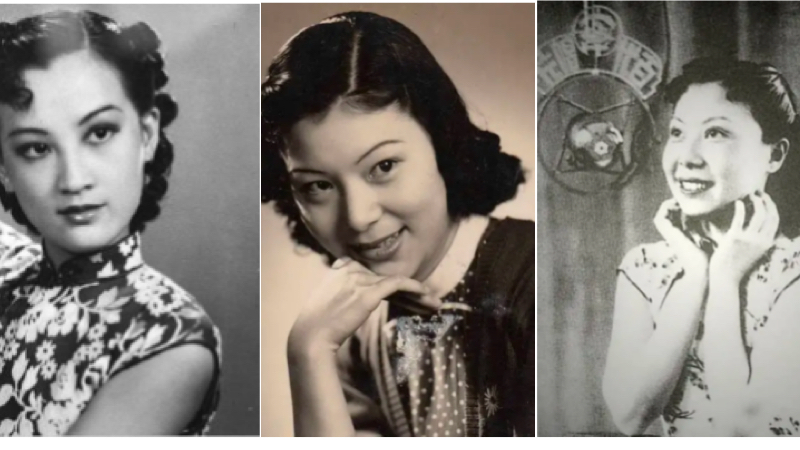
As a top-tier dance hall in Republican China, the Paramount was a gathering place for celebrities, tycoons, foreign residents, gangsters, and traitors, offering extravagant luxury. Outside, gunfire thundered and the nation was in turmoil; inside, revelry continued night after night, with toasts and music that shut out the world’s suffering. Famous singers such as Zhou Xuan, Bai Hong, and Gong Qiuxia performed on its stage, and melodies like The Wandering Songstress, Four Seasons Song, and Autumn Waters and a Lonely Beauty spread across the "lone island," becoming spiritual solace for countless people in that chaotic era.
Zhou Xuan (left), Bai Hong (center), Gong Qiuxia (right)
Most people took these melodies as mere love songs, but they did not know that within the singing lay the sorrow of a shattered nation and the bitterness of displaced people. The singers on stage, glamorous and adored by the masses, were in fact deeply entangled and powerless. The entertainment industry in the Settlement was controlled by the Green Gang, and the performers suffered year-round extortion of high protection fees, performance restrictions, and arbitrary oppression. If they disobeyed even slightly, they would be blacklisted and ostracized, or even physically threatened. They seemed glamorous but had no real agency.
Even more cruel than gang coercion was the cultural pressure from the Japanese and puppet forces. The Japanese army knew well the singers’ influence over public opinion and forced them to perform and record pro-Japanese propaganda songs, attempting to use sweet music to beautify colonial aggression and numb the people’s patriotic will. Caught between the temptation of survival and the pressure of power, a group of artists—represented by Zhou Xuan, Bai Hong, and Gong Qiuxia—held fast to their national bottom line. They firmly resisted all Japanese-puppet propaganda activities that glorified aggression and refused to participate in colonial cultural propaganda, even if their stage opportunities were limited and their lives difficult. They would never become tools of the invaders’ culture.
They did not perform grand heroic deeds, but in their own way as artists, they quietly upheld their conscience and helped their country. They used their artistic power to convey national spirit and console the hearts of the people in that disordered time, preserving the great righteousness of ordinary citizens. Meanwhile, the Green Gang forces in the Settlement also showed a complexity unique to that chaotic era. Du Yuesheng himself remained in Hong Kong for a long time, but the Green Gang branches he left behind in Shanghai, while monopolizing gray industries and profiting from the chaos to maintain their underground order, also secretly funded the resistance, aided refugees, and sheltered patriots—pulled painfully between self-interest and greater justice.
The neon glamour of the Paramount was always a false veil over the chaos. Beneath the glittering surface lay the desperate struggles of ordinary people, the complex play of human nature, and a never-extinguished glimmer of patriotism—witnessing the truest tableau of life in the "lone island" concession.
IV. Looking Back at the Chaos: All the Human Depravity Is the Truest Mirror of National Destiny
Looking back at China during the chaotic years of the War of Resistance—the colonial confinement of Manchukuo, the collapse of order in the occupied areas, and the abnormal prosperity of the Settlement—these three patterns, three worlds, piece together the most painful and torn picture of modern China. Setting aside the grand narrative of war and focusing on the fateful choices of ordinary people, we can read the simplest truth: all the human depravity was essentially the inevitable result of a collapsing national destiny.
When the nation loses sovereignty, society has no just order, and moral constraints become meaningless. Human greed, cowardice, and baseness are magnified without limit; betraying the nation and oppressing compatriots become shortcuts for some. But those who cherish righteousness and hold fast to goodness instead find themselves trapped and suppressed. The gangs of Manchukuo and the occupied areas were the epitome of selfish opportunists in chaos, who abandoned their nation and harmed their compatriots for power and wealth, and were ultimately despised by history. The humble entertainers of the Paramount, without power or influence and caught in the whirlpool of luxury, nonetheless held on to their integrity and silently shouldered responsibility, becoming a gentle light in a dark age.
True national spirit was never only about soldiers who bled on the battlefield; it was also hidden in the steadfastness and choices of every ordinary person. Some sank in the chaos, others rose in desperation; the line between good and evil ultimately revealed the human heart. Today, the smoke of war has cleared and the land is unified. We have long left behind that era of national division and moral inversion, and now enjoy a stable, prosperous, and peaceful life. Many mistakenly take this peace for granted, forgetting that it was won through the blood and perseverance of countless forebears.
The history of chaos repeatedly confirms: individual destiny is forever bound to the fate of the nation. When the nation is weak, everyone is a floating weed in troubled times, at the mercy of others; when the nation is strong, ordinary people can have stable lives, dignified existence, and freedom of choice. The gang chaos, the singers’ tragedies, and the human vicissitudes of those occupied years are never outdated stories; they are profound lessons that warn us today. Remembering the suffering of chaos, upholding our national conscience, and cherishing the peace and security of our homeland—this is the best way we can honor history and pay tribute to our forebears.
References
Institute of Modern History, Chinese Academy of Social Sciences. Data Platform on the War of Resistance and Modern Sino-Japanese Relations [EB/OL]. [2026-06-10].
https://www.modernhistory.org.cn.
War of Resistance Memorial Network. The System, Policies, and Content of Enslavement Education in the Manchukuo Period [EB/OL]. (2017-09-01)[2026-06-10].
https://www.krzzjn.com/show-633-55887.html
.
[3] Shanghai Municipal Party Committee History Research Office. A Special Battlefield of "Lone Island" Resistance [EB/OL]. (2025-12-23)[2026-06-10].
https://www.ccphistory.org.cn//shds/shhm/content/eefa7bfc-16ba-411a-a4e9-3c8820136ed2.html
.
[4] Shanghai Library (Shanghai Institute of Scientific and Technical Information). Shanghai Culture Database [DB/OL]. [2026-06-10].
.
[5] Bu Ping, Wang Jianlang, eds. History of China’s War of Resistance Against Japan: Volume 7, Puppet Regimes and Occupied Areas [M]. Zang Yunhu, Wang Xiliang, authors. Beijing: Social Sciences Academic Press, 2019.
[6] Frederic Wakeman Jr.
The Shanghai Badlands
Wartime Terrorism and Urban Crime, 1937–1941 [M]. Rui Chuanming, trans.
Changsha
Yuelu Press, 2021.
[7] Shanghai Paramount. The Development History of the Paramount Ballroom [EB/OL]. (2024-08-12)[2026-06-10].
https://mp.weixin.qq.com/s/31uaYB4_beP_KL1Z6csqXw
.
Source
Changelog.gg summarizes and formats this update. How we read updates.