
Update log
Full World of Warships update
The complete published notes, normalized for clean reading and source attribution.
Extracted changes
- Server
- Balance
- Gameplay
Captains!
In February, our developers took part in a special Q&A session on our official Discord server on the topic of ship modeling and design in World of Warships. We’re here to deliver the results!
| General design and Technique ● Research ● Ship-Specific Questions ● Miscellaneous |
|---|
[hr]
General design and Technique
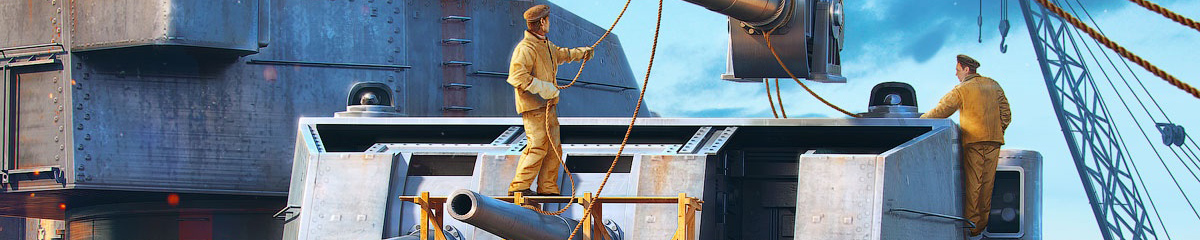
What software do you use for modeling ships?
The exact set of programs depends on the particular team and task, but our "go-to kit" is Autodesk Maya, Adobe Photoshop, and Substance Painter.
To what extent is physics involved in the ship design process?
We have a professional team of constructors, most of whom have solid experience working in shipyards and designing real ships. Virtual ships are designed on the same principles as real ships.
Since the designing of a whole ship from keel to mast is a topic worthy of a separate publication, we will only look at the example of designing the hull:
During the early stages of the design process, we accommodate the key equipment on board the ship: the main and auxiliary propulsion plants, armament and magazine sections, armor layout, aircraft hangars, catapults, lifeboats, etc. To do that, we create sketch plans for the ship's decks, holds, superstructures, and inboard profile. Those sketch plans are subsequently supplemented and finalized to be later used as the basis for final plans and drawings.
We need to do this in order to ensure that all the equipment fits within the hull we've designed. For that purpose, we calculate mass loads and verify the correspondence between the weight of the equipment and the water displacement of the hull.
The ship's hull is designed taking into account all the equipment to be placed within it. If the data doesn’t match, we either make changes to the composition of the ship's equipment and its characteristics or, if that’s not the best available option, we change the hull.
In the case of aircraft carrier Hakuryū, for example, we had to make the ship 20 m longer and 5 m wider compared to her prototype, G-15, so that the carrier could, in fact, "carry" her entire air group. The resulting increase in water displacement forced us to adopt a different propulsion plant—one that we had to find.
We figure out the seafaring characteristics of the ship's hull, its water displacement, the position of the center of buoyancy, and other hydrostatic parameters.
When creating new Tech Tree ships, is there some sort of "budget" related to the modeling of historical ships? Like, "this upcoming Tech Tree should have this number of historical ships at the very least."
We have no such "budget," but there is a general rule of giving priority to historical ships if they fit the planned gameplay of the branch.
When modeling obscure "paper" ships or even fantasy ones, do you put any thought into how their superstructure model will affect their turret angles and, subsequently, their future state of balance?
When designing a ship, there are many factors that affect gun angles and gun placement. The key ones are the requirements for ship balance from our game designers and the prototype designs on which the ship is based on.
We never intentionally make a ship worse in terms of angles, quite the contrary; however, this is always a back-and-forth process and a search for compromises.
For example, Plymouth: This is the original version of the improved Town class. She is, in fact, a
Source