
In this update3
Full notes
Full Paragnosia: Museum update
Read the full published notes in a cleaner layout. The original post stays linked below.
What changed
- Gameplay
- Events
Paragnosia: Museum changes
In Paragnosia: Museum, you are immersed in the heart of the Duskheath Museum. You play as the exorcist Claire Ballard, whose brother Jim has mysteriously disappeared.
As an employee of Cam-on-Rail, a surveillance company specializing in the paranormal, Claire operates a camera mounted on a suspended rail that travels through the museum’s various rooms in search of anomalies to exorcise.
Although the game is primarily focused on gameplay, Paragnosia: Museum offers an additional narrative layer that builds tension, enhances the player experience, and increases replayability. The goal is no longer just to survive, but to understand.
1) How did we develop the story?
Paragnosia: Museum belongs to the genre of “anomaly-hunting” and camera-surveillance games, such as I Am on Observation Duty, Exit 8, and Five Nights at Freddy’s. We wanted to deepen the narrative aspect to offer players a sensory and mental immersion. With this in mind, we designed the Paragnosia series around the gradual revelation of the secrets of the Cam-on-Rail corporation.
In the first game, the narrative scope is minimalist, but players can already begin to wonder about the motivations of the character they play, the mysterious banishment portal, or the strange Cam-on-Rail corporation. Many questions are raised here that will gradually be answered later in the series…
In Paragnosia: Museum, we wanted players to do more than just observe; we wanted them to take on the role of a character who investigates, interprets, and unravels the museum’s mysteries.
To do this, we have come up with new narrative approaches:
- A playable prologueFollowing the unexplained death of its curator, the Duskheath Museum was immediately closed, and Jim Ballard, an exorcist from the company Cam-on-Rail, was dispatched to the scene. The demo lets you discover 60 new anomalies and ends on a cliffhanger. (At this time, the prologue is no longer available on Steam, but is intended to be integrated directly into the game via a future update.)
A rich setting rooted in reality: the museum is a space rich with exploration inspired by the history of civilizations, funeral rites, and representations of spirits. The architecture of the Duskheath Museum also draws inspiration from the Louvre, the Musée d’Orsay, the Pergamon Museum, the National Arts Center in Tokyo, the Terukuni-jinja Shinto Shrine, and many other places around the world.
A main character shrouded in mystery: Claire Ballard, Jim’s sister, is driven by a personal quest that unfolds gradually, culminating in a final twist that we won’t reveal here.
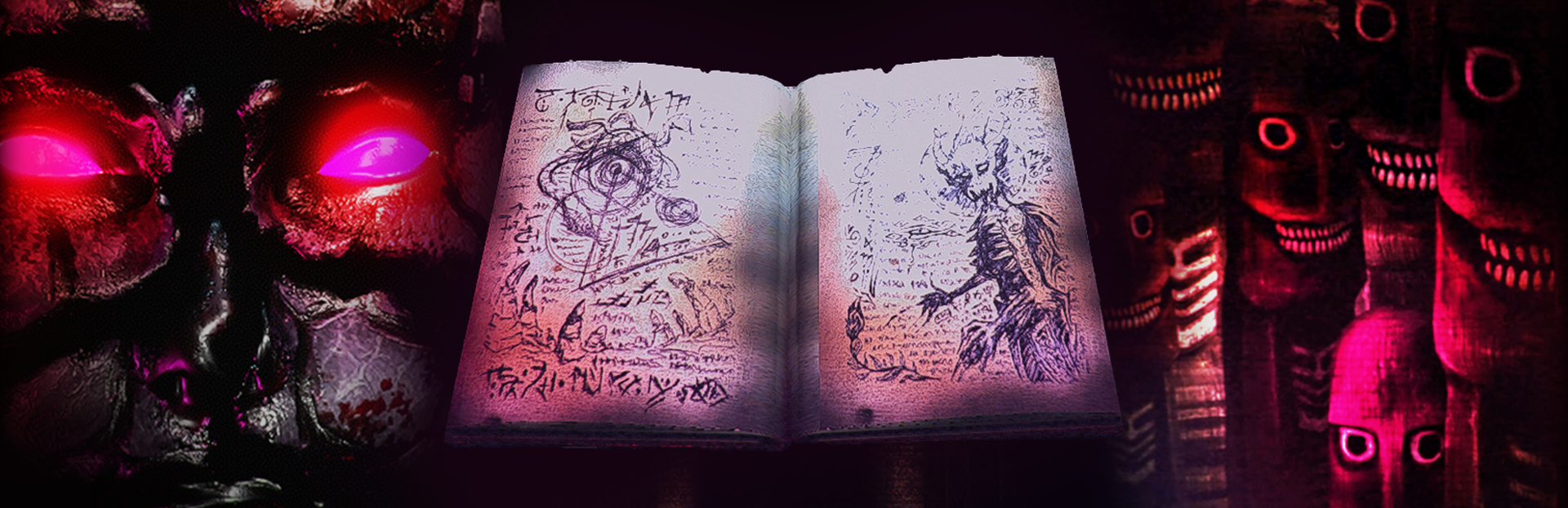
A fantasy world paying homage to H. P. Lovecraft: at the heart of the museum sits the Necronomicon, the cursed grimoire born of the imagination of the author of The Call of Cthulhu.
2) Why the influence of Lovecraft?
A leading figure in 20th-century fantasy literature, H. P. Lovecraft has had a lasting impact on the horror genre through stories that blend cosmic horror, forbidden knowledge, and ancient entities. At the heart of this universe lies the Necronomicon, a fictional esoteric text that has become legendary.
In the game, we chose to place the Necronomicon at the center of the museum, as an entity in its own right—a source of evil that corrupts the place. Set on a pedestal and visible from many points throughout the museum, it embodies a constant threat: silent yet ever-present. It radiates, influences, and transforms its surroundings.
Inspired by the film Color Out of Space, we also developed a “supernatural” color palette, blending fuchsia and turquoise blue. These hues seem to spring from the Necronomicon and gradually infecting the museum and its artifacts, culminating in its most hostile forms.
3) How did we incorporate storytelling into the game design?
The main challenge was to never separate storytelling from gameplay, but rather to ensure they were constantly interacting. The storytelling is thus directly integrated into the game mechanics:
Anomalies
Like the previous installment, Paragnosia , the core of the experience revolves around observing and photographing elements of the setting that appear to be animated or altered by an evil presence—what we refer to as anomalies.
In Paragnosia
Museum , several of these anomalies are directly linked to the plot: the Necronomicon that moves and comes to life, a demonic mask capable of possessing and gathering objects from the exhibition to form a body, cosmic entities with indistinct outlines, supernatural lights, and even openings to unstable spacetime.
The Investigation: At a pivotal moment in the game, a puzzle unfolds as a full investigation sequence. This feature further strengthens the connection between the plot and the gameplay by directly involving the player in the narrative progression.
So now it's your turn!
Be extra vigilant and discover what lies beyond appearances…
Or are you already among the 12% who have managed to reach the secret ending? 🤫
Source
Changelog.gg summarizes and formats this update. How we read updates.