
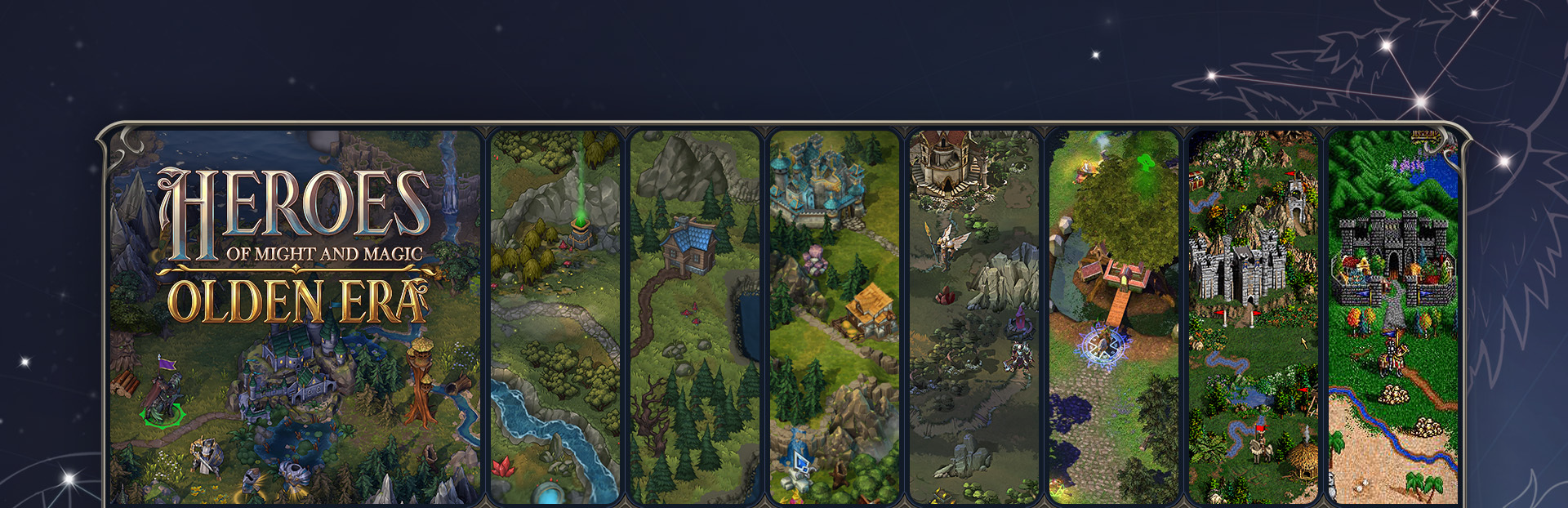
In this update11
Full notes
Full Heroes of Might and Magic: Olden Era update
Read the full published notes in a cleaner layout. The original post stays linked below.
What changed
- Performance
- Maps
- UI and audio
- Gameplay
- Balance
- Store
Heroes of Might and Magic: Olden Era changes
Heroes of Might and Magic has always embraced change — not only in the captivating blend of tactics, strategy, and economy, but also in its visuals. From the hand-painted charm of Heroes II to the high-fidelity realism of later titles, each entry introduced a new artistic direction that helped to define the tone, mood, and identity of the series’ universes. With Olden Era, we are continuing that tradition. While building on the legacy of the series, we are introducing our own identity and ideas to the players — one rooted in the vivid, magical style that first drew many of us to the world of Enroth. This devlog explores the artistic choices behind Olden Era and offers a behind-the-scenes look at how we approached key design decisions.
Listening to the Community
As we were working on the game, we reached out to the Heroes community across multiple platforms and conducted over 20 interviews with opinion leaders — including pro gamers, YouTubers, Heroes streamers, modders and map makers — to better understand what matters to players today. Here is what we heard loud and clear:
The game must run smoothly and be accessible.
Visual clarity is essential — everything must be easy to read.
Familiar gameplay is key, but it should be modernised.
The legacy matters, but players also want something new to explore.
These insights aligned closely with our own vision and became foundational pillars in the development of Olden Era.
Not a Remake — a New Chapter
One of the most frequent questions we continue to receive is: Where does Olden Era stand as a Heroes of Might and Magic game? The answer is clear and important: Olden Era is not a remake of any previous chapters. It is a brand-new, official entry in the franchise — built from the ground up. While we have deep appreciation for the earlier Heroes games, our intention has always been to create something original and fresh for people to enjoy. We have preserved the core mechanics that define Heroes, but we are also evolving the formula with new features, quality-of-life improvements, a distinctive tone, and a unique visual style. A fresh artistic vision is central to that evolution. While we drew inspiration from earlier games — especially Heroes II — we reimagined those ideas to suit modern computers, development tools, expectations, and our own creative goals.
Lessons from the Series’ Past
Heroes of Might and Magic is a series with a long history that you can learn a lot from. Each game brought something new to the table. Not only did mechanics vary, but also the visual style changed drastically. We studied them all — both gameplay and art — to understand what worked, what didn’t, why certain choices were less successful than others, and how we could do our best to choose the right direction.
Heroes I & II: Magic in Simplicity
Following in the footsteps of their spiritual predecessor King’s Bounty by the same lead designer Jon Van Caneghem these games embraced bold colours, charm, and fairy-tale aesthetics. Their visuals were immediately readable and emotionally resonant — an approach that inspired us deeply. This visual style and its vibrant, intense colours are what drew people in and earned the game’s spot as a memorable classic. As a group of fans who grew up with these games, we chose to honour this legacy and embrace it whilst working on Olden Era. Steam post image
Heroes III: Gameplay Reigns
While legendary Heroes III shifted drastically toward a more realistic visual style, abandoning the cosy hand-drawn animations of the former title in favour of 3D models rendered as 2D sequences. However, this new direction initially reduced the readability of the global map in comparison to earlier titles. At the time of its release, the change from a fairy-tale artstyle to baroque-inspired aesthetic was met with a wide range of responses. But in the end, what truly mattered was that its core gameplay loop had been solidified and became the standard for nearly all games released later. That mechanical brilliance remains a cornerstone of Olden Era. Steam post image
Heroes IV: The Cost of Experimentation
Creative and ambitious, Heroes IV took an unexpected turn toward the isometric 3D trend that was popular at the time. In doing so, it sacrificed clarity and cohesion — its combat maps remain a reminder that visual style should never compromise usability. At the same time, its approach to the core gameplay taught many that straying too far from the familiar gameplay can be a risk of losing more veteran players than attracting new ones into the community. Despite these missteps, Heroes IV is a game we respect deeply for its creative push, and we believe it was unfairly underrated at its time. Steam post imageSteam post image Heroes of Might and Magic IV and Heroes of Might and Magic: Olden Era battlefields side by side
Heroes V–VII: Potential Pitfalls of Full 3D Transition
Heroes V, developed by Nival Interactive, introduced another major revolution by fully transitioning to 3D. The shift brought stunning town screens and a dramatic visual overhaul that gave the game a unique presence. This bold leap left a lasting impression on players and remains a memorable chapter for all the players of the franchise. However, like any innovation, it came with challenges. Creating realistic proportions for characters and landscape in a fully 3D environment was not easy without negatively affecting readability essential in a strategy game. To keep the clarity, visual indicators, such as bright circles, were added to make the heroes and units stand out on the map. In addition, the richness of animated 3D objects, while visually impressive, also came with higher performance demands. While with the development of gaming hardware it was not a problem for some, the games became less accessible for those who had older and less powerful computers. In Olden Era, we tried to focus both on optimization and a lasting look, suitable for a strategy game. Steam post image
The developers of Heroes VI and VII explored a similar stylistic path by blending realistic 3D landscapes with more static, flat visuals for the faction towns. This approach moved away from the Heroes V designs — which had drawn some comparisons from the community to Warhammer Fantasy Battles — in favour of more unified, monochromatic heraldries. While this was a deliberate and interesting stylistic solution, some players still judged the new style for reducing the readability of the units within one faction. Steam post imageSteam post image Might and Magic: Heroes VI global map and Might and Magic: Heroes VII battlefield
Other Inspirations: King’s Bounty: the Legend
King’s Bounty
the Legend (2008) was both a commercial and artistic success thanks to its lush, whimsical visuals. This approach earned the game a lasting love of the players, that resulted in multiple expansions, and its place among the fans of turn-based strategies. Even to this day the game has aged gracefully thanks to its artstyle choice. In contrast, Disciples III — a darker, more ‘realistic’ fantasy title, released about a year later — highlighted how easy it is to lose readability and system performance when aiming for gritty photorealism, especially in 3D-strategy games. Despite that, the raw brutality of the chosen artstyle evoked strong emotions among the game’s audience.
From both, we gained a valuable lesson
artistic cohesion matters, however, in this genre readability matters even more. To sum up everything we have learnt from the visual history of Heroes and other genre-defining games:
Visual changes were always present throughout the Heroes series.
Our personal preference in style draws from the nostalgic looks of Heroes II and King’s Bounty.
Although changes and progress are inevitable, they must be done with care.
Readability and performance have always been and probably will stay crucial for the genre.
Factions should have their leading colour palette, but it shouldn’t dictate everything within it.
Stylisation is one of the keys to success that also prolongs the life of the art style and a game in general.
Visual Development: From Prototype to Production
With all of this in mind, we explored many directions during prototyping — tweaking saturation, contrast, silhouettes, scale, background detail, and more. Every iteration brought us closer to a visual style that blends personality, clarity, and performance. Steam post image Very early concept of the visuals, showing how Art Team experimented with lighting, shadows and saturation Early stage prototype. Objects are easier to see and have a clearer shape, colours are not as intense as before
Next prototype. Adjusted saturation, objects and decorations are closer to a unified style. Some purchased models are used here as placeholders
What we’ve landed on so far is a cohesive, hand-crafted visual identity — one that balances the key qualities important for the Heroes experience: nostalgic visuals recreating the feeling of familiar universe, and easy readability, so important for a turn-based strategy. As we approach Early Access, we continue working on the game visuals, improving them based both on our own vision and your feedback, which helps us see your perspective! The current development build. The artstyle for both objects and decorations forms a unified blend of familiar and brand new visuals
Performance and Visual Priorities
Aiming to avoid any major problems with performance we have designed Olden Era to run smoothly, with lower system requirements than the current Steam median, so that as many people as possible can get to enjoy Olden Era. A large-scale 160×160 Jebus Cross map can contain tens of thousands of animated and effect-laden objects, and millions and millions of polygons on the screen at the same time, which can severely impact performance. We handle this by efficiently backloading assets into RAM or GPU’s VRAM, keeping gameplay seamless and responsive. We strongly recommend using an SSD for optimal performance, especially to minimise load times. This is the hardware cost of optimization that allows for as few interruptions as possible. Our other goal is for the only loading screen you ever see to be when starting or continuing a game — not when entering towns or battles.
Smart Budgeting, Focused Effort
Even as we build a fantasy world, we face the practical reality of game development. As previously mentioned, we are developing Olden Era independently using our own funds. All development — both technical and artistic — is done by our internal teams, with almost no outsourcing. This ensures full creative control and consistency in vision during development. Even if we found ourselves in the middle of an AI-revolution, our direction for Olden Era was set years before it began. Therefore, we made a firm decision not to use AI to generate any assets. It means that every model, texture, and animation you see in the game is hand-crafted by our artists. This topic has created a huge discussion in the game development industry, sparking lots of thoughts but also outrage. Our philosophy and stance remains that we will not use Generative AI whatsoever during development and that decision will not change at any point — it would be disrespectful to the hard work our Art Team has done as well as to you, our community. We are further supported in that by our publisher Hooded Horse, whose CEO Tim Bender said the following in a recent interview that you can check here:
“I f*king hate gen AI art. It has made my life more difficult in many ways…suddenly it infests sh*t in a way it shouldn't," Bender said. "It is now written into our contracts if we're publishing the game, 'no f*king AI assets'.”
Part of this decision involved showing off our talented artists’ work, some of which you can check here Concept art created by our artist Dzikawa All of this means we must plan carefully what we can work on, and prioritise what matters most: gameplay, content, and long-term support. In fact, we are proud to say that Olden Era will launch with more content than any previous Heroes game at release — thanks in large part to our art style choice and efficient planning. This allowed us to implement more content without sacrificing other important features such as map editor, maximum map size, templates, and readability of the global map. To support this claim, we have analysed the most popular Heroes titles in terms of content:
Future-Proof Visuals
One of our primary goals behind the art style choice has been to ensure that the visuals remain appealing for years to come. Technology evolves quickly, however stylised visuals, when designed with care, retain their charm and legibility for years. Although nobody can deny Heroes III being the high point of the series, we personally believe that it was Heroes II — with its timeless visuals — that caused the franchise to become so well-known in the first place. That’s the kind of longevity we aim for. Our visual direction is trying to blend the best of Heroes I through III, with touches from King’s Bounty, presented in a clean, almost isometric presentation that highlights the charm. In the end, it’s not just about nostalgia, we want to ensure that Olden Era has its own identity, and even a decade from now players can return to it and still find it beautiful.
So why 3D and not 2D?
At first glance, 2D graphics seemed ideal for our goals. They evoke fantasy worlds, carry hand-crafted charm, and tend to be less demanding on hardware. However, working with 2D comes with a lot of hidden challenges.
Not Really Simple
Many people love 2D animation for its “simplicity and warmth”, but in reality creating high-quality 2D animation is anything but simple. Every object must be drawn by hand, and every angle or rotation — animated separately. It’s a slow and labour-intensive process. Imagine a unit that can move not only left and right but diagonally. In 2D, diagonal movement requires an entirely new set of assets. Add in attack and defence animations, and the workload multiplies fast. Then there’s the matter of volume. To make an object feel three-dimentional in 2D, light and shadow have to be painted directly onto it. These highlights, however, will remain static — rotating the unit or moving a light source won’t change them. In Hollow Knight, for example, highlights are painted right onto the beetle sprite and stay the same no matter how it moves This limitation is why many games with “flat”, cartoon-like visuals are actually 3D under the hood — a style often called 2.5D. The Banner Saga is a great example of 2.5D game with turn-based combat Ori and the Blind Forest uses similar techniques, blending 3D technology with a painterly style In 3D, dynamic lighting is built-in. A 3D model is made of polygons, and the engine can calculate light rays hitting each surface, adjust shading based on position and movement. This eliminates many of the manual steps required in 2D.
Animating the Models
We learned these limitations first-hand while working on Iratus: Lord of the Dead . Creating that game was… let’s just say, a learning experience. The thing is, when it comes to 2D animation, there are really only two main approaches: #1: Skeletal animation (aka Spine animation). Moves parts of a flat image like a puppet. It fakes depth but cannot truly rotate, often looking stiff and “marionette-like”. It is still a ton of work, for the result that does not always feel great: Because this technique was often used in older browser games, it also carries that visual association for many players. Iratus, our previous game, was built with this animation style in mind #2: Full frame-by-frame animation (classic Disney™ style). Every single frame is drawn by hand. It can look amazing, but costs in time, finances, and labour are enormous. Disney™ films were made by hundreds — sometimes thousands — of artists, working frame by frame. And what if you want to change anything in the finished animation? Welcome back to the drawing desk to re-do every single frame again! Doing this for over 140 creatures, each with multiple animations, would be unrealistic. A standout example of the modern games that used this approach is Cuphead , whose creators spent at least 7 full years hand-drawing, scanning, and colouring tens of thousands frames. Apart from time consumption, the reality is that nowadays skilled 2D animators are scarce (roughly one for every 20–30 experienced 3D artists).
To sum up
3D is just much more suitable when it comes to budgeting and longevity of the game’s life-span.
In simple terms
a lot of the work that has to be manually applied in 2D on a case-by-case basis, is automatically handled by 3D engines’ various features.
Reviving Legacy Material with a New Vision
By setting Olden Era centuries before the events of the RPG game Might and Magic VIII, we have gained creative freedom to explore the early days of Jadame — a continent of the world of Enroth, not explored in the Heroes series before. That meant we could create multiple new factions, creatures and heroes, with their own stories and personalities. Of course everything that is added has to be in accordance with Branding Team’s vision of the world and its inner structure. One of our main goals (and challenges!) was to create a perfectly balanced mix of old and new — a game in which characters familiar to many of us since childhood would head out on new adventures across the new continent, fighting monsters not seen before and living through the stories before untold. This meant:
New designs for iconic creatures and heroes
Unicorn in Heroes II vs Unicorn in Olden Era
Pixie in Heroes II vs Pixie in Olden Era
Vatawna in Heroes II vs Vatawna in Olden Era
Ethric the Mad in RPG Might and Magic VI vs Ethric the Mad in Olden Era
Bringing more Might & Magic characters into Heroes series
Not known to many, the world of Enroth is going through technological decline the closer we get to the events of the RPG Might and Magic VIII. “TERMINATOR” Drone in RPG Might and Magic VI vs Worldwatcher in Olden Era Couatl in RPG Might and Magic VIII vs Couatl in Olden Era
Artorius Veritas in RPG Might and Magic VIII vs Artorius Veritas in Olden Era
‘Aging down’ classic figures and expanding their stories
As we wish to relive the nostalgia of seeing a hero we’ve grown to know as a child, we decided to also bring back a few familiar faces, as well as units from the other Heroes of Might and Magic games, especially in cases where the lore allowed us to do so!
Old Vesper in Heroes II vs Young Vesper in Olden Era Even when the only material available was a blurry sprite or a low-res portrait, we worked to reimagine it faithfully. The result was a visual blend of the old and the new that honours the franchise’s roots while pushing forward.
Your Feedback in Action
Although we have our own vision, we are carefully listening to the feedback of our community, implementing the most interesting ideas and suggestions as well as tuning the game to appeal to most of you. Following a lot of the feedback we received over the last few months we decided to come up with quite a few changes to the readability of Olden Era’s both combat map and adventure map. Here are some of the ones we’ve already shared with you as well as a few fresh reveals.
Expanded Battleground
One of the key pieces of feedback we have received from you was that the battleground isn’t large enough. We expanded it and adjusted most units’ statistics to accommodate for that.
Visual Settings
New Readability Settings
As you shared your feedback with us whilst playing the demo, it was made clear that you would like more readability options. This is why we created a separate readability tab that allows you to adjust various options to your liking. We’ll go over these options below.
Customisable highlight settings
We added various options for the highlight feature, allowing you to change its colour, the way the highlight pops up (be it by pressing ALT, hovering over objects or to be permanently on) as well as adjust the highlight colours based on what you’re interacting, such as heroes, guards, visited objects and so on.
Customisable colour profiles
Colour profiles can be used to make the image more vibrant, turn the game darker or keep the middle ground between the two. Depending on what you choose, you will either lower or further increase the saturation of the game. Default colour profile Saturated colour profile Dark colour profile Apart from that we added the options so everyone can adjust the visuals of the game to their liking:
Option to toggle outlines:
Keep them on as they are
Keep the outlines on interactive objects only
Turn them off completely
Combat map highlights for active units
Player-coloured spaces beneath units
Full UI toggle for clean screenshots
Toggle the cloud shadows
Option to fully desaturate background on the global map, leaving the interactable objects clearly visible (see the images below)
No desaturation, 50% desaturation and 100% desaturation
Updated User Interface
Since our first reveal, your constant feedback was that our UI could use a little bit more love. We updated it to be more immersive and reminiscent of the older games. We believe that it’s in a good place between old, nostalgic UI and a new, modern approach to the interface. We will continue to read your feedback and use it to improve the UI in Early Access.
Updated Models
Many of you voiced your concern when it comes to certain models in the game. We also want our units to be as aesthetically and visually pleasing as they can be, so we look closely at what the community wants and all the ways we can improve upon them! While many models already received some changes, we are constantly listening to more and more feedback from our players, and here we would like to show you some of the most recent changes we made according to that! In addition to that, we also added a way to rotate, zoom in on and view models in the unit preview screen.
The model viewer lets you fully rotate the units and zoom in on them
The Angels
Angel models were redesigned for clarity and visual impact, but at the same time they kept their unique look. Old angel model New Angel models featuring angels (right-most), archangels (at the top) and apotheosis (at the bottom) However, you’ve let us know that the Archangels would look much better if they had a different hue so we updated them according to your feedback! Updated Archangel colour scheme
The Dread Knights
We’ve heard your feedback about the old Dread Knight model and so we decided to replace them with a new one that is more in line with the nostalgic look they were known for in Heroes III and IV. Old Dread Knight model New Dread Knight Model
The Aqualotls
You’ve let us know that aqualotls from Mexican mythology were difficult to distinguish in combat and that you would like to see more humanoid creatures in the Grove’s lineup. We removed them and added the greek Naiads, who kept a bit of the aqualotl in their visual design. Old Aqualotl Model New Naiad Model
The Hive
Hive units are retextured to stand out more, gaining a more distinct and insect-like colour scheme. They have also had their Gnats and Mantes replaced with more distinguishable Parasites and Scorpions. Old Hive units New and updated Hive units Thank you for all of the feedback you have provided so far — we appreciate your passionate approach to our work and will continue implementing changes as we push forward towards the Early Access release!
Future Modding Support
We know how much the Heroes community values modding, and that it’s one of the key elements that helped the series live such a long life. That’s why Olden Era is being built with high modability in mind. Once the game is fully released, we are intending to give you the chance to swap or adjust visuals or create new content of your own. We believe players should be able to shape the game they love.
Conclusion: A Game Built to Last
We are building Olden Era not just for launch, but for the years ahead. We believe this game carries forward the legacy of Heroes, but also stands on its own. We want the game and — by extension — the franchise to become more accessible to new players while remaining engaging to the veterans alike. We want Olden Era to be a new chapter in the series’ journey through the years with its own stories and unique design. In summary:
Olden Era is an original, standalone entry in the franchise — not a remake — which allows us to deliver a lot of unique content, with endless possibilities.
The game is funded and developed by the Unfrozen team alone, which gave us creative freedom, but also posed some technical and financial limitations we had to consider.
Since development is funded by us, we need to plan our budget wisely — by prioritizing performance and readability of the game, which is our main focus.
The stylised art style is central to the game’s identity and longevity. The initial games in the series were designed with bright, fable-like and cartoonish style in mind. In following these decisions, we return the series to its roots.
Our artistic and design choices are based on deep research, previous experience and multiple stages of the project.
The art style choice allows us to include more content without sacrificing clarity or gameplay features. As it is similar to the classic games, it lets us work with your feedback faster and allows us to add more nostalgic objects and creatures that you all remember and love with a refreshed, but very familiar design.
2D animation tends to be extremely time-consuming and expensive, while mostly yielding average results. Animating such art style comes with a lot of restrictions. This is why we chose 3D — so that we could create the game on a bigger scale than what 2D animation would have allowed us to.
Performance, clarity, and readability guide every design choice we make.
To ensure a smooth gameplay experience, performance is and will remain our top priority, with lower system requirements than the current Steam median. This is one of the most important factors to our playerbase, and as such, we take it very seriously as well, and will constantly optimize the game further!
Every asset is handmade and done nearly exclusively in-house. This is a strict position that we took on for the project and it will not change in the future. No AI. No shortcuts.
Community feedback is actively shaping the game — and always will. Many changes that happened were the result of us not only reading your feedback, but also immediately acting upon it. As listed above, some of the changes are: New unit models, new settings for visual effects or readability, expanded battlegrounds and a partially updated UI.
From all of these various changes that we’ve made, the visual settings that we implemented will let you tune the look of the game to your liking so that you will be able to make it darker or brighter based on your preferences. You will also be able to adjust highlights between certain interactables on the map to your needs.
Modding support will ensure that players can customise their experience in the future.
Thank you for being on this journey with us so far and stay tuned!
Follow news and updates:
Source
Changelog.gg summarizes and formats this update. How we read updates.