
In this update2
Full notes
Full Absolum update
Read the full published notes in a cleaner layout. The original post stays linked below.
What changed
- UI and audio
- Gameplay
- Maps
Absolum changes
In composing a track, what is the part that comes the most naturally to you? And what is the part you deem the most difficult?
YUKA KITAMURA: The part that comes most naturally to me is the overall image that forms as soon as I read the brief — the mood, the intro, the chorus, and the general flow all start to take shape in my mind.
What I find most challenging is striking the right balance between my own musical identity and the overall tone of the project, especially when working alongside other composers. I try to blend in with the world while still keeping a part of my voice present.
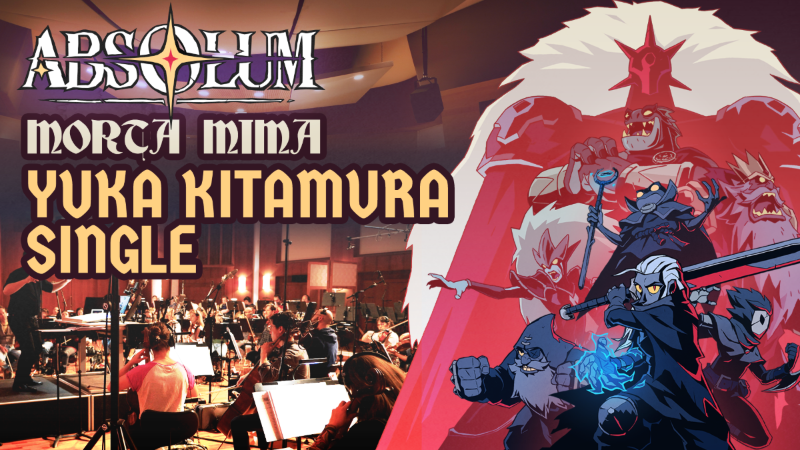
LISTEN TO YUKA KITAMURA'S SINGLE "MORTA MIMA" NOW!
The Silver Queen is one of the most tragic and mysterious bosses of the game. How did you approach composing a track for such a complex character and boss fight?
YUKA KITAMURA: When composing, I don’t just focus on the visual impression of a boss — I try to capture the complexity of their inner world, the emotions that can’t be seen. With the Silver Queen, I felt a deep joy in expressing her emotional journey — the kind of feelings that might have led her to stand against the player.
Rather than just a battle theme, I wanted the music to hint at her story, inviting the listener to imagine what brought her to this moment.
You have worked on many dark fantasy titles in your career. What do you feel are the main differences between the Japanese and the European approach to dark fantasy?
YUKA KITAMURA: I feel that Japanese and European dark fantasy each carry their own distinct sensibilities.
European works often explore large-scale fears rooted in mythology, religion, or fate — sometimes portraying the struggle against overwhelming external forces. In contrast, Japanese dark fantasy tends to focus more on the unseen — concepts like “on’nen” (grudges) or “kegare” (spiritual impurity), which quietly distort the world from within.
Personally, I resonate with this idea of unseen emotional weight, and I think it naturally influences how I approach expressing darkness in my music — not just as something loud or powerful, but as something deeply layered and quietly unsettling.
Your compositions are often praised for the sublime use of arcs, especially violins, and the Silver Queen makes no exception. Do you have a particular relationship with this instrument?
YUKA KITAMURA: The violin is probably the instrument I've been connected to the longest in my life. I feel it’s especially well-suited for expressing delicate, feminine emotions — both in terms of its range and its timbre.
For a character like the Silver Queen, who carries both grace and sorrow, the violin felt like the perfect fit. Its ability to express both softness and sharp intensity made it a natural choice to portray her inner world.
As Absolum is a whole new IP, what were the music influences and references you used to compose your track?
YUKA KITAMURA: For this track, I spent a lot of time listening to Gareth Coker’s music again. I was deeply inspired by the balance he creates between beauty, energy, and drama — his sound has a strong narrative presence.
According to your experiences, what makes a Boss Battle music memorable?
YUKA KITAMURA: I think what makes a boss theme memorable can vary from person to person. But for me, it's when the music feels truly connected to the character and their story — when it feels like it belongs only to them.
As a guest composer, do you find it hard to compose something that will both resonate with your own sound and the soundtrack crafted by Gareth Coker?
YUKA KITAMURA: I was first deeply moved by Gareth’s music through Ori and the Blind Forest, and I’ve listened to many of his works since then. So being invited to join a world where he is the central musical voice was both exciting and a little intimidating.
Through exchanging ideas and being part of the recording process, I gained a much clearer understanding of the elements that make up his sound — his delicate sense of structure, his emotional clarity — and the whole experience became a valuable learning opportunity for me.
Can you describe how the collaboration went with Gareth, and the recording process?
YUKA KITAMURA: We exchanged demos while aligning his musical direction with my own intentions for the track. Each round of feedback added new layers of depth, and the process was both challenging and creatively fulfilling.
During the recording sessions, we paid close attention to the nuances of the strings and vocals. Among many inspiring moments, I was especially impressed by Gareth’s brass work — the way he layers sounds and controls dynamics carries a unique beauty and tension that really stood out to me.
What is your usual approach on crafting the sound for a Boss Fight?
YUKA KITAMURA: When I begin working on a boss theme, I first think about what kind of impression I want the music to leave on the player. Then I start searching for a sound or texture that could represent the boss — something that captures their essence.
One of the things I often do before composing is creating a kind of “mind map.” I write down keywords related to the character — emotions, imagery, symbols — and connect them like a web. While expanding those ideas on paper, melodies or structural concepts often begin to take shape in my mind.
It's less about building music from the top down, and more about discovering the emotional and sonic landscape before it fully becomes sound.
I feel like the violin in most of your work echoes the often-tragic story of the Bosses, while the voices singing seem to emphasize the importance of the fight in the global story of the protagonist, but that’s just my own interpretation. What would be yours? Do you think of your music as a storytelling tool?
YUKA KITAMURA: The subtle tension and movement that arise when string melodies intertwine felt perfect for expressing aspects of the boss — her inner conflict or past — that may not be fully visible through gameplay alone.
Vocals, on the other hand, represent emotions that have built up inside her, resonating like thoughts or memories. They’re not spoken, but felt — as if her soul is reaching out through sound.
To me, music is a way to convey what cannot be put into words. I write with the hope of gently passing along the emotional undercurrents that lie beneath the surface of the story.
Pre-save Absolum’s OST and pre-order its vinyl right now!
PRE-SAVE ON PLATFORMS & PRE-ODER ABSOLUM'S VINYL!
Join the rebellion by following us on Social Media and rise against the Sun King!
And you can also find us on Facebook, Threads, Bluesky, TikTok, and on Discord!
Praise the Blessed Mothers, rebels.
Source
Changelog.gg summarizes and formats this update. How we read updates.